For years I’ve wanted a Himber Pail. I think it’s one of the coolest props. If you don’t know what it is, here’s a video:
I’ve missed them at auctions due to internet or time issues on multiple occasions. The prop has been just out of my reach for years. Recently Stevens Magic Emporium had some made and I jumped at the chance to get one.
Here’s the problem, I don’t know what I’m going to do with it. How am I going to frame it from a presentation stand point. I could just play some music and do it, but I think it needs more than that. Once I figure out the hook, everything else gets easier.
About five years ago I started contributing magic tricks and routines to Vanish Magazine. In that time I’ve published over 60 items in that magazine! Only once (that I’m aware of) that I recreated something that already had been done. The exception to this would be the new routines I published for standard magic tricks.
A new trick was just put out called Impress by Kevin Li and Hanson Chien which is very similar to something I published over a year ago (you can read a blog post about it here). Here’s the trailer for it:
The trick referenced in that blog post from Feb 2019 ended up being published in the September 2019 issue of Vanish Magazine under the title of Second Impression. Here’s the write up of my trick as a .pdf:
I’m curious if they were aware of what I published and gave me a credit?
The idea of making a blister change isn’t a huge leap from making the blister appear. I honestly don’t think my idea was soo novel that no one else could possibly think of it. I do think I was the first person to actually make a working gimmick for it.
Am I upset if I’m not credited?
Nope.
If they legitimately were unaware of my trick, then it’s all good. However if there were aware, then a credit should be given. There are soo many outlets for people to publish magic, many behind a paywall (in something that you have to purchase like a book, membership to a website, etc) that it’s impossible to know everything that’s out there.
I will 100% say that moving the impression to the person’s palm versus the fingertip big step forward that I couldn’t do with a key. It allows you to hide the altered impression on their hand better than on the finger tip. So it is a step further than what I was doing.
A few weeks ago I posted about a Quad-Triumph routine. It’s a triumph style effect that used four shuffles. Then about a week later, I came up with a kicker where the deck starts and ends in red/black order. I liked the idea of this kicker, but didn’t like that to accomplish it I had to do a straight cut. My Goal was to only have shuffles.
After a bit more work, I “cracked the code” by adding a fifth shuffle. The fifth shuffle was the key to making this work without a cut. Here’s a quick practice video of the sequence.
I think I should restate that this isn’t as good as the standard triumph routine with one shuffle, cutting at the natural break and flipping that half over. That standard way is much more direct. This initially was a fun challenge as I was trying to get the deck into a specific order. I wanted the deck to go face down card, rest of deck face up with the selection face down within the face up deck. That was for a reveal that I wanted to do, but then this kinda grew out of that.
It was fun to figure out, but I’ll probably never do it in a performance.
Yesterday I wrote about a Cork To Coin effect (read it here) and I’ve taken it a bit further than a simple 2 second trick. It’s not gone much further, but here’s where it’s at:
I like the idea of a transposition between the cork and the coin. It adds a layer of less obviousness to how the trick works. I think I may flesh it out a bit more and rerecord it with better lighting and put it out as a social media video.
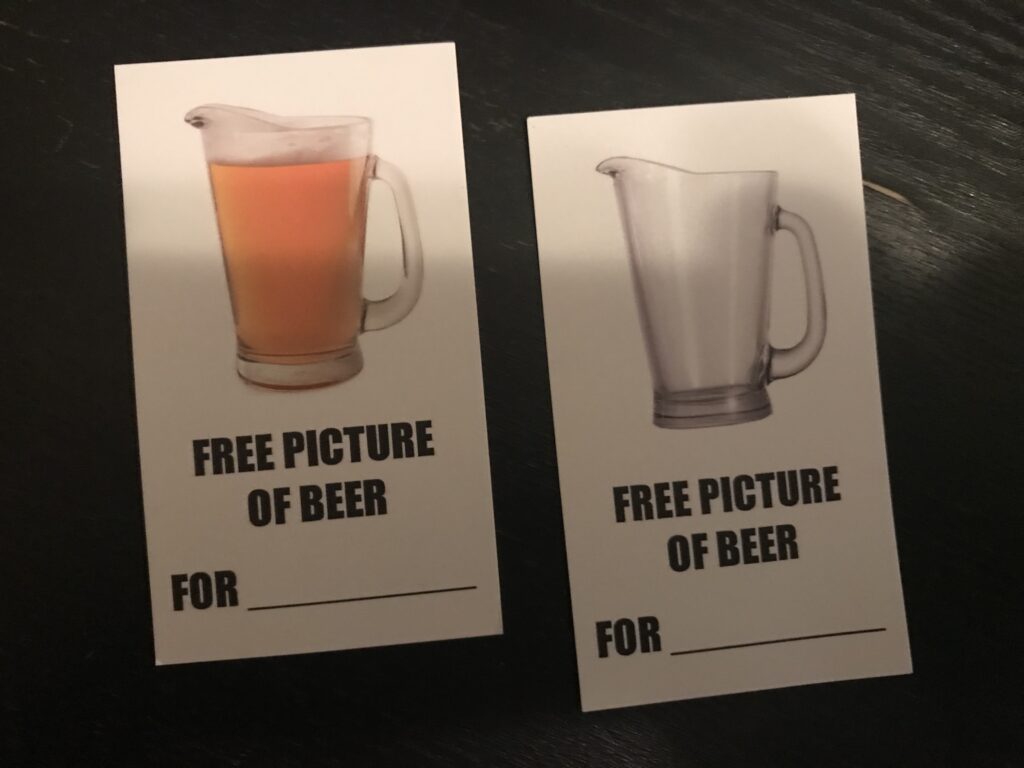
Recently I got to try out the “Free Picture of Beer” gag on a couple of different people. It got the desired laugh, so that’s good.
I also got to try to follow up trick where the full pitcher of beer becomes empty. I’m using the Out to Lunch principle to do the switch. The first time, they didn’t really notice the change. I think this is because they looked at the card and it registered in their brain as just a pitcher of beer, not a FULL pitcher of beer. It’s like showing someone a two of spades, but the spades are red. The average person won’t notice it’s the wrong color until you point it out to them.
The second time I added a little line which made the trick work much better. Once I got the laugh, I asked them, “what kind of beer do you think that is?” This question makes their brain actually process what they are looking at. That made the change at the end a lot more amazing!
I’m glad I got to try out the trick, and glad that I noticed what I needed to change!
Yesterday I wrote about an idea of doing a matrix with pickles on the bun of a hamburger. I made some mock up bun shapes out of cardboard and gimmicked some pickles and worked out the trick.
Here’s it in its proof concept video:
Obviously it’s still got a long way to go. Figuring out a way to make the bun rigid will be my next challenge. I also need to buy or make some fake pickles that are all uniform in shape. Those are the next two challenges (that I’m aware of).
The last couple of days I’ve been writing about putting together a script for the Ring on Rubber Band trick that I’ve been working on. Yesterday I wrote a bunch of jokes, and today I’m going to try to put them together in some sort of a logical way.
“This is the most expensive trick I do. The rubber band cost me 37 cents, but the ring cost me half of everything I own.The ring represents the 18 years I’ve been married and the a rubber band which memorializes the one time I bought broccoli ”
Show ring and rubber band. The rubber band is around your left index and thumb. Point to the sides of the rubber band as you say:
“This rubber band has two sides, just like congress…a left side and tea party”
“I will push the ring through each side of the rubber band defying the restraining order from the laws of physics.”
Push the ring through the first side of the rubber band
“Through one side…that’s the easy side. It’s the bunny slope of the rubber band. The second side is the double black diamond. Three men have died trying this next part, but they all had preexisting conditions… and latex allergies.”
Push the ring through the second side of the rubber band.
Pull the ring off the rubber band one side at a time.
“and that’s how I wrote my wedding off on my taxes!”
Alright the routine looks like more of a routine now, and not a bunch of random jokes. The routine now runs about a minute. That’s way better than the 12-15 seconds before I started writing for it.
The jokes still need some tweaking. The congress joke needs a better punchline, and the double black diamond needs a better word/name in its place. I also need something in between the the two penetration phases, where the ring is over both sides of the rubber band, but before I pull it off.
On Monday night I was a guest on the IBM’s facebook live where I played some online games with Billy Hsueh and Amy Nichols. Before the game, I did a cocktail demo. You can watch it here:
There’s a couple of magic tricks in the demo. I like using a loaded cloth to produce a bottle that’s not loaded in the cloth, then producing the bottle in the cloth and finally producing a third bottle, that’s not in the cloth. All three bottles use different methods, and it’s a fun little sequence.
After having done a few of these demos I’m starting to have little tricks that I like and keep falling back on. I think it’s good to have my “go to” tricks, but I still need to be creating new stuff for them.
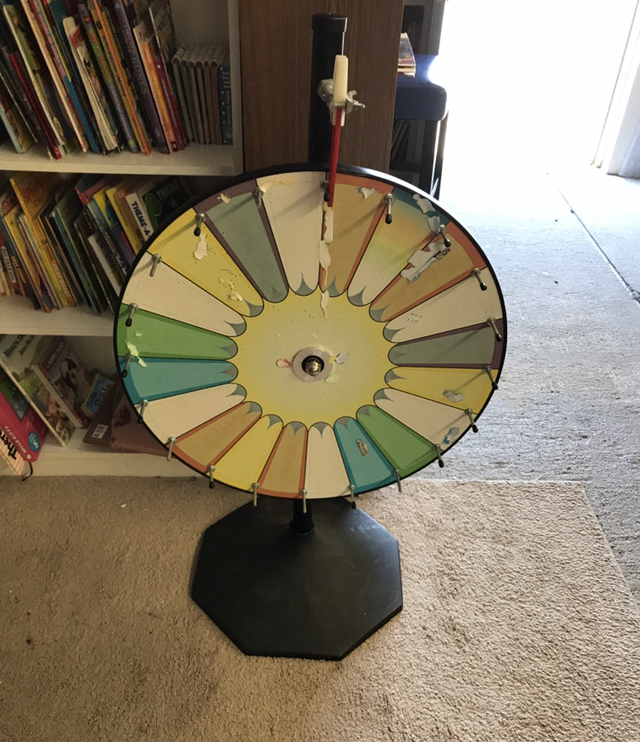
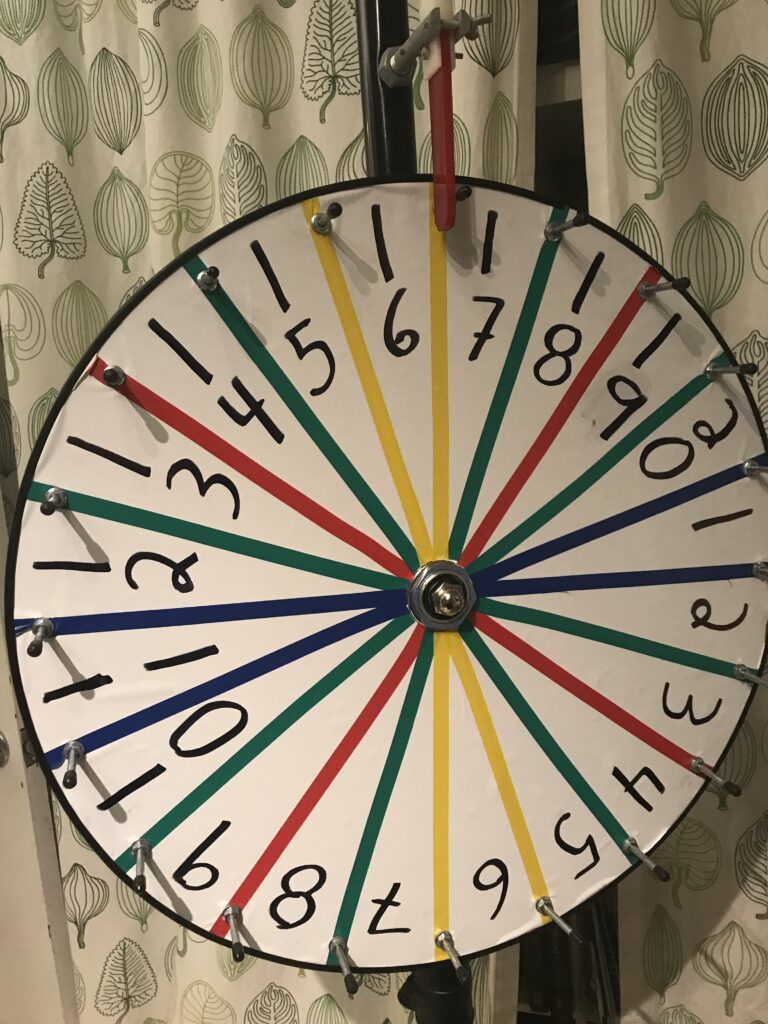
Way back in the early summer when my state had first started to reopen after the initial pandemic shutdown, and friend texted me this picture of a game wheel at a thrift store for $2.99.
I drove up and bought it. It needed some work, the whole from was stained, and have some sort of glue residue in it. What I found interested was that it was heavier duty that most of the game wheels that I’d seen before. The wheel is two feet in diameter, and made of thick wood, so it’s heavy. The pole it’s on looked like the top pole of a speaker stand. I took it home and it fit into the base of a speaker stand, that would allow me to use it without a table. I threw away the plastic base in the picture above.
This then ended up sitting in my shed for months, as I didn’t want to deal with cleaning up the wheel. I didn’t have an idea of exactly what I was going to do with it. Then I remembered reading about trick called Wheel of Mind by Amir Lustig and Hiam Goldenberg. I wasn’t exactly sure of the what it did, aside from that it was a force. Hiam puts out some pretty clever stuff, and for $15, I figured why not check it out.
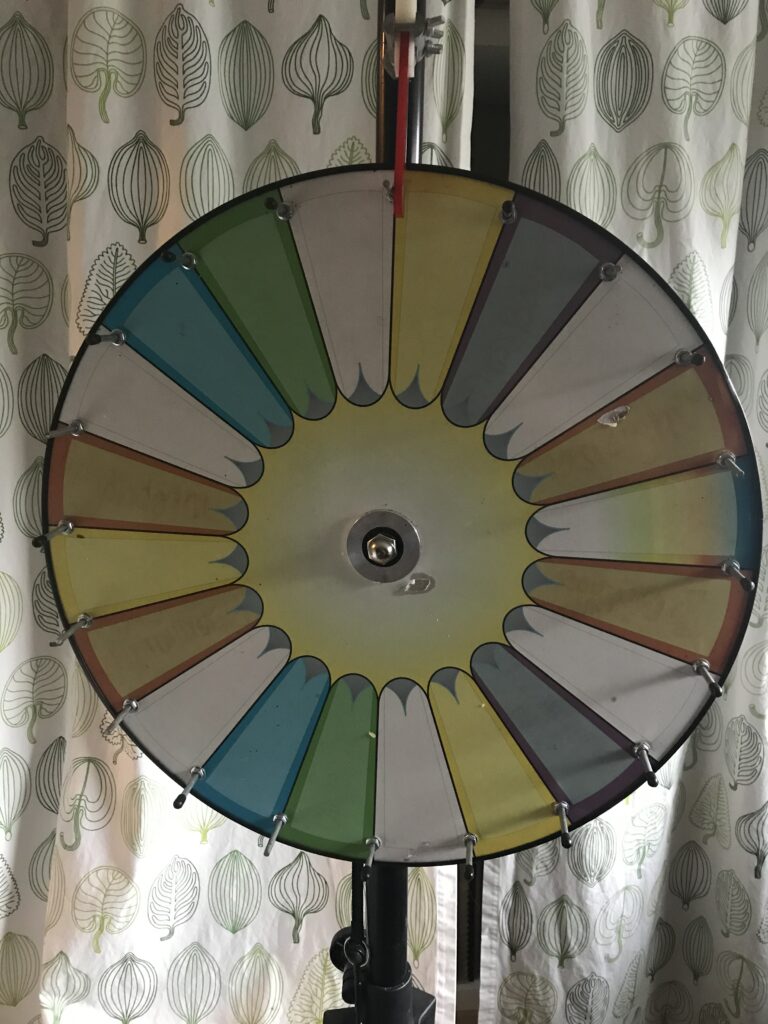
Wheel of Mind uses twelve spaces and my game wheel has 20 spaces. Luckily the trick still works with more spaces. The other challenge is that Wheel of Mind uses both sides of the wheel. It turns out it’s really easy to remove the game wheel I have from the stand and turn it over. Now that I have what I’m going to use the game wheel for, it’s time to clean it up.
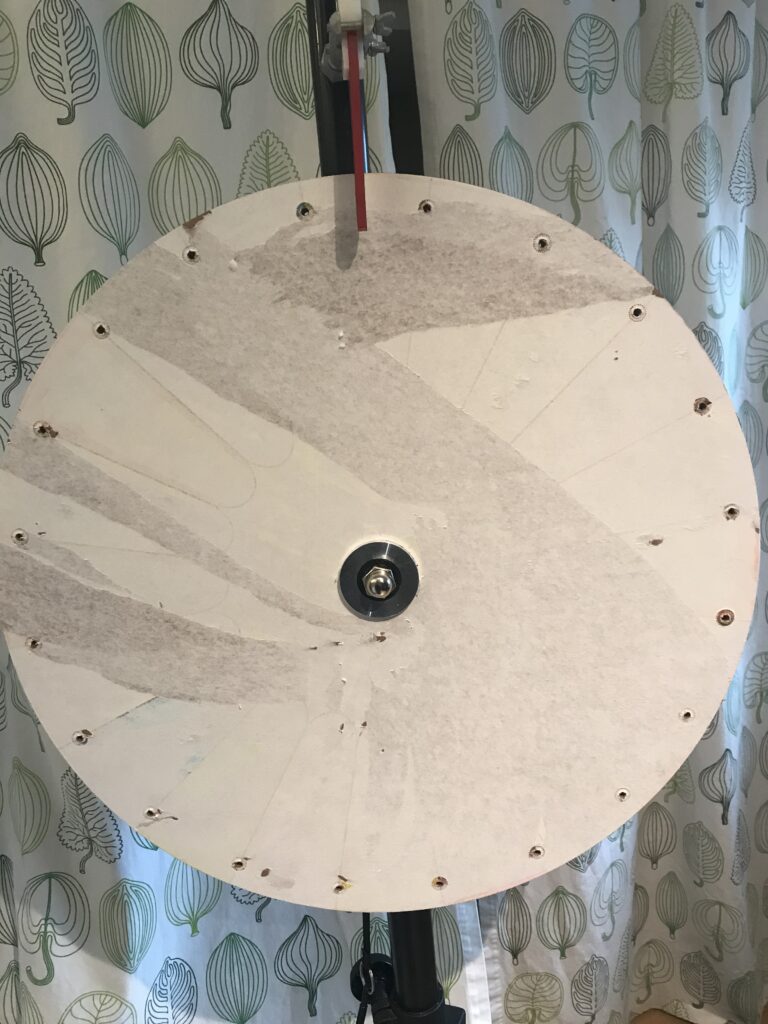
The first step was scraping all of the glue off of it. However the actual wheel was stained by whatever pen had been used on it previously. The next step was to remove the pins, and peel off the graphic from the front.
I recovered it with white contact paper on the front and back. Then using electrical tape, I made some lines and wrote the numbers in.
For less than $30 (that’s including buying Wheel of Mind) I now have a fun looking prop that will force something. I probably wouldn’t travel with this, unless I was doing a run of shows. It’s mostly for virtual shows, it’s also a cool set piece to have behind me.
One of the current projects that I’m working on is a video from my kitchen. It’s a magical video, and I needed to do a trick with a lime. I had written up a bunch of ideas like:
Lime that moves out of the way when I try to cut it
Lime that cuts itself
Bouncing lime
Finding something needed later inside the lime
While driving to the store to buy some limes, I hit upon this idea:
That’s just a quick snipped taken out of context, but it’s a lemon that turns into a lime. I originally read this in a book years ago that turned a red apple into a green apple as you ate it. I think the method works better with a lemon / lime due to the texture. Also, in theory it’s changing to a different fruit, not just changing color which may make it a better trick from an effect standpoint.
Ultimately the video above didn’t make it into the final project, an expanded version of the trick did that used two lemons and two limes. I’ll probably post it in the future, once it’s used by the group I’m creating it for.