This is just a heads up to let you know that I’ll be out of town from March 18th, 2024 to April 8th, 2024. While I’m away, nothing will be shipped and nothing will be built/worked on until I return.
This week I started working on routine using some giant safety pins that I came across (read about them here). My initial plan was to see if I could make my close up linking pins routine work on stage with the the giant pins which are about 14 inches long.
The routine works onstage, but it needs more. It’s hard to justify the time it takes to bring someone onstage for a quick trick. I needed to build out the routine and add more.
I think that adding a thumb tie to the trick adds time and texture to the trick. The idea is after my normal linking pin routine, I would add the thumb tie using the giant pins as the “ring” that would normally go on and off my arms.
I’m thinking of using electrical tape for the tie as it’s easy to get almost anywhere. Method wise I’m thinking of using Irv Weiner’s Red Tape thumb tie, as I have all the stuff for it.
Here’s a packet trick from the 1980’s that I came across.
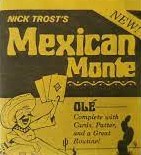
I think Nick Trost’s Mexican Monte is a pretty solid routine. Here’s me doing the routine and my thought on how to improve it:
It’s really a small change at the end, and I think Nick really nailed it with this one. I’d change the patter, but it’s good and worth checking out if you find one at a magic swap meet!
Inspiration comes in some strange places. I was cleaning out my storage closet in the office and found a gimmick that was for an ACAAN that was marketed in the late 1990’s. The trick was garbage, and was about to throw it away when I realized part of the gimmick had potential for a different trick.
Here’s the video I sent to my brainstorming group a while ago:
I like the concept of the card turning blank from a deck that’s in order. It makes it very easy to determine that the selected card is the one that’s blank. I don’t think I’ve seen a trick like this before, where a card turns blank in a deck that’s in order. Usually trick where the selected card turns blank, it’s away from the deck or it happens from a packet, like Gordon Beam’s Limited Edition trick.
I’ve been having fun doing this trick which I call Placeholder.
One prop I don’t really like, but spend way too much time thinking about is the Money Paddle. I’m not sure what it’s supposed to be.
Is it an olde tyme drink stirrer?
And if it is, how do you give it context for a modern audience?
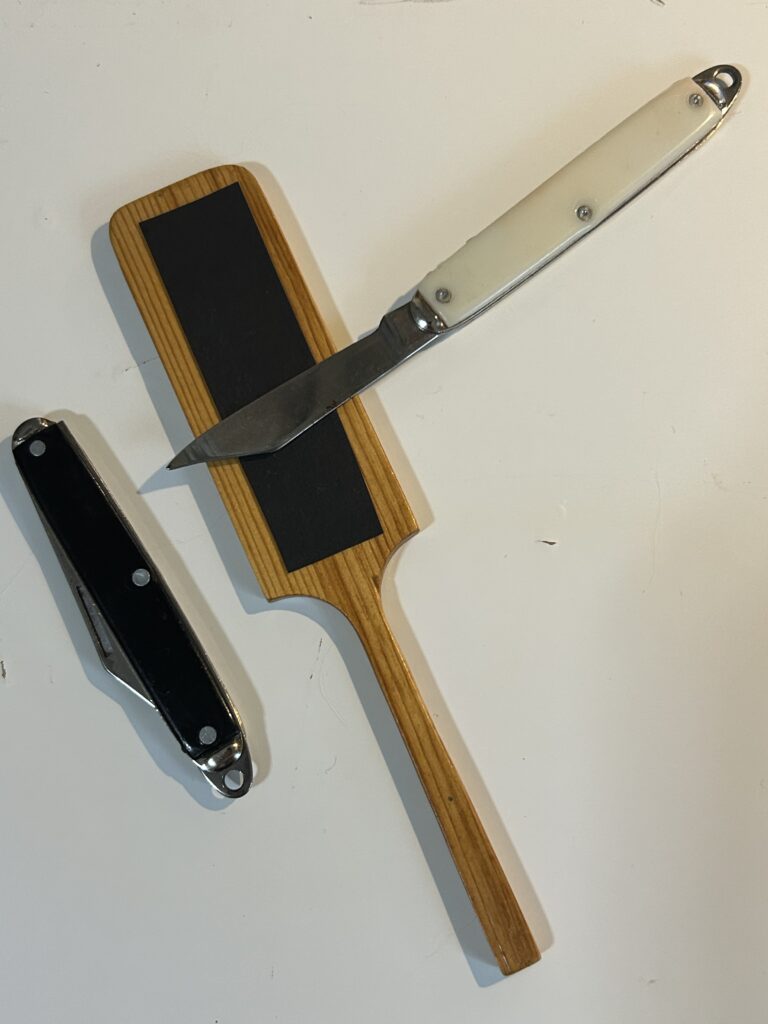
One thing that it reminds me of is a strop for sharpening blades.
The strop pictured above is probably 18 -24 inches long, where a money paddle is about 6 inches. That’s a small point to give it context. A knife and a strop belong together, so the props are connected.
I glued some black and white paper to my money paddle and now the next thing is to try to figure out a routine to do with them.
Also on a side note, the only reason I own a money paddle is that some were made out of wood from Houdini’s house in New York. I thought that was a fun thing to own, but since it see it everyday, I want to figure out something to do with it!
I’ve been playing a lot with a shot glass production lately. There’s not much to it, or pretty much any shot glass production. Basically you sneak it into where ever you want to produce it and uncover the shot glass and show it to the audience.
The real challenge is having an airtight seal on your shot glass cover that can still be easily removed. Here’s the idea that I’ve been doing:
One of the lesser challenges is what to do with the cover after you’ve removed it from the shot glass. For probably 80% of productions from things like an egg bag, you can simply leave it in the bag. However for a production from something like your shoe, you need to get rid of the cover.
My solution is simple, hide it in plain sight!
This is something that’s working out for me, however I still consider it in the testing phase for me.
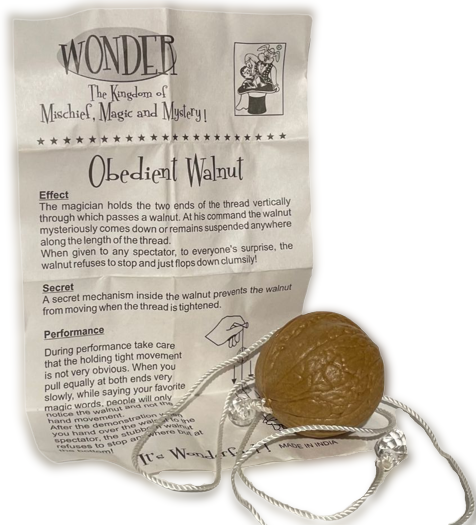
A few months ago I found some Obedient Walnut tricks in a bin of junk magic at a magic shop. This is a version of a classic trick where you have an object with a string running through it, in this case it’s a plastic walnut. As the walnut slides down the string, it stops whenever you want it to.
Honestly, from a magic perspective, it’s not really a good trick, it’s pretty obvious how it works. I did pick up three of them out of the junk bin as I had an idea for a routine with them. The routine is an interesting idea, but still a bad trick.
I did it once, it confirmed it’s not the best idea or trick and now I can throw away the Obedient Walnuts.
One magic trick that I’m fascinated by is the Cup and Ball trick. Most of these are “Chop Cup” routines as that reduces a lot of sleight of hand. Unfortunately many of these routines are very similar and use the gimmick in the exact same way. My Cee Lo routine uses the gimmick as a holdout, and not to replace sleight of hand and it’s a great, working cup and ball(s)/chop cup routine.
I’ve had an idea in a notebook for while and finally got around to figuring it out and posted it on Tik Tok. Also if you’re on Tik Tok, give me a follow @LouieFoxx
What’s interesting about it is that it doesn’t have the traditional chop cup move where you shake the ball in the cup. It also has a final load not being a physically larger version of the ball, but the bill changing to a larger denomination bill. I don’t know if that ending is better than producing a bigger item…
One of the things that I really like is using confetti in my show. I think it’s something that makes a lot of tricks “pop”. It’s an interesting challenge to frequently use in a show. It’s not easy to steal as a pack, unless you’re using a snowstorm packet, which is a lot more than I want to use for most tricks.
It’s got some limitations, and I don’t like that the gimmick ends up on the floor after the trick. While it sorta blends in with the confetti, if it’s in the performing area, you will need to pick it up, or kick it out of the way.
Yesterday I hit another solution. A while ago I picked up one of Jay Scott Berry’s FS2 gimmicks from a junk magic bin. I just happened to see it the other day and realized that it would be a perfect confetti holder!
Here’s the trial run:
I don’t know if Jay Scott Berry has used confetti in it or not, but it’s looking like the solution I need for the confetti production I was trying to add to the end of my ball routine!
This discovery for me is a classic case of having routines never being finished AND having your vision of what the trick will look like and constantly trying to achieve that. Sometimes you won’t get there, other times you figure it out quickly and usually for me it’s a years long journey to hit the solution. The key is sticking with it!
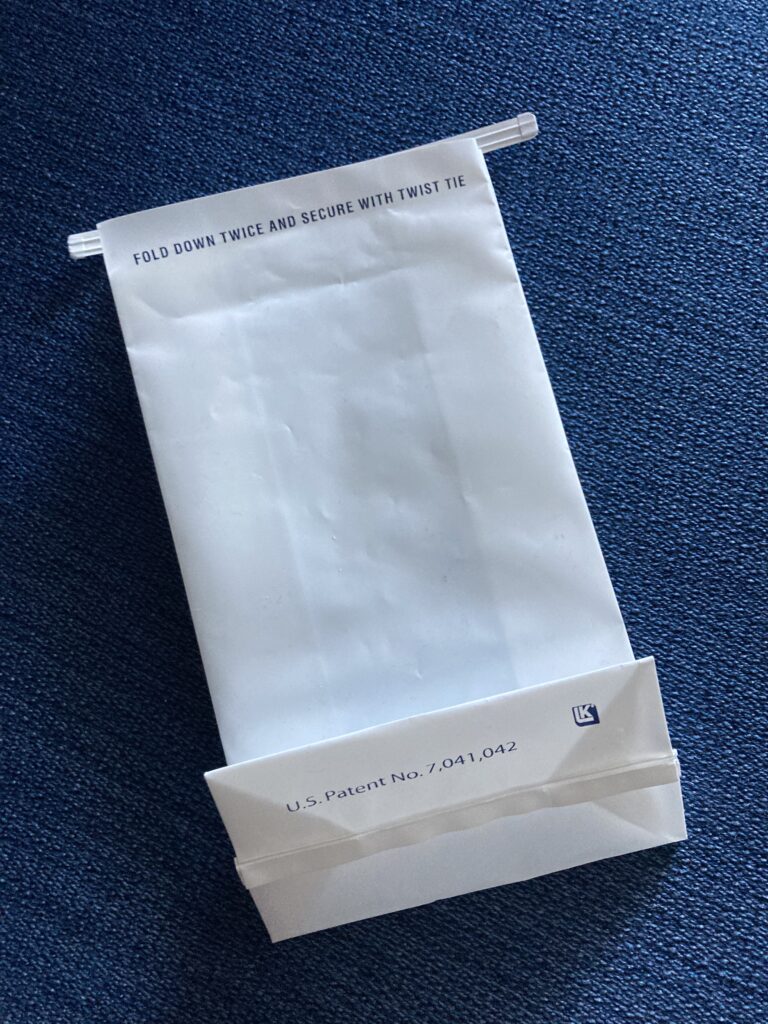
Right now I’m on a cruise ship and it’s pretty bumpy out, and I noticed that all of the floors at the stairwells have “sick bags”. These look like paper lunch sacks, but are made of plastic and have a tab at the top to seal them.
I grabbed one and took it back to my state room to see if I could figure out something to do with it. Here’s my brainstorming from this morning:
Chew up some food, spit it in…then blow up the bag and pop it and it’s confetti
Someone reaches into the bag and pulls out a single cookie (it’s the only thing in the bag). You take a few bites and spit them back into the bag. Shake the bag and dump out a whole cookie
You have the bag sealed. You tell the audience you breathed into the bag after breakfast and have someone try to guess what you ate. You have a note that confirms they are right!
Someone from the audience breathes into the bag, and you tell them what they had for breakfast
you have a line of people onstage. With your back turned, someone breathes into the bag and seals it. It’s handed to you and smell the bag and tell whose breath it is
You put food into the bag and it turns to rubber vomit
You say you opened the bag on the plane and captured the air at your seat. Someone smells the air and guesses your row and seat number.
What I like about this is the specific property of the bag, it being plastic and sealable ended up taking me away from tradition paper bag tricks. I really like the idea of trapping air in the bag. I think that the row and seat number might be the winner as it doesn’t involve anyone’s breath, so it’s not cringy.
I don’t know if I’ll ever do this stuff, but it’s a fun creativity exercise. -Louie