I’ve been using The Rocket Card Fountain for about 9 months now and I still like it.
I have learned recently that with it being 3d printed, it doesn’t handle sitting in the sun with no shade at 108 degrees during a 45 minute show very well. This is a very extreme situation for it to be in and knowing what I know now, I probably wouldn’t use it if I was in that situation again. What happened is that part that holds the cards warped in the heat and no longer holds the poker size playing cards.
I was able to get it to sort of work by putting it back in the sun and then trying to reshape it. However the fix was simply to cut a deck of cards narrow.
Worked like a charm and the cards shoot out just fine! I’m still happy with The Rocket Card Fountain, but it’s good to know it doesn’t handle extreme temperatures very well.
The next two weeks I’m performing at the Ohio State Fair in Columbus, OH. On my day off yesterday I drove two hours up to Cleveland, OH to do some touristy stuff. While I was up there I decided to try to find Karl Germain‘s grave at the Riverside Cemetery.
When I got there I did a lot of wandering in the section where it should be, but couldn’t find his grave and then it started raining. Normally I’ll wander until I find the grave, but the weather was bad, so I went to the office to ask for assistance.
While I was in the office I was chatting with one lady and about what I did and the other lady overheard part of the conversation where I mentioned I was a magician. When she heard that she said I should try to find Karl Germain’s grave!
She told me that originally his headstone didn’t have his death date, just the birth year. It was years after his death that the year was added.
The office workers at the cemetery were also amazed at how much some of his props have sold for, like the blooming bush that went for $132,000!
On Saturday I have an appointment at the mausoleum in Columbus to see Howard Thurston!
A couple of weeks ago I had a thought go through my head that was that I’d like to 3d print a new magic trick. It’s been a while since I’ve 3D printed any new magic tricks. I’m not looking for simply printing a trick that I found a model of online, but to design something and print it.
I was reading a trick with pennies in Bob Farmer’s Flim Flam book and that got me thinking of the using a “need a penny, take a penny” trays that many stores have by the cash register.
It only took a few tries to get the size of the tray to what I wanted and two tries to get the gimmick the right size.
This tray solves a problem with trying to borrow coins, as people don’t really carry coins anymore. I ask to borrow some pennies and then say, “it’s OK if you don’t have any” and take out the tray with pennies on it. It gets the tray into play logically and with a laugh.
This was a fun project to make and I’ve been having fun doing the trick!
One of the coin magic props that I really don’t like are coin boxes, like the Okito Box. I’ve never never really had a way to use one that makes sense for me. Recently I came across an O-Korto Coin Box Routine set. This is one lid and three coin box bottoms. There’s a regular Okito Box, a Boston Box and the O-Korto Box, which is a an Okito Box, but with a thicker wall so that the coins won’t fit into them. This set was an old Paul Diamond set and is quarter sized!
I thew this in my close up case and have been playing with it in my roving close up at the fair. I’m familiar with many coin box moves, so adding this is pretty easy. Just because I don’t do something, doesn’t mean I can’t do them or practice with that prop every now and then.
There’s not much to the routine that I’m doing and it’s basically following what comes in the instructions as far as flow of the effects. I did change a bit of the prop managment as the instructions are written for a performer that’s sitting and I perform standing.
The flow of effects is:
Coins go into box and coins penetrate into your hand
Coins won’t fit into the box when spectator tries
Coins now fit and you put the box without lid on your hand so the coins can be seen, then the box penetrates your hand leaving the coins on the back of your hand
Much to my surprise the part of the routine that’s getting the best reaction is when the audience can’t put the coins into the box. I’ve only read about the small box, and thought it was a dumb effect and I did up until the first time I tried it this week.
I love being wrong and having my opinion changes on things!
If you can find an O-Korto Coin Box set or a small box that matches your Okito box, you should give it a try.
On this episode of the Moisture Festival Podcast we welcome Martika Daniels. She tells us about growing up in the Military and how being stationed in Germany exposed her to circus arts and busking.
She tells us how stunts helped her deal with crippling anxiety and depression and how she weaves that message into her performances. We also discuss her new book that is available now. A great conversation with a fantastic person.
I’m relearning to do the strait jacket escape while wrapped in 50 feet of chain. One of the things that I recently figured out, which made me feel dumb that I never realized this before was the chain management.
I used to just throw the chain in the bottom of my case. The problem with that is that it would frequently tangle. I started keeping it on a spool and it makes a huge difference! The spool makes laying it out and cleaning it up really easy!
The locks also are locked to the spool making it an neat and tidy package!
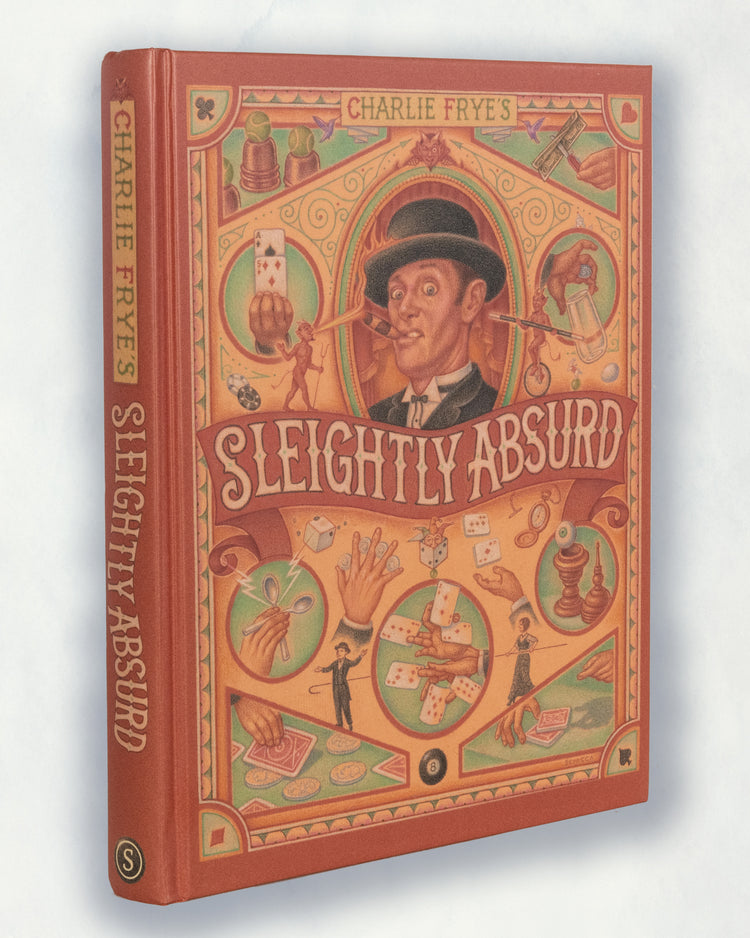
I’m finally wrapping up reading Charlie Frye‘s magic book Sleightly Absurd. I picked this up at Hocus Pocus in Fresno way back in October when I was visiting their shop.
This book is a fun read and it has a lot of “non traditional” magic book feeling routines in it. The routines have endings to them, which is something that lacks in many magic books by magicians who aren’t out there working. The other thing is that Charlie isn’t a “I do easy stuff so I can concentrate on performing” type of person. He’s doing things with whatever level of difficulty that the trick requires to make the trick the best. Sometimes that’s means hard sleight of hand and sometimes it’s a math principle. I totally respect that approach!
One of the interesting things for me is towards the back of the book there’s Charlie’s approach to Any Card at Any Number. It’s a fairly standard approach where you use a memorized deck and a variety of techniques to get the card at the desired number. He does a great job of breaking down his thought process how determines the best way to go about it and describes many scenarios.
For me the best part is how he calculates the stack number backwards (from the face of the deck).
I had to read that part about half a dozen times for it to make sense for me and once I did, it made total sense! I also figured out a way to get rid of having to remember the pairs, they all all up to 3 or 13, so there’s no memorization of the five pairs, just remembering one rule. This is a game changer for me, it makes the doing the math from the face of the deck insanely easy! This one little thing is worth the price of the book if you use a memorized deck!
This is a great book and totally worth the $75 it sells for!
I was playing with Fly Cards II by Aldo Columbini from 1991. I’m not familiar with Fly Cards I, so I can’t compare the two to talk about the improvements that this one has over the original. The effect is similar to an ace assembly, you have four cards with flies on them and a dozen blank cards. You make put 3 blank cards on each card with a fly. The first fly disappears and reappears in the next packet, so that packet now has two flies. Then those disappear and reappear in the third, so that packet now has three. Finally the three flies disappear and you accidentally tap the fourth packet revealing the surprise ending of four smashed flies.
What I like about the trick is the progressive assembly, where the flies keep moving to the next packet. What I don’t like is the flies. It’s strange theming, maybe something like honey bees would be better, but then the smashed ending would have to be different as you don’t want to smush honey bees. I think this idea would be interesting in an ace assembly context, however the problem is that I don’t think it would work out as you’re passing off one card as two several times.
It’s a good trick, and I think if someone spent some time thinking of a better theme OR used it as a custom thing for a social media video it’d be useful!
Over the weekend my buddy Mike Dobias hosted a magic garage sale! Mike had bought out the inventory of Mickey Hades magic shop in the 1990’s and wanted to get what was left of it out of his garage. He also had some of his old personal props from his shows and let me bring a couple of boxes of stuff.
There were some fun surprises, like a stack of Bill Goldman’s Monkey in the Middle trick, Dean Gunnarson’s Escape Artist trading cards and Bob Driebeck’s Necktie Servante that was put out by Nielson Magic!
I took home a banker’s box full of old packet tricks, which will end up on my Tik Tok where I show “vintage magic tricks”. If you aren’t following me on Tik Tok, shoot over there and give me a follow at: https://www.tiktok.com/@louiefoxx
Then there was the social aspect of hanging out and BSing with other magicians! It was a fun day!
A few weeks ago I was performing at a fair. I was doing street style shows and they gave me an assigned spot and assigned times. On paper this sounds like a good idea, however in practice it’s usually a horrible idea. 99% of the time the entertainment coordinator doesn’t walk the grounds at different times of the day to see where the shade is.
Here’s one of my assigned spots a few minutes before my assigned start time:
I should mention it was over 90 degrees out and you’ll notice there’s no shade. If you look to the right, you’ll see my case is in the shade, but most of the case is in the sun. There’s zero usable shade at this spot and very few people will stand in the sun for more than a few minutes. I personally will stand in the sun as I’m getting paid, but I don’t expect an audience to do that.
However a little bit up the pathway there’s this spot:
There’s plenty of shade and I decided to “go rogue” and do my magic show there with shade for the audience. I was able to get people to stop here and watch the show.
Personally I’m a “ask for permission” person and not a just do it and “ask for forgiveness” person. However this was a situation where it made sense and if anyone asked about it, I could simply show them the pictures and I think they’d agree with me. Also I’d probably walk that person into the full sun spot and then show them the pictures and talk for a long time and watch them get uncomfortable in the sun to emphasize my point.