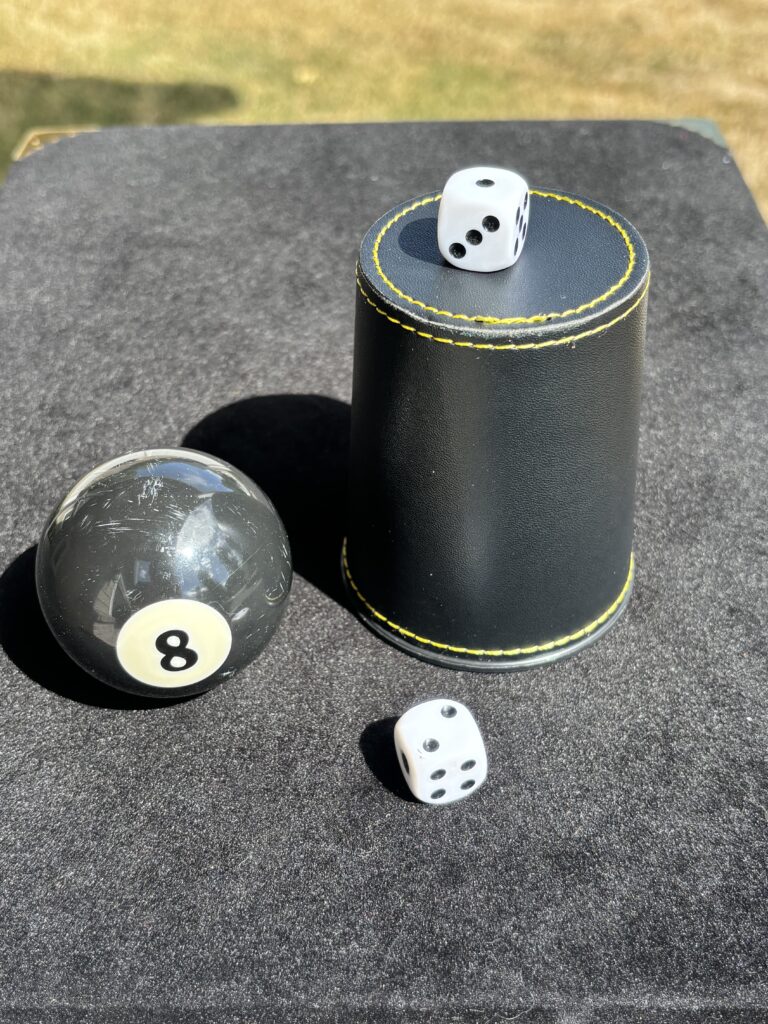
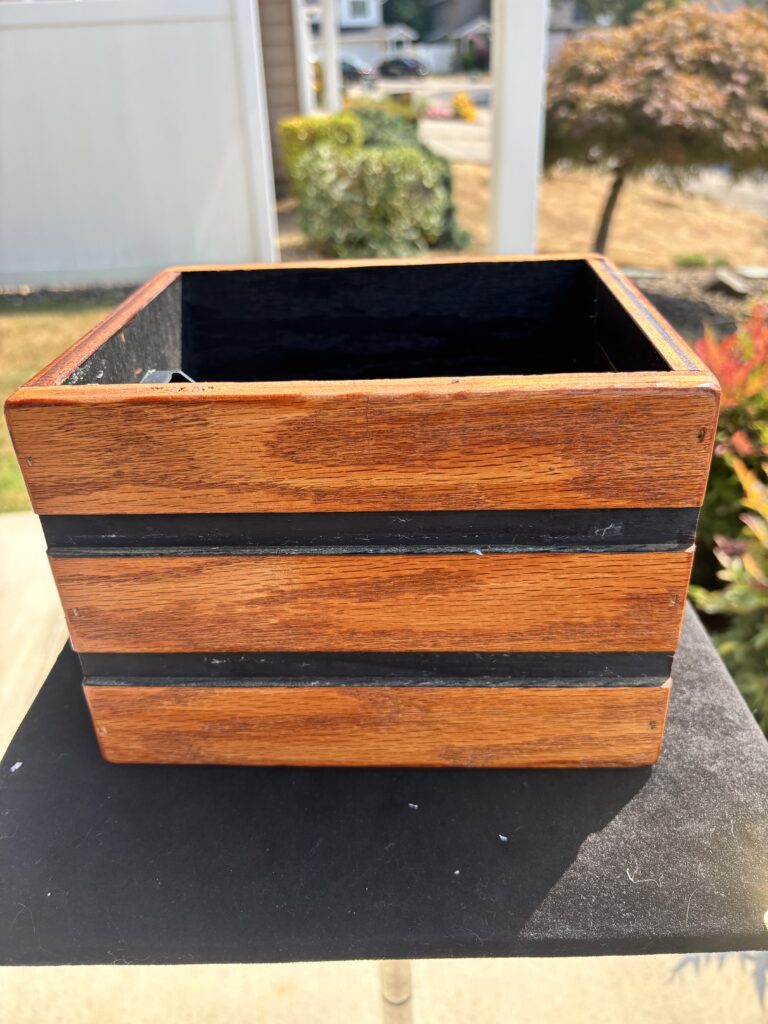
Last week I started working on a new sequence with a chop chop. Here’s what it looks like:
The cool thing about performing at a fair is that I get a lot of opportunities to try out different sequences to find what I like. This is what the routine looked like at the end of last week, and then in a few days I’ll be starting at a new fair and really deciding if this is what I want the final (for now) routine to look like.
Here’s a simple chop cup routine that you can learn, and do with any standard chop cup.
What I like about this routine, over many chop cup routines, is that I only go to the pocket once, and it’s not immediately before the production of the eight ball. -Louie
When I made a small batch of dice chop cups last week, people asked me for a video. Honestly, I thought everyone knew what a chop cup does, but I was wrong. If you don’t know what a chop cup is, it’s a gimmicked cup that will hold out a ball, or in this case dice.
Typically, this is one with one visible ball; however, in routines like my CeeLo routine, it uses three visible dice. How the normal routine goes is that a ball keeps disappearing and reappearing under a cup, then at the end, there’s a giant ball or whatever under the cup.
Here’s a quick video of a chop cup routine that I made for the people who asked:
I was just improving and did this sequence. It’s actually a pretty good sequence; it has a lot of effects. 1: Teleportation: Die goes from pocket to under the cup 2: Penetration: Die goes through the top of the cup 3: Vanish: Die disappears from my hand 4: Production: Eight ball appears
When doing a card trick, the ending is the most important thing. Here’s three options that I’m playing with:
Each has something going for it.
Option 1: quick and direct
Option 2: BIG
Option 3: a gag, then a bonus trick
I posted this video on my social media and everyone liked number three the best. One thing I didn’t mention was the conditions; this was a stage piece for large groups.
After trying all three of them, the one that played the best for me was number 2!
The size of the reveal, I think, made a huge difference. Also, when the folded card comes out, you have a little bit of build as it’s being unfolded.
I think the problem with option #3, which is the 52 on 1 card that turns into the selection, is that the gag is too small to be seen from the stage, and everyone has to take my word for what’s on the card. Also, you have a gag and a magic trick that are pretty close together. The changing of the card, I think, doesn’t hit as it should. I think to the audience it feels like the card just has the 52 on 1 on one side and the selection on the other, and I just turn the card over. Yes, I do show the back of the card twice; however, I don’t think the audience processes that or remembers that.
I’m glad I tried all three and was surprised at the result.
Last year, I picked up a Chattering Teeth by Doug Malloy (routine by Terry Seabrooke). This is Terry’s routine that I first saw in the mid 1990s on a VHS tape of his called The Vidiot and the basic routine is also in his lecture notes that are still available from Magic Inc for about $6.
I thought the fan in my unit was broken, it had two AA batteries in it, and I changed it to a 9v battery, and it started whirring…but was super loud! I changed out the fan and here’s a before and after video:
I thought the unit I had was unusually loud when I got it, but after posting that video, I have the impression that all of them were pretty loud! This isn’t a knock at the maker, it was made with 1990s technology, and it appears Doug fabricated the fan from scratch!
When I changed the fan, I also added a remote control to it. The remote is two channels, so my remote control chattering teeth and the fan can run off a single remote contol!
Here’s what it looks like:
I’m glad I finally got around to updating the Chattering Teeth prop! Working on this set is actually a stepping stone for a version of the trick that I want to build for myself.
One of the endings that I’m doing with my three shell game routine is using a small cap that goes under the shell to replace the standard shot glass. I got the idea when I was on a flight and realized the tiny liquor bottle cap would fit under a shell. (you can read the post about it here)
Here’s a demo of what it looks like:
You could put a shot glass on top of the cap and shell for a triple cover! I really didn’t want to use the shot glass, as it’s bulky, heavy, and semi-fragile. This is a good solution for me!
It’s no secret that while I have used phone based app magic, I’m not a huge fan of them. They are frequently abandoned by the creator once sales slow down or are affected by a lack of internet connectivity. Recently, I posted about a trick with my phone that doesn’t go the traditional magic app route. Here’s what the first version of the trick looked like:
The first version needed some double lifts, which is fine, but I learned they are totally unnecessary. There’s no reason to have them, and they could be eliminated with a slight adjustment. Taking them out, really streamlined the trick, and the adjustment allows me to do it with a borrowed deck!
This is a good example of looking at a trick and trying to improve it past the “it works” phase to make it work better!
Recently I did a national news spot at a gig where I was doing my street organ. This is a bit more challenging for a news spot. I was told we’d have 30 seconds, so the reporter, producer and I planned the bit and here’s how it came out:
Unforeseen Challenges of Performing on Live Television!
Those 30 seconds ended up being over a minute! I was rushing because I thought we didn’t have much time. I was also getting a weird vibe from the reporter and wasn’t sure what to make of it. In my past experience, the weird vibe means we have to wrap up. After we finished, he mentioned he lost the audio in his earpiece, so he didn’t know how we were doing on time. We both were kinda flying blind!
Not too long ago, a magician I was hanging out with said he didn’t think that younger people understood or knew what the shell game is. I disagree; I think young people know what the three shell game is, and my reasoning is that every ballpark in the USA plays a version of it on the jumbotron. Here’s the shell game at a Cincinnati Reds game:
It’s a simple concept of a game, and younger people definitely know what it is, or it wouldn’t be played in stadiums! This is one of the things that I like about it, it IS RELATABLE because people have played it before!
Modern magic, especially close up magic has moved to very visual effects. Things that look like AI or if you’re old school, then trick photography. Magicians rarely look to the past, there are some amazing tricks that look like a modern AI fake magic trick.
One example is the Joseph Silk Gun. Another is the Jumbo Card Restoration Frame which was invented by Theo Bamberg in 1909. I’m sharing a greenroom with a magician who has one of these and it looks amazing!