The ending to a card trick is one of the most important things. Does the ending have punctuation, or is it just “meh”? A card trick routine that I’m working on ends with a prediction of the selected card. I’m not going to get into the routine in this post, but just the ending. Here are the three options:
Not too long ago, a magician I was hanging out with said he didn’t think that younger people understood or knew what the shell game is. I disagree; I think young people know what the three shell game is, and my reasoning is that every ballpark in the USA plays a version of it on the jumbotron. Here’s the shell game at a Cincinnati Reds game:
It’s a simple concept of a game, and younger people definitely know what it is, or it wouldn’t be played in stadiums! This is one of the things that I like about it, it IS RELATABLE because people have played it before!
In the summer, I frequently work with Jeremey the Juggler, who is a juggler, but also an origami master (I’m not sure if that’s an official title). One day he mentioned that he made an origami box that just happened to kinda do a magic trick.
There’s really not much to do the trick. A false transfer and use your arm to cover you loading the object on top of the box. Then use the box to do the second vanish.
It’s a quick, fun little sequence that appeals to magicians and origami people.
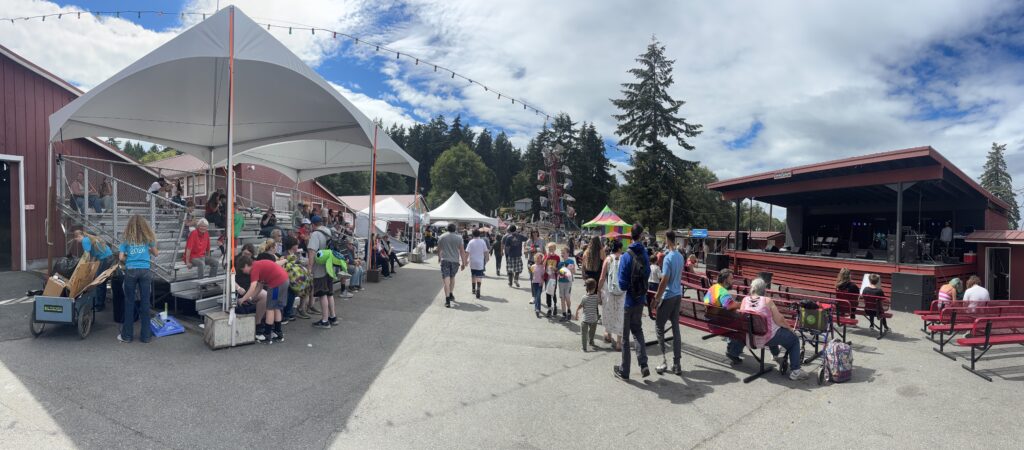
Sometimes there are stages that are more challenging to work than other stages. This stage and audience configuration is a good example of that.
First, let’s tackle the obvious: there’s a walkway between the benches and the bleachers. Unfortunately, that’s just how it is, and there’s not really anything you can do about that.
The bigger issue is getting on and off stage; it’s a high stage, so a lot of stairs, and the stairs are off to the side. It’s good that they are on the side; if they were on the front of the stage, the handrails would be a visual distraction. It just takes a lot of time for me or someone from the audience to get on and off stage.
I have a spot in the show, right after my introduction, where I need to hand something to someone in the audience. That’s dead time while I walk on and off stage.
Here’s what I did:
Opening bit, then walk into the audience to give the thing to someone in the audience.
2nd trick happens on the floor in front of the stage.
After the second trick, I bring someone from the audience to the stage with me for the third trick.
For the fourth trick, it happens on the floor in front of the stage. This trick needs access to people so they can hold things at different points.
When the fourth trick is done, I bring someone from the audience back to the stage with me and send them back to their seat when the fifth trick is done.
The final trick happens with me solo onstage.
There are a lot of ways to deal with the “long walk to the stage“, however for this situation, moving my show between the floor and stage worked great; it reduced the dead time a lot. This makes the show feel tighter!
One of the things that I try to do when creating magic routines is to think about what they look like. This is important when you perform at places like state and county fairs, where you have a transient audience. Having strong visual hooks that will stop someone that’s walking by is important in that market.
Here’s an example of a visual hook, it’s part of my Body Language Book Test which is in my 2025 PCAM Lecture notes.
In the routine, a guy ends up hitting me in the belly with a tube. It’s a great bit, but more importantly, the routine is visually interesting virtually the whole time!
Three Easy Way To Adding Visual Appeal To Magic Routines
Here are three common, and easy ways to add visuals to magic routines: 1: Props – If you have an interesting prop, that is obviously visually interesting, and of course, the bigger the better! People need to see it from a distance, or they won’t stop. 2: People – More people onstage can create drama. You’ve changed your show from monologue to dialogue. 3: Action – Having motion onstage makes people stop to watch. A bad dance troupe will having an easier time getting a crowd than an amazing stand up comedian.
Ultimately, most things will use more than one of the things above to draw attention.
Also keep in mind that not every single routine needs to be a giant thing, for texture in your show, you should vary things. A great example is Franz Harary in one of his MEGA illusion shows also does silk to egg.
He’s popping up everywhere, and that got me thinking, what magic trick could I do with him.
A Simple First Step To Creating Magic Tricks
The easiest way to create a magic trick quickly is to find the theme, in this case Jimothy and figure out what to do with it. I’m travelling right now, so I’m limited with props, which can be a good thing when trying to create something new. I did have some blank face playing cards, so that gave me a start, it’ll be a card trick, with a picture of Jimothy.
My idea was to do an ace assembly type trick, with Jimothy and things raccoons eat. The challenge was that I didn’t have enough blank face cards to do it in the traditional way with 16 cards. I think this was a good thing, because most ace assemblies are too long and redundant, but you kinda need to have three “traveler” piles because there are four aces. I didn’t have that restraint for this trick.
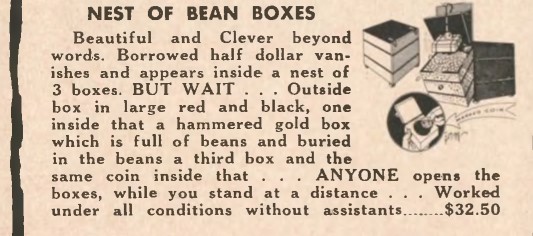
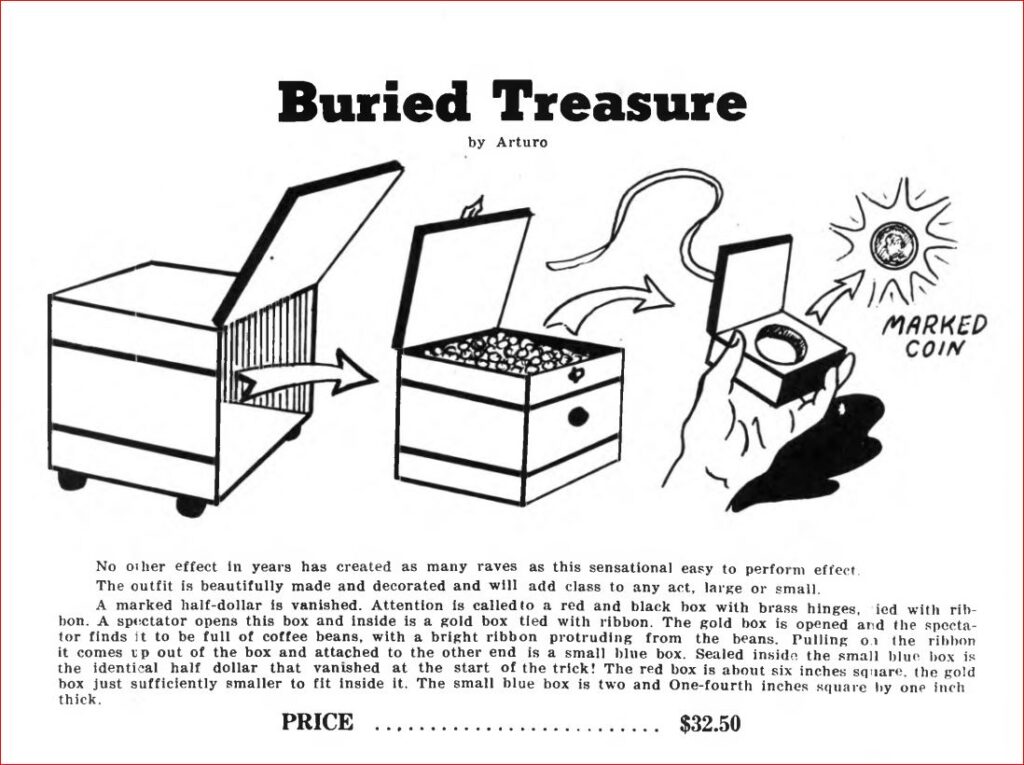
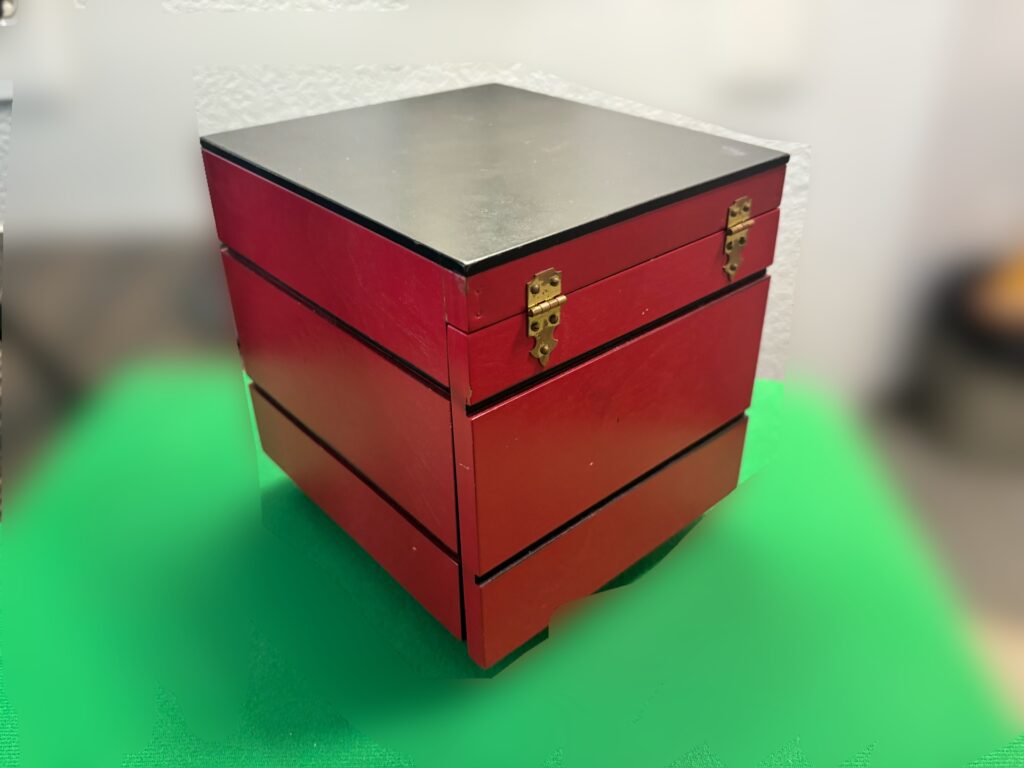
On my trip to the Bay Area a couple weeks ago, I ended up picking up a great vintage magic prop! It was Buried Treasure Bean Box by Arturo. Here’s what the original ads looked like:
And here’s what mine looks like:
This is a prop that I do plan to use in my show. I have an idea for it, so when the opportunity to buy it popped up, I jumped on it!
I really like the idea of the item being buried in beans (or whatever). The problem with this is visually it’s hard for an audience to see what’s going on because you have to see the beans from the top. With a camera, this would work great!
In my children’s show, I use a mouth coil as the end of my ball manipulation sequence. I use the mouth coil as a production coil, so I don’t use the double loop ones like the David Cressey Mouth Coils, but the ones that are just a coil of paper. The ones I’ve used for years (decades?) are the Bazar de Magia mouth coils.
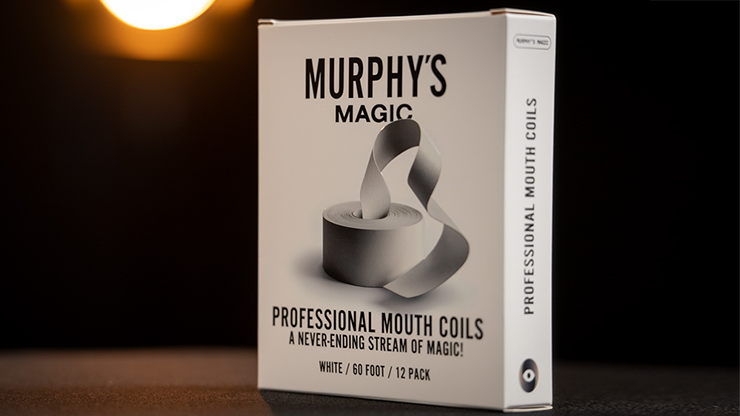
Recently I noticed that Murphy’s Magic is now making them called Professional Mouth Coils. I was running low on the ones I normally use, so I decided to give the Murphy’s Magic ones a try.
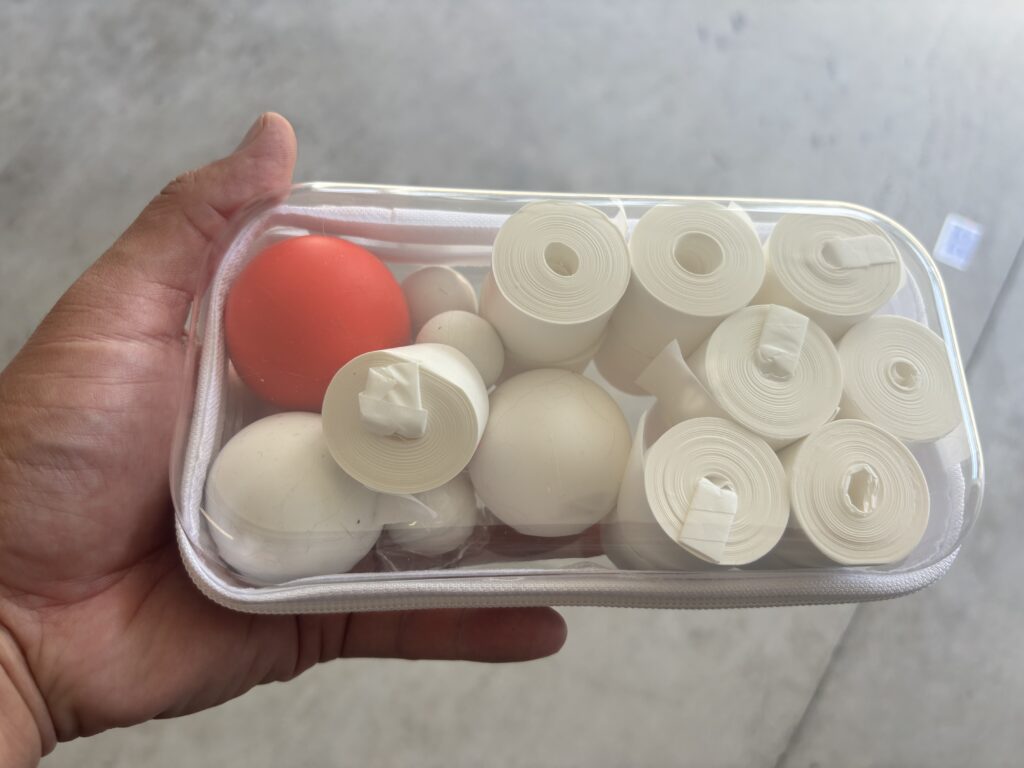
The coils look the same when coiled up, there is a slight texture difference that I can see. The picture below shows both of them inside of the case:
The main difference is that the Murphy’s ones are made from thinner paper than the Bazar de Magia ones. The Murphy’s are also ten feet longer, but both coils are pretty much the same size.
For me, the uncoiling action of the Bazar de Magia mouth coils works better. When the ball turns into the coil in my routine, I start by pulling on the end one long pull, then let gravity do its thing as my other hand catches it. I don’t let it fall on the floor. The main reason is that if kids are sitting on the floor, anyone not in the front row won’t be able to see the coil as it piles up. I think the Murphy’s mouth coils, being a lighter paper, don’t pull themselves out of the coil as well as the Bazar de Magia ones, which makes my catching hand have to do a lot more pulling initially.
For me, and how I use the mouth coils, the Bazar de Magia ones are the winner! They work better as a production coil in my hand. The Murphy’s mouth coils still work fine, but if I have a choice, I’ll grab the Bazar de Magia ones. If you produce them from your mouth, you may be looking for different characteristics than I am.
-Louie PS: The first half of my ball routine is called Sankey’s Balls and in my lecture notes 2 pack. That part is my version of Balls In Net, which doesn’t use a net. The second half of my routine that uses the mouth coil is unpublished, but basically Percy Abbott’s Perpetual Balls with a couple of surprises thrown in.
One of the reasons I think most magicians shouldn’t do a “one off” show with special themed props is that if you don’t know about the prop and how to handle it, you can unintentionally be disrespectful. Yesterday was Independence Day in the USA, which is celebrated as the country’s birthday. In the USA, we have the US Flag Code, which defines what a flag is, how to hang it, and how to handle it. This is a law, but one that has no enforcement mechanism, so it’s basically etiquette.
Many performers slapped flags on their show for Independence Day and didn’t learn the basics of how a flag should be treated. I wrote this little facebook post:
PSA for “Patriotic” Performers
Many magicians and variety acts are posting pics of them doing magic with US Flags.
Please take a minute and read the US Flag Code. About 70% of the pics / video I’ve seen today are disrespectful to the US Flag.
Here’s a few quick pointers:
1: When displaying the flag (in most instances) the blue should in top left from the audience’s view
2: after producing the flag, do not crumple it up and toss it in your prop box. Respectfully fold up and place it whenever it belongs after the trick
3: Do not set things on top of the flag
4: A flag isn’t supposed to be clothes. (it may be too late for this)
5: do not use any “disposable” items with flags printed on them, like napkins or paper plates.
Don’t be a disrespectful to the US flag! A quick search for the “US Flag Code” will give you more in depth info, like if you want to learn more like how to properly display it on your car. Spoiler alert: 99% of pickup trucks with flags on them are in violation of the flag code.
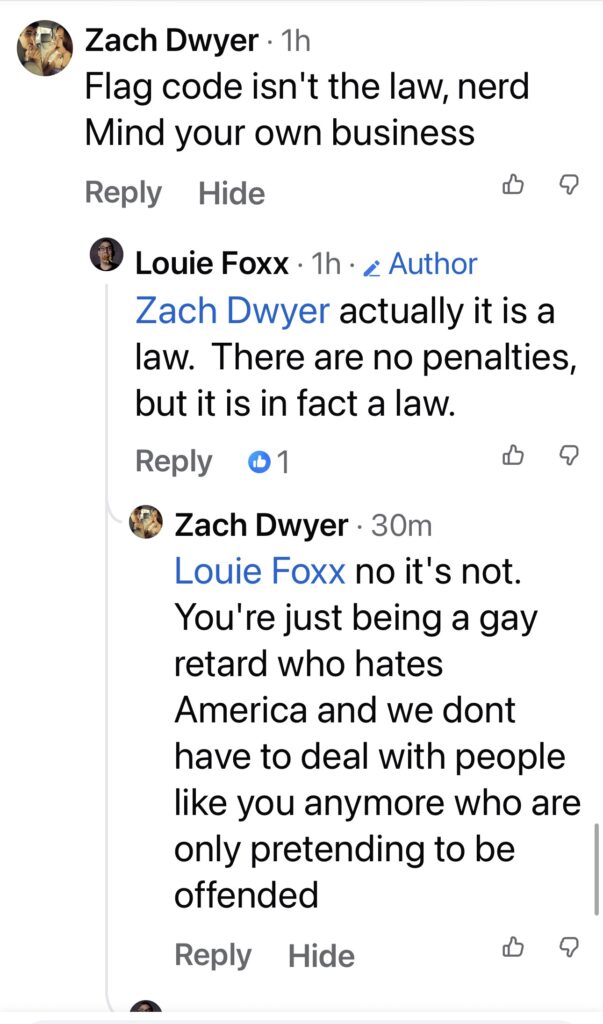
I thought it was basically a pretty straight forward. If you’re going to honor something, learn it about it. Then I got this comment from Zach Dwyer:
I’m not sure what triggered him, being wrong or what, but he immediately jumped to calling me names, instead of admitting he was wrong, or even letting it go.
Yes, the flag code is unenforceable, there are no penalties for violating it, but it is, in fact, a law.
Should You Do Magic Tricks with Symbolic Props?
In a larger context with performing, why would you use a prop or theme you don’t understand the rules for?
For example: doing a gig for a mosque and using a picture of Mohammad?
That’s an example of a trick that there’s no law stopping you from doing; however, it would be considered disrespectful. It’s a basic courtesy to treat the symbol how it is supposed to be treated.
When I get offered a gig, let’s say for Purim, I don’t do a special show for them, or add in a Purim trick, I do my show. The reason is that I don’t know about it and don’t want to offend anyone.
I should add that I’m all for intentional acts of disrespect. When Sinead O’Connor tore up the picture of the Pope, that was an intentional act. Whether I agree with it or not, she was making a statement.
I’ve always said that if I die because of someone else, I want them to have wanted to kill me. I don’t want to be killed because someone didn’t look before they turned and ran me over, and my death was an accident. If someone kills me, I don’t want it to be a “whoops”; I’d like it to have some purpose to at least that person. Also, I should note that in a perfect world, I wouldn’t die because of someone else.
OK, so that’s a long post to say, if you use a prop that has symbolism, learn about how to respectfully handle it!
We’re at the end of the summer and the Summer Reading Library shows are done. Here’s look at the props that I have on my person during the non-themed library magic show:
And here are the props in my prop bin:
This show had a pretty simple set up, it took about 15 mins to set and strike the show. The non-themed show had elements of other shows that I do, so it was like a “greatest hits” and was fun to do!