Close up pads used to last me for years, now not so much. The difference is that I use them frequently for roving magic, not just practicing at home. That means they have to look clean or at least not gross.
Between replacing these for my close up/roving magic and my stage magic show’s consumables, my show generates a lot of trash. I wish it was less, but that’s how it is.
I’m really liking the economy close up pads. They’re not the best, but for an item that I replace sometimes after a single gig, I’m willing to compromise for the price. Also they’re slightly lighter than the nice close up magic pads, so that’s handy if I’m flying to a gig.
If you use a close up pad in your work, really look at it closely and see how clean it is. Sometimes comparing it next to a new one will show you how beat up your old one really is!
Recently, I was on a quick vacation to Chicago, and one of the things we did was go on a Pizza Tour. At our last stop on the tour, we were sitting at a table with a family that had a kid who was probably six years old. This was a great moment for sneaking in a magic trick. The family didn’t know I was a magician, so it would be a surprise.
What trick did I do?
Since I didn’t have anything on me, I did an impromptu trick where it looked like I swallowed a knife. I learned at a Tony Clark lecture when I was a teenager at Bob Goodsell’s West Coast Wizards Magic Camp in the early 1990’s. It’s a great trick and if you don’t know it, it’s worth learning!
I asked the kid how he liked his pizza, then I said that I loved it so much I wanted to eat the knife (that I cut it with), and then I did! I played it for real and that’s one of those moments of pure wonder that I created!
As a magician, you should be able to do something at any moment, sometimes it’s an improvised trick and sometimes it’s a planned trick that you carry with you. Also, just because you CAN do a trick and any time, it doesn’t me you have to!
Moments like that are great and perfect for impromptu magic!
I picked up the booklet Card Man Stuff by Al Leech recently and I’m digging it!
The stuff in it is older school card magic, and the clunkiness, I think, can be easily fixed. For example, he used the cut deeper force to have a card selected, and that’s a move that I really dislike. I think the problem with that force is that when the cards aren’t in face up and face down clumps, it kinda gives it away. There are better forces that can be done in its place.
The first trick is the production of a four of a kind, and that naturally flows into the second trick, which is a transposition of the two four of a kind sets of cards. I like things in books that can be routines that flow from one to the next to eliminate set up in the second trick, but still work as stand alone magic tricks if needed.
Despite the clunkiness, the tricks are pretty direct, which I like!
Yesterday I wrote a post about doing a Chop Cup with a film can and “weed nugs”. What I was using for fake weed looked really green. It’s probably been over two decades since I’ve seen what they look like in real life, so I had to consult a friend of mine who partakes in that marijuana. He agreed and sent me some pictures of what they should look like.
The one on the right is the bright green one, and the one on the left is one after I gave it a dusting of a couple of colors of paint.
I think the one on the left looks way better, not perfect, but good enough to sell the premise to an audience. Things like getting the color of a nugget of weed is one of the challenges of magic prop building that magicians don’t normally think about. I don’t want the chopped weed nugs to look so bad that it takes people mentally out of the presentation hook of the routine.
I’m not sure where I’ll ever do this routine. I have an idea for the presentation that I think works. I personally don’t smoke marijuana, and am not involved in that culture. When performing, my persona is more clean cut, so pretending this is mine doesn’t work. I needed to come up with a routine that doesn’t feel fake. I’ll probably write a blog post about how I intend to present this sometime in the future.
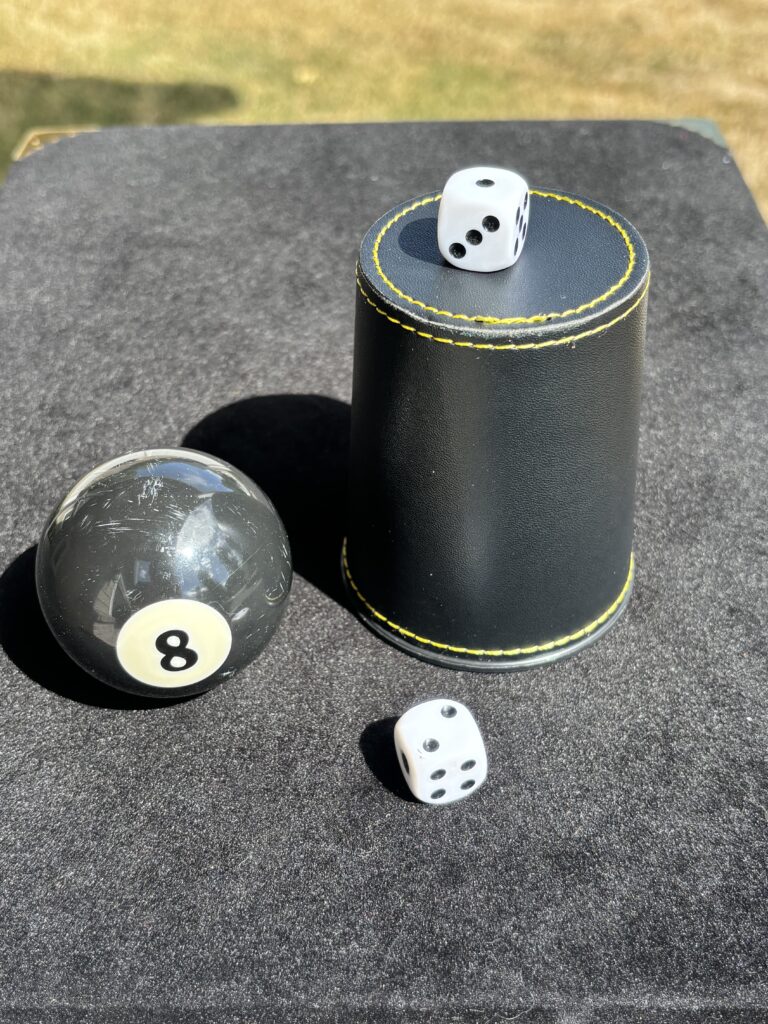
Since I released my Film Can Dice Force, I have a ton of film cans kicking around and have been playing on a chop cup with a film can and “weed nugs”.
I’m trying to work out the most efficient way to arrange everything for what I want to do: 1: The magnet is in the film can, and the weed nug has a shim 2: The film can has a shim, and a magnet is in the weed nug 3: The film can and nug both have a magnet
These props are kinda unique, as the fake weed nugs have really no weight to them. So it’s hard to build inertia to dislodge them. The little bit of weight that a traditional ball has really makes a huge difference in how hard you have to set down the film can.
These little challenges make prop building much harder than people think.
On a leap of faith I bought a box of vintage magic tricks for $25 while I was in California. I didn’t really know what was going to be inside of it, but I figured it was worth the gamble. Here’s what was in it:
There wasn’t one thing that totally blew me away. The box was definitely worth more than the $25 I paid for it, but not a crazy score.
I’m lucky that I was able to fit everything into my suitcase. A couple of the things are going to move to my shelf!
The other day, I started playing with Tommy Wonder’s Card in Ring Box. This prop is detailed in Tommy Wonder’s book The Books of Wonder. The effect is pretty straightforward, it’s a signed card to ring box. What makes it cool is that the audience sees the card drop out of the ring box.
Before I give my review of this, I should mention that I didn’t pay for it. I don’t know if that really affects how I feel about this, but figured I should mention that.
I took it out and gave it a try at the fair I’m performing out, here’s a peek at it in action:
The box looks great, and the measurements are what is in the Books of Wonder. I really like it, and I think it works great for doing a card under a box, then ending with the folded card in the ring box.
My only issue with the box is how the card is attached to the box. In the Tommy Wonder Books of Wonder, there’s a loop of thread that you slip the card into. In the JM Craft magic’s version of it, the card is permanently attached to the box.
This doesn’t sound like a big deal…until you are in a situation where you have a blue deck and the gimmick is red!
At the gig I’m at, I took a brick of Bicycle Cards, which are 6 red and 6 blue. I go through a deck each roving set. That means that on my 7th roving set, I couldn’t do the trick.
Not being able to easily change the gimmick is an issue for me. Sure, I can pack only red decks, since I buy my decks by the brick, which means that I can’t do the trick in half of my shows.
If the gimmick color is an issue for you, like all your gimmicks or whatever are one color, make sure the gimmick matches that! Other than the change from how the card attaches to the box being different from what’s in the book, the JM Craft version of Tommy Wonder’s Card in Ring Box works great!
I have a knack for creating magic tricks with a prop that is an everyday object, but the specific version of that everyday object that I need is the least common version of it!
My Film Can Dice Force is a good example of this. It uses a normal film can, it’s the one with a black can and a grey lid. This one is the minority of film cans that are out there right now.
I needed more of them, and it took a lot of work to find enough of them locally to fill orders! I do have a bunch coming from eBay, but that shipment got delayed, and I didn’t want people to wait for their orders.
All orders for this trick have shipped thanks to a couple of vintage camera repair shops that also still develop film in-house!
One thing I really believe in is developing relationships with the places that I source the components for my tricks. When they know me and know what I’m using the stuff for, it makes them much more willing to help me with weird requests than a website where I’m just a number.
The idea of using a Nest of Envelopes as a running gag with a magical payoff is taking shape. In the first version of the trick, the magic trick was going to be card prediction. Playing cards are uniquely grouped to allow several choices of groups to get to a single card that nothing else I could think of can. Ideally, this trick wouldn’t be a card trick, but it’s looking like it will.
When I first came up with the idea, as a placeholder for the trick, I used an invisible deck. The goal is to have something more original or less common than an invisible deck. Also, the invisible deck is less punchy of a reveal. It takes time and steps to get to the reveal.
What I want is a single card in the envelope. That’s it, the card is chosen (in 3-4 steps), the last envelope is opened, and that’s the card in the envelope! I didn’t have a method, but with the re-release of Phil Goldstein’s trick Shinkansen, that jogged my memory.
A few years ago I made a vintage magic trick video of that trick:
I also made a jumbo version of the trick and did it onstage as a filler piece. Part of the method of the Shinkansen led me to the method I’m going to start to use to do the prediction in Nest of Envelopes!
If you’re a magic creator, this is why having a broad knowledge of magic tricks and methods is a huge help! Part of the method for cards across got me closer to my vision for a playing card prediction!
Last week I was performing at a fair, and a couple days into the run, I walked to my stage like I do everyday and this was my view from the stage!
The previous days I had rows of chairs, but this day I had a wrestling ring!
If I asked this on a social media magician’s group, people would say “put it in your contract that people are seated in rows” or something like that. That’s easy to say, but in reality, it’s not that simple. I’ve already got a couple of days of work into this gig and a couple more to go. That wrestling ring isn’t going to move for me. All the people who say it violates the contract (if written), what are they doing to do, walk away from the gig. If you do that, they’re not going to just hand you a check; you’re going to have to fight to get paid if you walk away.
What would you do in this situation?
I simply converted my stage show into a hybrid street/close up magic show.
This worked great, and this is why I always think that if you do stage magic, you should be able to do close up magic as well. Sometimes it just works better to do some card tricks!
I’ve done many shows with stages and situations that varied a lot, I can adapt to pretty much any situation.