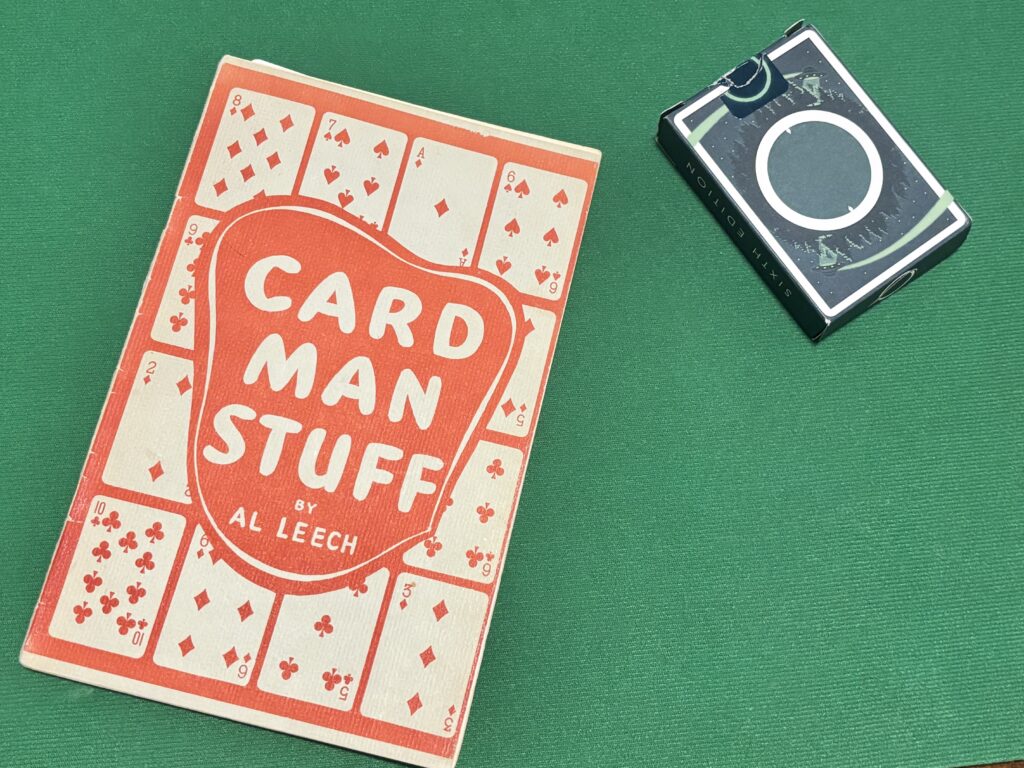
I picked up the booklet Card Man Stuff by Al Leech recently and I’m digging it!
The stuff in it is older school card magic, and the clunkiness, I think, can be easily fixed. For example, he used the cut deeper force to have a card selected, and that’s a move that I really dislike. I think the problem with that force is that when the cards aren’t in face up and face down clumps, it kinda gives it away. There are better forces that can be done in its place.
The first trick is the production of a four of a kind, and that naturally flows into the second trick, which is a transposition of the two four of a kind sets of cards. I like things in books that can be routines that flow from one to the next to eliminate set up in the second trick, but still work as stand alone magic tricks if needed.
Despite the clunkiness, the tricks are pretty direct, which I like!
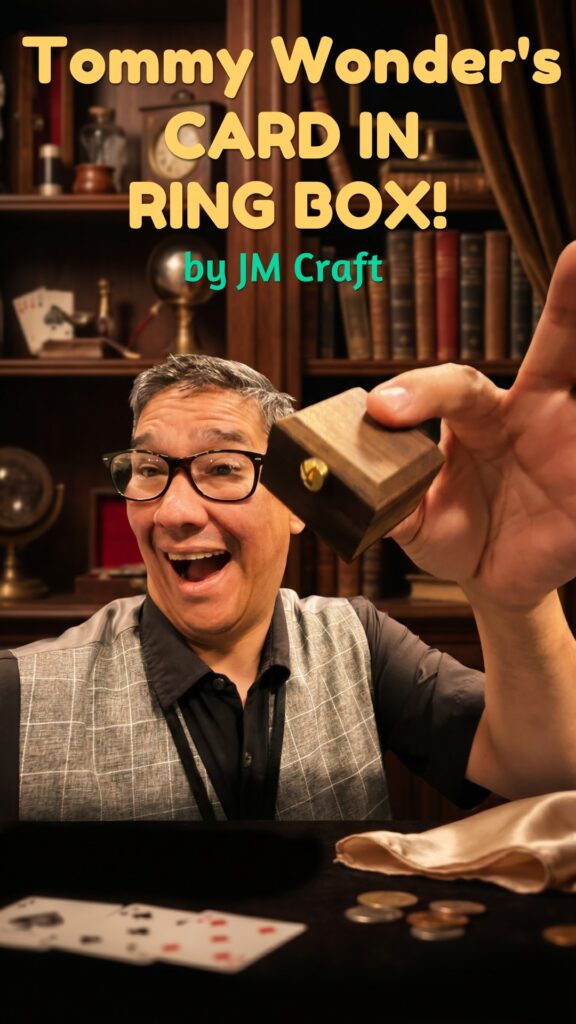
The other day, I started playing with Tommy Wonder’s Card in Ring Box. This prop is detailed in Tommy Wonder’s book The Books of Wonder. The effect is pretty straightforward, it’s a signed card to ring box. What makes it cool is that the audience sees the card drop out of the ring box.
Before I give my review of this, I should mention that I didn’t pay for it. I don’t know if that really affects how I feel about this, but figured I should mention that.
I took it out and gave it a try at the fair I’m performing out, here’s a peek at it in action:
The box looks great, and the measurements are what is in the Books of Wonder. I really like it, and I think it works great for doing a card under a box, then ending with the folded card in the ring box.
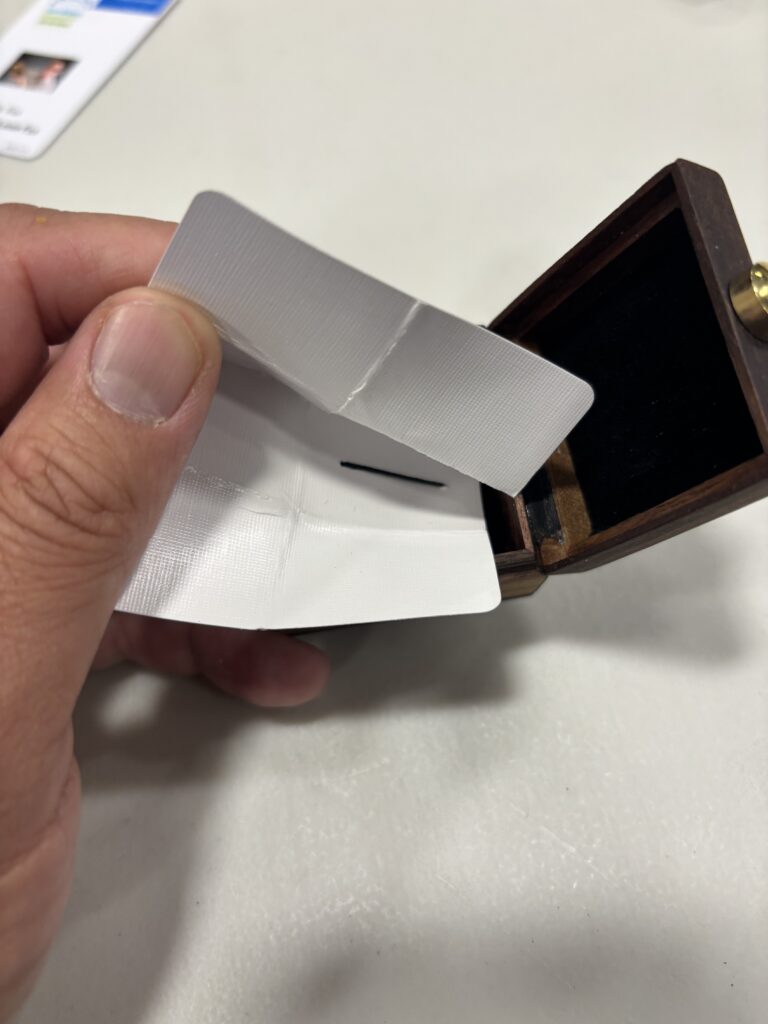
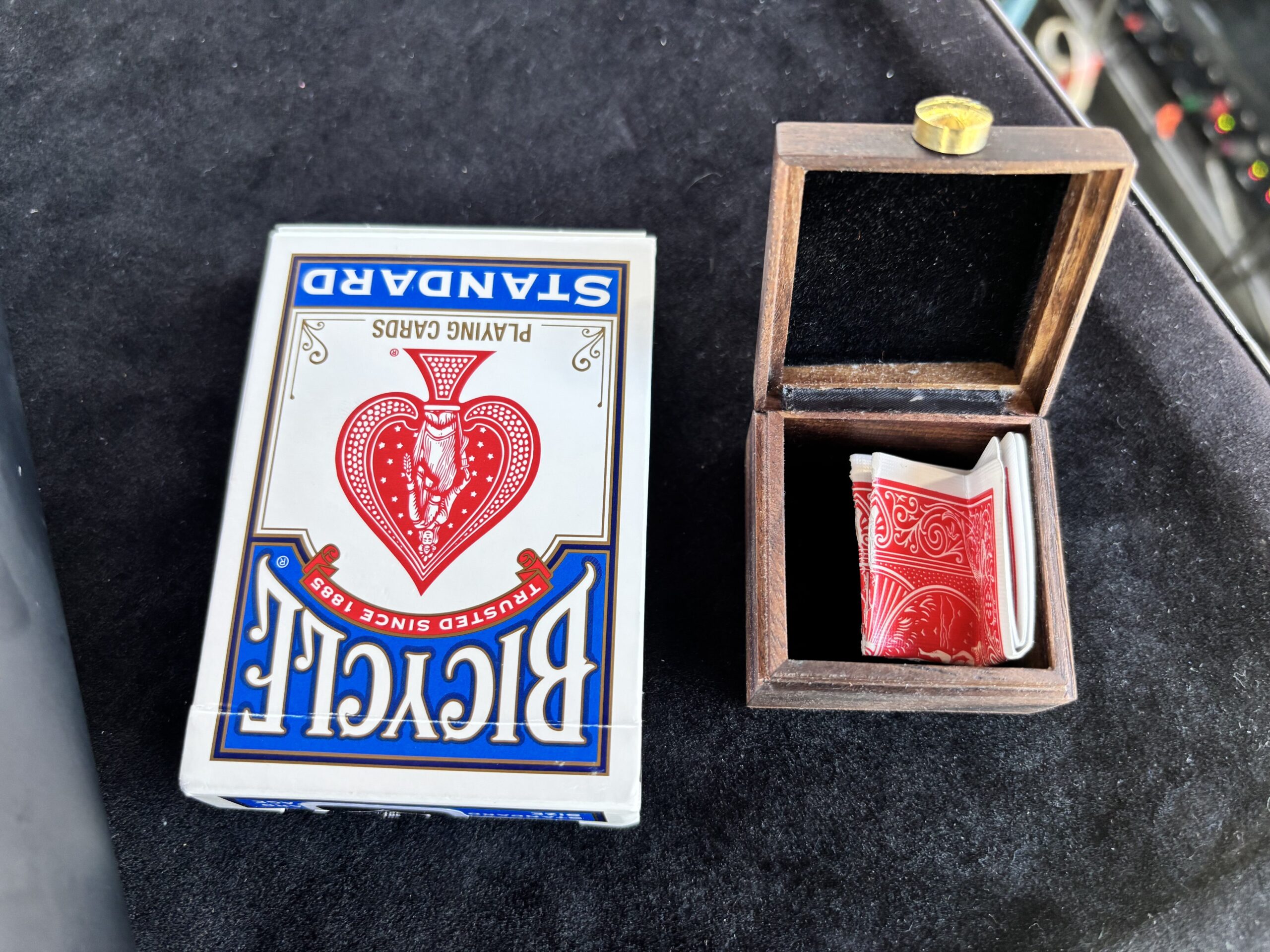
My only issue with the box is how the card is attached to the box. In the Tommy Wonder Books of Wonder, there’s a loop of thread that you slip the card into. In the JM Craft magic’s version of it, the card is permanently attached to the box.
This doesn’t sound like a big deal…until you are in a situation where you have a blue deck and the gimmick is red!
At the gig I’m at, I took a brick of Bicycle Cards, which are 6 red and 6 blue. I go through a deck each roving set. That means that on my 7th roving set, I couldn’t do the trick.
Not being able to easily change the gimmick is an issue for me. Sure, I can pack only red decks, since I buy my decks by the brick, which means that I can’t do the trick in half of my shows.
If the gimmick color is an issue for you, like all your gimmicks or whatever are one color, make sure the gimmick matches that! Other than the change from how the card attaches to the box being different from what’s in the book, the JM Craft version of Tommy Wonder’s Card in Ring Box works great!
A few days ago was a meeting for the Portland SAM magic club. I remembered it was a meeting day, so I wrote a new script for it, made the cards for a new method and tried doing it as a solo spot instead of as a running gag.
The script had the flow that I wanted, and the spots for the jokes that I wanted were there. The jokes were just meh for the most part, but for me, the important thing was to get it in front of people to see how it felt.
The trick played well, but the ending is going to take time to figure out the best way to reveal the card at the end. I have a lot of options and variables on those options, like is the person from the audience onstage, does the whole thing happen in the crowd, do they hand me the final envelope from the audience, but I open it onstage, etc.
In playing with different ideas with the Nest of Envelopes, I’m trying to decide if it works better as a bit that’s split up as a running gag sort of thing, or if it’s better and a single trick.
The advantage of it being part of a single trick is that the effect and the selection process are much clearer. That’s because it all just happened.
I’m still doing it as a card trick, and I’ve also learned it needs to be done with jumbo cards! I’m personally not a fan of using poker-sized cards where people in the audience need to see that a card is a specific card. Having the reveal of the card bigger will make it hit harder.
This routine has a way to go, but I think it’s a great idea!
Each envelope will have an instruction written on it. This is independent of the card selection process.
The rough flow is that they will make a choice, like red or black. Then they will open the envelope, and written on that envelope will be an instruction. They do that. Then you do another routine and come back to the person with the envelope. You give them the next choice, like hearts or diamonds. Then they open the envelope and do what’s written on it. That is repeated until the choices have narrowed it down to a specific card. The last envelope has the invisible deck in it, which reveals the selected card!
I think this will make the invisible deck play bigger with all the envelopes, but also allow me to get more time out of the prop, without it being a single routine that’s dragged out.
For the Nest of Envelopes, I need to figure out what is going to end up inside the envelopes. I’m thinking that a choice will be made as each envelope is opened. And those choices will narrow it down to a single thing. Then that single thing or representation (i.e., picture of it) will be in the innermost envelope.
While I hate for this to end up being a card trick, it looks like it will be. A deck of cards lends itself to being a group of items that can be grouped in a lot of different ways that are easily remembered. You can give people choices like: color, suit, letter or number, odd or even, male or female, exact value (i.e., four). A performer friend and I sat down and tried to brainstorm different things that could be grouped in different ways, hopefully four or five groups. We didn’t come up with anything that was good or easy for a person to understand.
If the trick is going to end up being a playing card prediction, then the obvious choice is an invisible deck. I travel with Rough Stick, so I quickly made an invisible deck:
I don’t know if this will be the final method, but it’s nice because it’s self-contained. The deck can go into the smallest envelope, and I don’t need to add or alter anything. Just open the envelopes, and when we get to the invisible deck, spread it to reveal the selection.
There are magic props that look like they were created to make a trick work, and don’t exist in real life. The TV Card Frame magic trick where a card appears between two pieces of glass is one of those tricks.
Recently at a junk shop I saw a picture frame that I’m guessing is what the TV Card Frame is trying to look like:
I’m always amazed that these things that look strange to me, but were created long before I was born, were designed to sort of look like things that existed in real life back then.
I wonder what props that look like everyday items now won’t look like anything people will have interact 40 years from now?
The Jumbo Tom Foolery Transformation is a series of changes of four playing cards. One at a time, the cards flip over, then the backs change color, then the faces change.
The challenge with this is that you use the same move 13 times in the routine. I think this routine was originally done with poker sized cards, but then someone decided to sell it in jumbo size to have an additional product to sell. The move doesn’t really lend itself to the jumbo cards, especially with the provided thick 8082 Bicycle Cards!
I came up with a different handling, the move still has to be done 13 times, but I think it makes more sense with jumbo cards. Here it is with my move:
One of the days I was performing at the Moisture Festival, there was a delay in starting the show. The producers asked me if I could fill some time to keep the people in the theater occupied. I did my Any Card At Any Number (ACAAN). Here’s the full spot because there’s a joke that’s a callback and doesn’t make sense if you don’t see the beginning before the trick starts.
For me, ACAAN is a great stage trick; it’s solo with just me onstage, but it involves the audience, and it’s a good trick!