Coin Balm by Rocco and Roy Kueppers

Over six years ago, I published a trick called Lip Bomb in this blog and in Vanish Magazine. Here’s what the trick looks like:

Then recently, I saw an ad for a trick that Rocco and Roy Kueppers called Coin Balm. It looks like this was initially released in 2004, here’s what it looks like:

It looks very similar to my trick…doesn’t it?

I do like the lifting of the coin up out of the tube that Rocco does, that makes the trick play bigger than the dumping of the coin downwards that I do in my trick. However I really like the spectator producing the coin from the chapstick tube that I do more than the reveal that Rocco does where he pulls it out himself.

I haven’t bought this product, so I don’t know if my trick is credited in it, or if Michal l P Lair’s Rich Smoke trick is credited.

-Louie
A Close Up Magic Routine

There’s a new sequence I’m playing with for my stage show. This is close up magic with projection. This whole sequence is done solo, with just me onstage. Here’s what’s going on:

1: Stand Up Chop Cup: This is the chop cup routine from my 2025 PCAM Lecture Notes. This routine doesn’t use a table and is done solo onstage with no projection. It ends with the production of a tennis ball.

2: Shuffle Routine: I move to the table, with the close up camera on it. A deck of cards is introduced and shown in new deck order. It’s shuffled a few times and is spread out to show it’s back in new deck order. This is repeated a second time.

3: That Way More: This is a modified version of my horizontal Ambitious Card routine. I’ve published parts of this routine in Vanish Magazine.

4: Card in Tennis Ball: The ending of the sequence is the selected and marked card comes out of the tennis ball that as produced at the beginning of the sequence!

What I like about the sequence is that it ends with a callback to the tennis ball that was produced at the beginning of the sequence.

-Louie

Demo of An Easy Elmsley Count Trick

Yesterday I posted an simple color changing back routine that is Elmsley Count based. You can learn the sequence here. While I waiting in my car for an appointment, I grabbed some cards and made a quick trick using that sequence:

I think more people should use the Elmsley Count with the cards held vertically. You have to shift your thinking a bit, as it’s backward. Your finger will do the thumb’s action, and your thumb will do your finger’s action.

Doing the Elmsley Count vertically puts your face into the frame, which in theory is good.

-Louie

A Hard Hitting Card Trick Sequence

I think magicians try to overcomplicate things with the card magic they do. You can get amazing reactions with a couple of very simple things. Here’s a quick three beat trick that gets great reactions:

There’s not much to it: two forces, a top change, and then a double lift. I don’t do a double turnover. The reason for that is that most people who have had a passing interest in magic tricks learn a double turnover in the context of either an ambitious card or simply changing the card. When I do this sequence, it looks nothing like what they’d learned in a YouTube tutorial. While I’m using techniques that they may know, they don’t look like what they’d learned.

This is a good lesson: if you keep getting busted doing something like a double turnover, either find a way to eliminate it or make it look different.

-Louie
PS: If you want to learn about my thoughts on the classic force, it’s in my 2025 PCAM lecture notes.

Stud Playing Cards

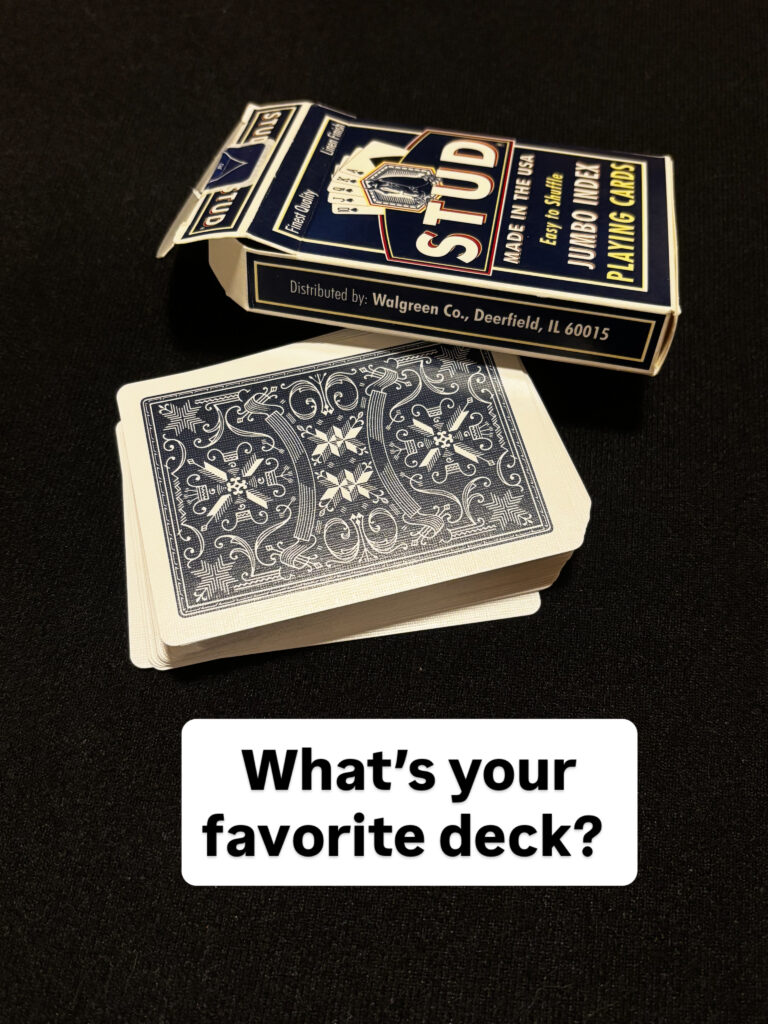
My all time favorite deck of cards are Stud Playing cards. Recently made a post about finding a couple of decks of them at a junk shop. I finally opened up the deck and and starting using them as my “fun” deck.

stud playing cards

These cards handle exactly how I remember them! I could immediately do a table and in the hands faro with the deck!

When I was a teenager, these were the cheapest usable decks that were around. There were cheaper, but those were junk by any standard. Stud cards were made on great stock, had a great finish, and were available for a great price.

I wish these were still available…

-Louie

Stud Playing Cards – New Old Stock!

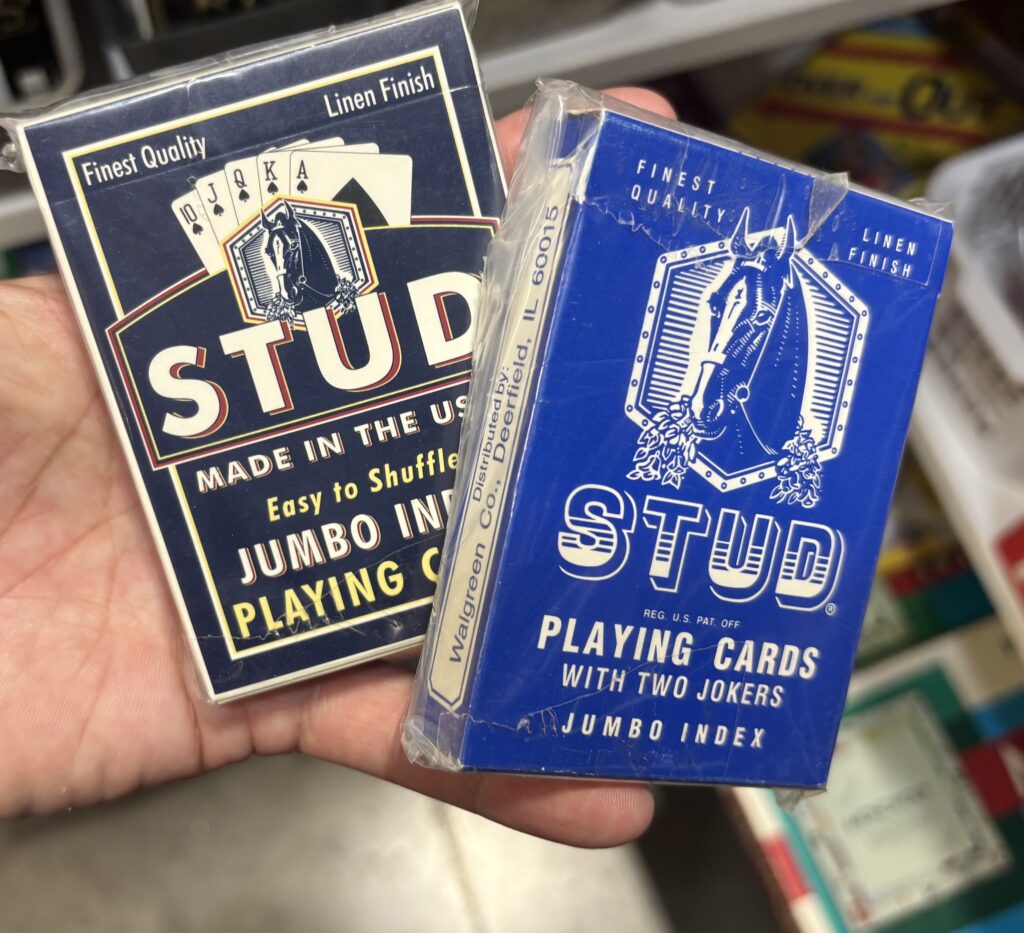
When I’m on the road, I frequently stop to stretch my legs and walk through junk shops. I was super surprised to find two unopened decks of old stock Stud Playing Cards!

two decks of stud playing cards

These were my favorite playing cards when they were available. They haven’t made them in years. I think someone (US Playing Card Co.?) made another batch of them about 10 years ago; however, they were on a different stock than the original, and basically Bicycle Cards with the stud back printed on them.

I’m planning on adding these cards to the stack of nice cards that I practice with. They’ll last longer that way than a working deck that lasts 45mins to a hour.

-Louie

What is a Slick Card and How is it Used in Card Magic?

When I was a teenager, I remember reading in (I think) Scarne on Card Tricks about slick cards. These are cards that have a smoother finish than the rest of the cards. In that book, John Scarne mentioned that they were made by using car wax to make the face or back of a card smoother.

At some point when I was a teenager in the 1990s, I noticed that Bicycle Pinochle Cards had a different finish than the poker cards, even though the box said they had the same “air cushion finish” and those cards could be used as a slick card.

Recently I came across an old deck of pinochle cards and made this video:

Most magicians back in the 1990s had never actually seen slick cards; they’d only read about them in old books. I’m pretty sure that now even fewer magicians have heard of them.

What can you do with them?

First of all, you don’t need to drop them as I did in the video. You can bump the deck and it’ll break at the slick card. That will give you a spot to then cut or shuffle to.

Another thing you can do is toss the deck on the table so that they spread a little bit. The deck will naturally spread wider at the slick card, and that can be used for the psychological force of them taking the card at that point.

It’s a weird thing I wouldn’t want to rely on, but it’s fun to play with having one in the deck!

-Louie

How to Add a Beat to a Packet Trick

Yesterday I made a post about David Regal’s Off With His Head. I wanted to add a third beat to it, and one of the ideas I mentioned was making the three cards that weren’t selected blank. This is really following the B’wave format.

Here’s it with the three blank cards as the ending:

I think it’s (for me) a better trick than the original and away to turn B’wave from a mindreading trick to a magic trick.

-Louie

Triumph Card Trick Variation

The Triumph card trick, where cards are shuffled face up and face down, ending with all the cards going the same way, except a selected card, has fascinated me for a while. In the past, I’ve published a version or two in Vanish Magazine. Here’s my newest idea for it:

I really like using the old drop the deck and the top card flips over thing as a way to flip over the top card. I’ll probably write this up at some point and publish it somewhere.

-Louie

Three Shell Game Ending

One of the endings that I’m doing with my three shell game routine is using a small cap that goes under the shell to replace the standard shot glass. I got the idea when I was on a flight and realized the tiny liquor bottle cap would fit under a shell. (you can read the post about it here)

Here’s a demo of what it looks like:

You could put a shot glass on top of the cap and shell for a triple cover! I really didn’t want to use the shot glass, as it’s bulky, heavy, and semi-fragile. This is a good solution for me!

-Louie