How Do I Do This?

Here’s a card revelation I found on a hard drive from a January 2024. I’m not sure how I did it.

Here’s what it looks like:

I guess I posted about it here:
https://www.magicshow.tips/magic-show-tips/card-production/

It’s kinda cool, I wonder why I stopped playing with it?

-Louie

Old Stock Bicycle Playing Cards

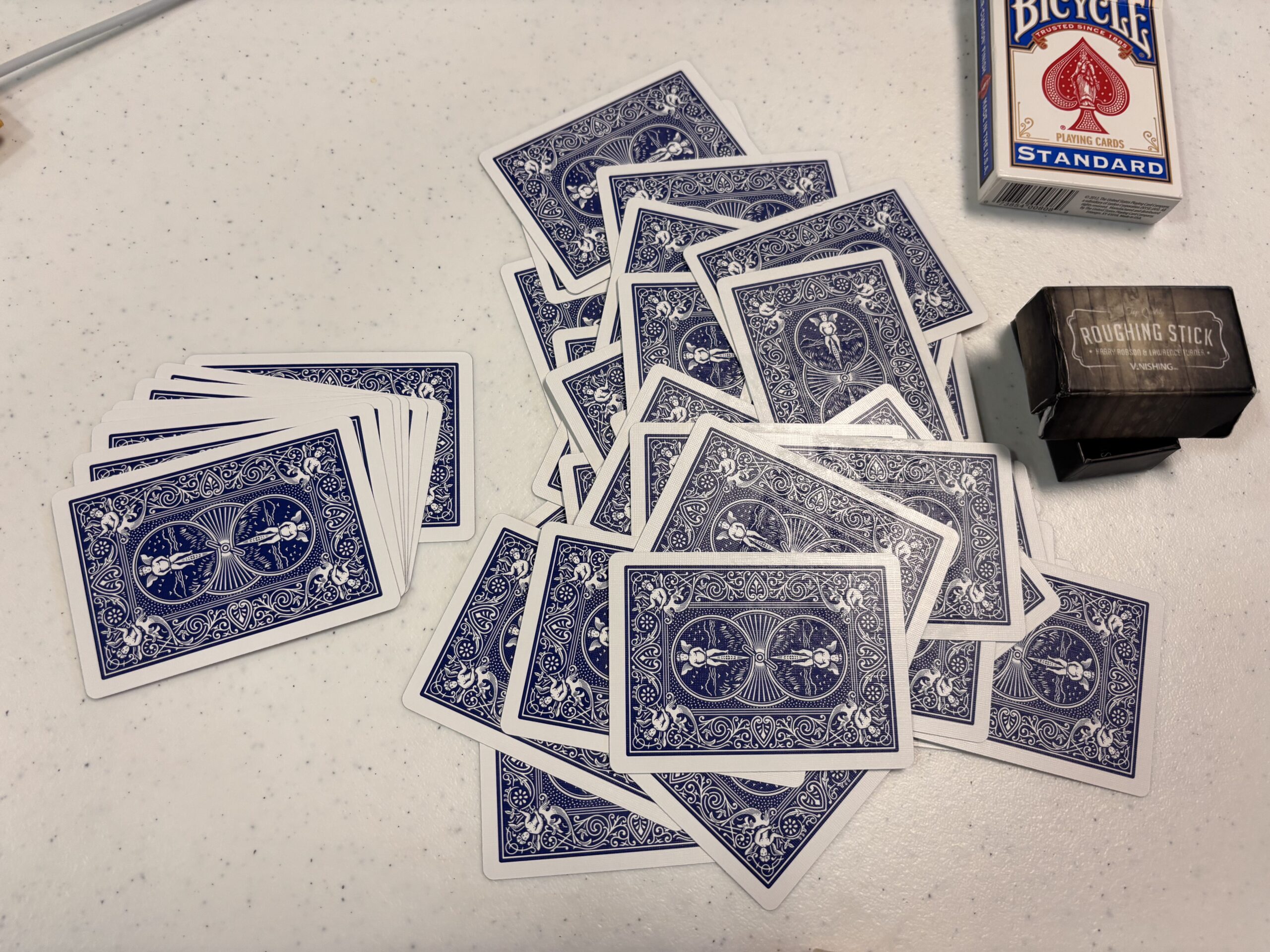
My favorite playing cards are Old Stock Bicycle Playing Cards from Cincinnati. As I travel I find sealed decks in junk shops and always try to buy them. Sometimes people want way to much for them, but usually I get them for about $2 a deck, and never pay more than $3. Over the years I’ve filled a bin of them!

Old Stock Bicycle Playing Cards

These decks faro beautifully out of the box! They also last longer than the Bicycle Cards that are currently sold. I don’t use these for shows, they are for practice / play for me. When I have a good deck, I’m more motivated to practice than with a deck that’s inferior.

For shows I use new decks, these are good for about an hour (or one set), which is fine because so many cards will get destroyed in that set that I replace the deck each set.

-Louie

Snake Basket Magic Trick V2

This snake basket magic trick I’m working on feels like a “project car” that’s in someone’s garage that they are constantly working on. It’s something I keep finding ways to improve. The first version is barely finished, and I’m working on a second one!

snake basket magic trick

The big change is that I’m going to move it away from a card trick. I’m going to merge it with Terry Seabrook’s Chattering Teeth Routine. The snake will chew holes in the paper, and the reveal will be when the paper is opened. A paper is physically larger than a playing card, even a jumbo playing card. Bigger is better for a reveal!

Moving to paper also allows me to customize the routine to a show. For example, if I were doing a safety-themed show for kids, the snake could chew a stop sign in the paper. It could still be a card a la the original Seabrook routine, or spots (like on a die) or even the image a piece of art!

I’m liking flexibility of this idea!

-Louie

Snake Basket Presentation

The snake basket magic trick that I’m working on won’t have a basket or any of the old snake charmer tropes. The main reason is that after reading about snake charmers and their rise in pop culture, I don’t think my personal values align with that imagery. It’s like “yellow face” Asian stuff that used to be popular in magic. The original intent of it was not positive.

Another reason I’m not using the basket is that it’s a trope that no longer exists. It’s not something that appears in modern pop culture. I know it was in every Bugs Bunny cartoon, but kids haven’t watched those for decades. There’s really no reason to have a basket today.

If you see a reptile show at a school or library, none of the snakes are in baskets; they’re all in boxes or tubs. That’s what I want my snake basket to look like, a box, well, specifically a wooden crate. I’m waiting on the supplies to make it, but the box will be cardboard, so it packs small and light. I’m going to cover it in wood grain contact paper and then add trim with wood grained duct tape.

I’ll post pictures of it when it’s finished!

-Louie

Snake Basket Demo!

The snake basket that I’ve been building is finally starting to take shape! I have a completely functional version of it! Here’s what it looks like:

I’m going to make a small change to the code. I’m going to add a three second delay after the button push for the action to take place. I want to be able to have some physical distance between my hands and body when the actions take place.

-Louie

Topsy Turvy Cards

There’s a great little card trick that I think is a George Sands thing and more recently popularized by David Williamson. You and the audience have four cards each. They follow along with you, turning cards over, and you always end up with all your cards facing the same way, and theirs don’t.

The instructions that I learned from said to give them the cards to do the last phase. The problem I had with this is that you’re handing them a packet that secretly has a card reversed. Most of the time, the spectator would expose that reversed card. My solution to this was for me to hold the cards in one hand and they perform the action. That keeps the cards squared, and the secretly reversed card a secret!

Here’s what it looks like:

This is a trick that isn’t part of my normal work, but it’s a fun thing you can do for a group that they all get to do. What I don’t like about it is that the spectator doesn’t “win” and I haven’t figured out a way to make that happen. In David Williamson’s version they do win and it’s great!

-Louie

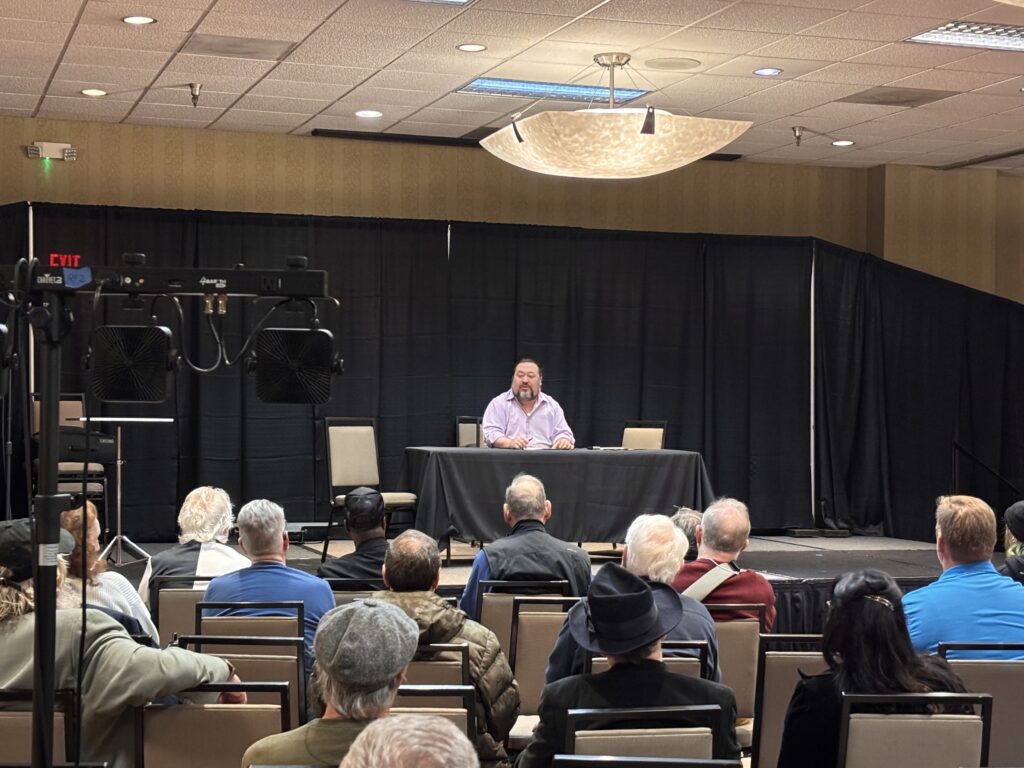
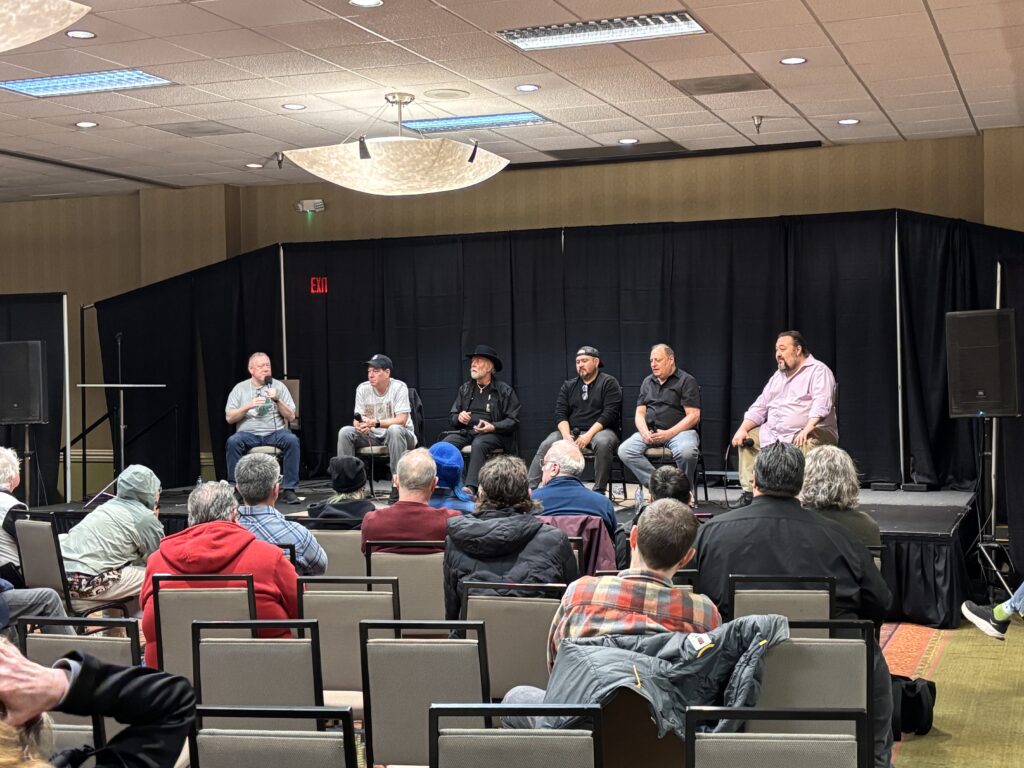
The Louie Foxx Magic Lecture

In January, I have two magic lectures: one was last week, and the other is in just over a week. I usually don’t do many of these, as my performing schedule is busiest during the summer, when the magic conventions happen.

I had a blast at the one last week for the Portland Society of Magicians. Here’s a peek at what the 90 minute lecture looks like in 60 seconds:

If your local magic club would like a lecture, feel free to contact me and we can try to make it happen!

-Louie
PS: you can get the lecture notes here:
http://www.magicshow.tips/lecture-notes-2025/

Working on a Snake Basket…

For decades, I’ve wanted to do a snake basket that combined the two popular versions from the late 1990s. Those two were Terry Lunceford’s Viper and Collector’s Workshop’s Khyber Kobra. I wrote a blog post about those two a few months ago, which includes videos of them; you can read it here. In a nutshell, I wanted to combine the two of them, so there’s the byplay of the Khyber Kobra with the ending of the Viper.

I’ve been working on learning to use Arduino and over the summer I made a working model on an Arduino simulator, but haven’t had time to actually make it, until a few days ago.

snake basket magic trick

The arrangement above has a lot of wires, but it works! All of the functions do their thing. Like any project, once it becomes a physical thing, it will change. I realized I could eliminate one motor and have one servo handle two tasks. The motor would make the snake rise, then the servo would make it move back and forth. I decided to eliminate the motor and have the servo make the snake rise and shake. That simplified this a lot, and here’s the new wiring:

snake basket magic trick

Usually, simpler is better; here’s less to go wrong, and it’s easier to diagnose if something does go wrong.

The next step will be to move it from an Arduino UNO board to an ESP32 board and put everything onto a PCB board for more sturdy final version of this.

-Louie

Everything Has Already Been Invented

I always hate it when people say, “Everything has already been invented.” I think it’s a way for the person who said that to:
1: Justify them not trying to be creative.
2: Used as a way to trivialize someone else’s creativity.

That said, there are a lot of ideas that are reinvented, and that’s not necessarily a bad thing. Many tricks from a long time ago weren’t complete because they couldn’t find the final piece of the puzzle. Sometimes a technique or material didn’t exist that would take the trick from just “meh” to amazing.

I was reading The Bat magic magazine from the 1940s on the plane home from Florida and read the Bowman’s Bullseye. Read the circled effect:

Bowman's Bullseye

Does this sound like a modern trick? If you said The Stranger, then you’re correct! The effect is the same, but the method is quite different and wouldn’t work today. In fact, I’m not sure Bowman’s Bullseye was practical in the 1940s.

What the stranger did was create the same effect, but using techniques that would have been impossible 15 years ago, and made it practical! The two tricks are light years apart (OK, actually like 90 years) and can’t be compared, other than they are both based on the telephone tricks that were invented pretty much where the telephone was.

Keep creating!

-Louie

Ah Nertz: a Card Trick From 1943

In the second issue of The Bat Magazine from 1943 there’s a packet trick called Ah Nertz. Packet tricks didn’t really exist at that point, there were things like 3 card montes or tricks with the four aces, but nothing like post 1960’s packet tricks.

Here’s Ah Nertz as written:

If you think about the effect, this is an early version of twisting the aces.

I wanted to update the trick with a few modern moves, so here’s what I came up with:

One thing that the original lacked was showing all the cards going the same way. To do that I added a modified DM Move/2 for 4 Count. I also wanted a reveal of the one the upside down cards, but where you see all of the cards. That was accomplished with an Elmsley Count.

Here’s a walk through of the updated version of Ah Nertz:

What I think is interesting is that in theory you could theme the trick very easily with customizing the last card. It could be a trade show trick, “all the options for buying X got your head spinning…”. Or a story could easily be attached to it, like a kid who always felt different. Then the reveal on the final card ties it all together!

I think this trick’s premise is one of the hidden gems in The Bat magazine!

-Louie