I'm on the road from July 12th to August 17th.
No physical item orders will be shipped until I return on August 18th.
Digital products will still be emailed during this time
-Louie Foxx Dismiss
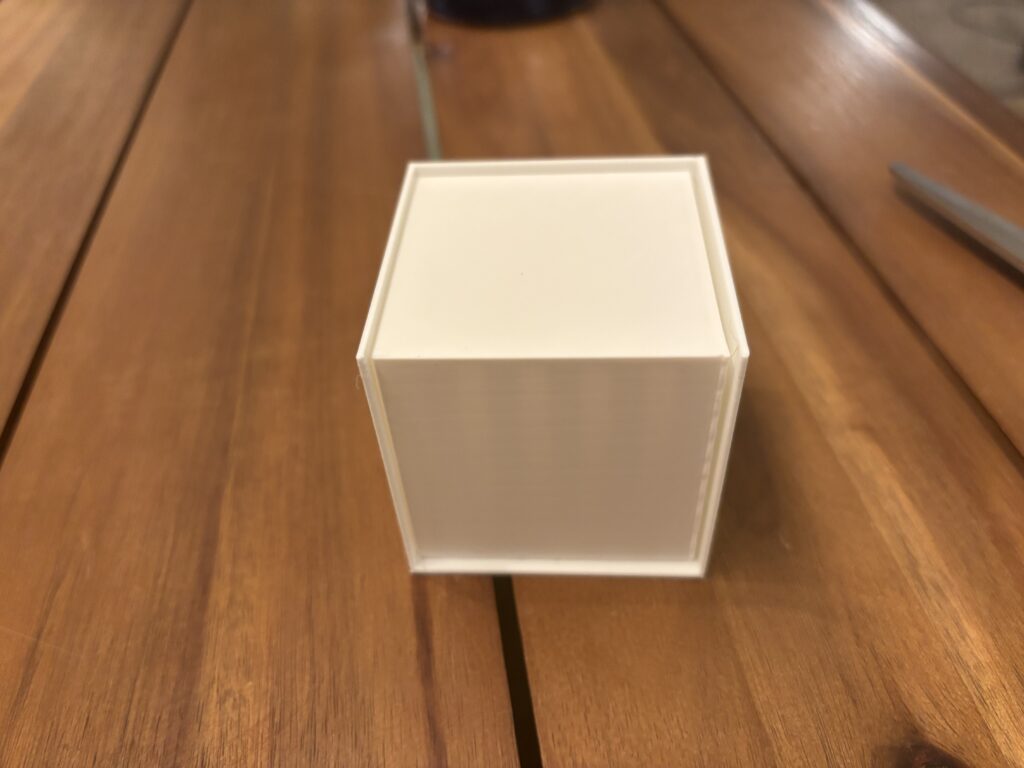
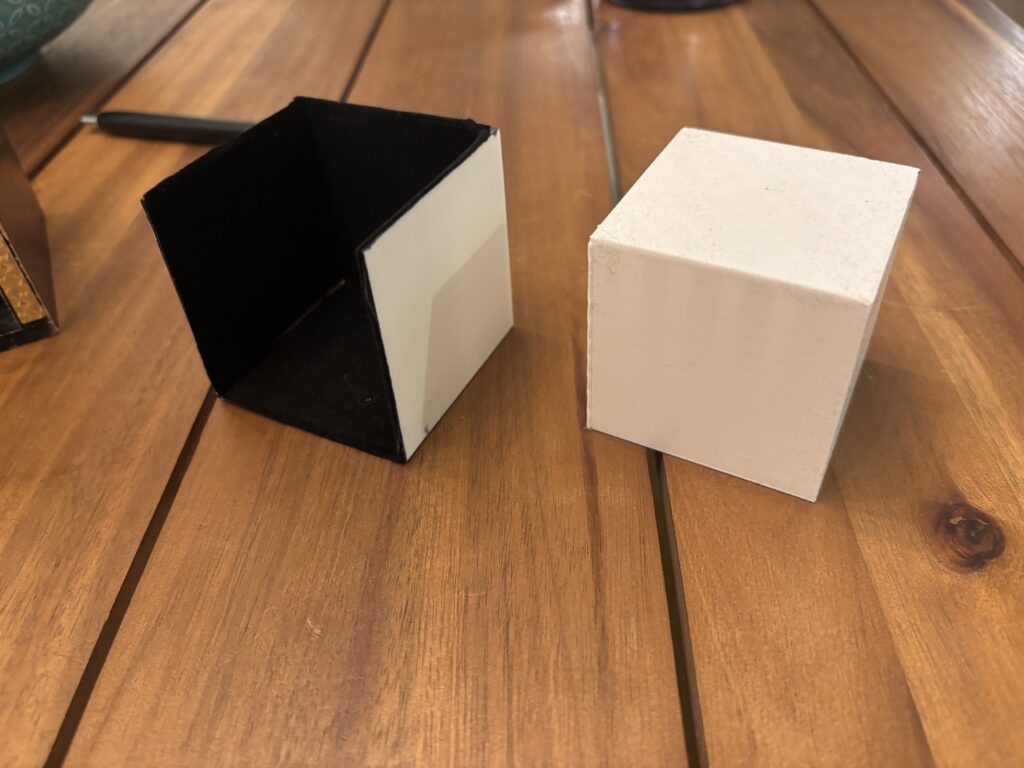
In the off season I spend time replacing worn out parts of my show. The fish bowl on the left is the one I’ve used in the show for the last year, and the one one the right is the new one.
It always amazes me how things can get beaten up slowly, and because it happens over time, I don’t notice till it’s really bad. It’s always good to check your props and clean or replace them regularly!
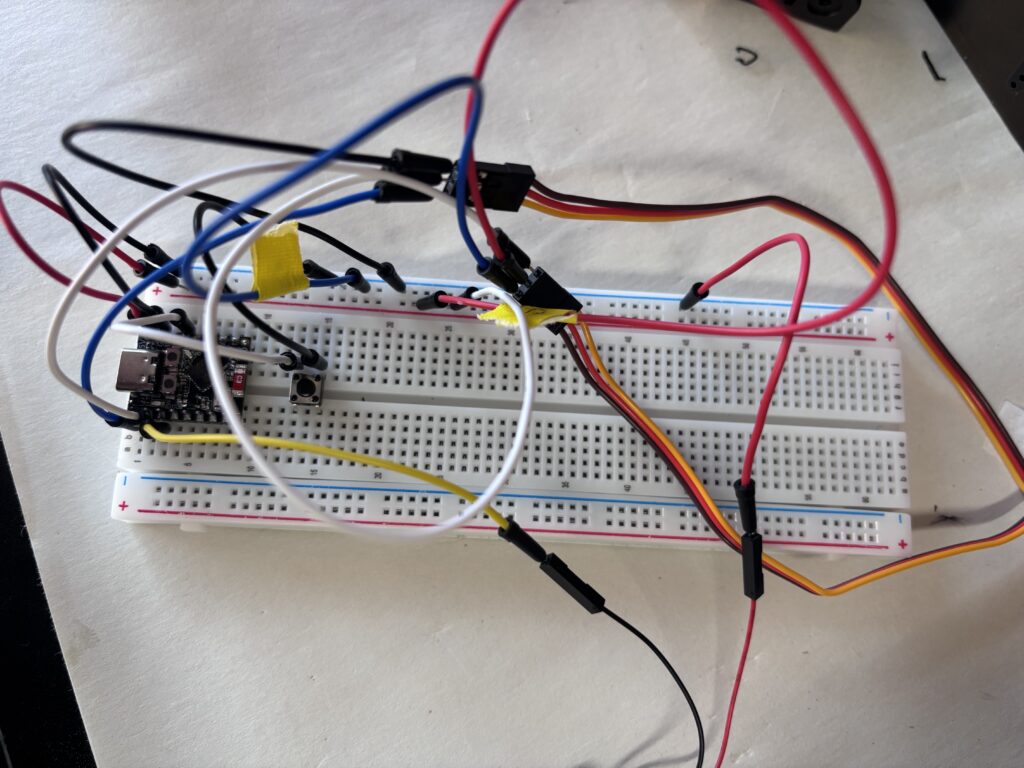
I’ve been working on learning to use Arduino and over the summer I made a working model on an Arduino simulator, but haven’t had time to actually make it, until a few days ago.
The arrangement above has a lot of wires, but it works! All of the functions do their thing. Like any project, once it becomes a physical thing, it will change. I realized I could eliminate one motor and have one servo handle two tasks. The motor would make the snake rise, then the servo would make it move back and forth. I decided to eliminate the motor and have the servo make the snake rise and shake. That simplified this a lot, and here’s the new wiring:
Usually, simpler is better; here’s less to go wrong, and it’s easier to diagnose if something does go wrong.
The next step will be to move it from an Arduino UNO board to an ESP32 board and put everything onto a PCB board for more sturdy final version of this.
Recently, I bought an old box of magic props from the late 1950s/early 1960s, and it contained some 65ish year old flash paper. People frequently ask in magic social media groups, “Does flash paper go bad?” Well, let’s find out!
I’m amazed that it worked as well as it did and that it didn’t burn my fingers!
I think the issue that people have with flash paper is that they store it wet for safety, which is absolutely what you should do. Then dry out what you need to use a few days before you need it. That said, I think the paper sitting wet in a sealed bag over time will deteriorate. That takes years, and you really should be buying decades worth of flash paper at one time. It’s something you really should be buying a few months supply at a time. I personally wouldn’t want to store a ton of it at home.
Right now I’m writing a show that I’ll be doing for a elementary school assembly tour in April. One of the challenges is that I’m trying to avoid the whole 6 7 thing.
That makes counting tricks a challenge and there’s a card across type trick that I’ve written into the show. I don’t want to lose control halfway counting a packet of cards, and that needs to be done four times!
Right now is that my plan it to talk about the objects as I’m counting them. That would break up the 6 to 7 with dialogue between them. I’m not sure if that will work, but it’s an idea. Another idea is to use 9 items instead of the traditional 10. Then if three items move from one packet to the other, that will reduce the counting that will have the numbers 6 and 7 from four times to three times.
Another option would be to not have the trick about counting, but about specific items moving from pile to pile. So three red backed cards end up in a blue backed packet.
There’s not much to this idea; it’s a confabulation routine where you predict a Venmo transaction. The three things predicted are a name, an amount, and an emoji.
Method wise, my first idea was to use a no force mental epic. There are a couple of things I don’t like about that. The main one is that you don’t have much room to write. Also, the prop doesn’t look like something that I would use in my show.
When you think about it, you just need to force the three things. Ideally this would be a routine that could be done onstage, alone, without a spectator. That leads to a simple method, the Three Section SvenPad Picasso. This is a forcing pad that’s cut into three sections.
For the routine, I’m thinking it starts by tossing a paper ball into the audience. That person selects a name. It’s tossed to a second person who chooses an amount, and finally, a third person who picks an emoji. All of those selections are them saying stop as you riffle through a section of the pad. The paper ball is tossed back to the stage, and it’s opened to reveal all of the information
Yesterday, I posted a little routine for the latex vanishing bottle prop. If you haven’t read it, you can read it here and do that before you read this as what follows will make more sense. Here are some ideas for yesterday’s routine:
Use two bags instead of one so that the item travels across the stage.
Say they’ll change places, the spin the bag 180 degrees.
If using two bags, one could be labelled “full” and the other “empty”. You then turn the bags around, and they have the other word on the back.
To add a layer, to make the method harder to back track, you could start with a variety of drinks that are different colors and force the latex bottle.
This morning, I was thinking about uses for the latex vanishing bottles. Here’s one of the routines that I thought of:
Effect: You put a full beer bottle and an empty glass into a paper bag. A snap of the fingers and you remove an empty beer bottle and then a full glass of beer!
Method: You need a bag, a latex beer bottle, a matching real beer bottle, a glass full of beer, and a fake bottomless glass. This fake bottomless glass is basically a thin plastic tube. In the old days of magic, they would call it something like a “celluloid fake”.
Set Up: Place the empty beer bottle and the full glass inside the bag on your table.
Working: Show the empty glass (plastic tube) and put it into the full glass that’s inside the bag. Next, you show the full bottle (latex) and put it into the bag.
Snap your fingers, then remove the full glass (with the plastic tube inside), and then remove the empty beer bottle. Crumple up the bag (with the latex bottle inside) and toss it offstage.
That’s it, there’s really not much to it, but a bit more simply vanishing the bottle or making an empty one become full.
One of the things that I’m playing with is a Coin Matrix. One thing I thought about is why the coins are in the corners of the performance area rather than in some other shape. I get that there’s a lot of tradition, as the modern coin matrix is based on Yank Hoe’s Sympathetic Coins. Then, when Al Schneider created the modern version, he called it Matrix, and I think in math, those are traditionally a square or rectangular shape.
I was playing with some other shapes and layouts for the coin matrix. A straight horizontal line, a diagonal line, however I think I’ve settled on the classic Ace Assembly layout. With a leader coin in front and the three follower coins in the back.
I really like this layout, as in my routine, there’s some other stuff that needs to happen, and it moves all of the empty spaces once the coins travel to my edge of the table, which makes the next part for me a lot easier to do!
I want to say there’s nothing wrong with the standard coin matrix layout; however, there’s also nothing wrong with changing it!
Here’s a quick little mindreading trick that I came up with a few years ago.
Effect: You ask someone to think of one of the following Christmas things: Gift – Stocking – Candy Cane – Santa – Snowman You then tell them letters in the word they are thinking of, then finally the word!
This is a simple progressive anagram. There’s really not much to it, you follow the card below:
I remember the word NASM for the flow of the letters named. Then, for the order of the items, think of a “Gift left in a stocking, which is a candy cane from Santa.” Then if it’s none of those, it’s a snowman.
There you go, some propless mentalism for your family gathering.
While I was on the cruise ship I was asked to do a 5-7 minute spot in the farewell shows. I don’t do short spots as often as I used to do them a couple decades ago. They stress me out because you don’t really have time to establish a character or vibe and you don’t have time to win back the audience if you lose them.
Here’s my props for the 5-7 min spot:
Here’s what I did: My stand up chop cup routine (see my lecture notes) which ends with the production of a tennis ball. Then I did a card to pocket routine with a signed card. The routine ends with the signed card coming out of the tennis ball.
One thing to note is that aside from these props, where everything happens in my hands, the only other thing I used (but not necessary) is a stool to set the tennis ball on after it’s produced, so that it’s visible the whole set. The stool was already on stage from the act before me and the one after me, so there was zero moving of props for my spot.
Oh, the black string thing is one of Nick Lewin’s Ultimate Microphone Holders. That allows me to use a handheld mic, so I don’t need to get mic’d up with a head set.
It’s an action packed 5ish mins, with a nice little surprise at the end.