When making deliveries, Amazon uses these totes to haul packages:
I don’t know if they’re common enough for people to recognize what they are. They collapse flat and I think they could be converted to a magic prop. It wouldn’t be hard to make one into a tip over trunk. You would also simply put a panel that flips up on the bottom and put it on a mirror base and you’re good to go.
The challenge is that I don’t think they’re quite super common knowledge like a milk crate was. Maybe in a couple of years…
I finally finished reading Ginosko. This is a fantastic magic book, what I like about it is that it’s not just tricks. The whole back half is advice from other magicians and people in David’s life.
For me the routine from the book that’s worth the price of the book is “Asking the 8 Ball”. It’s a transposition of a selected card with the 8 of the same suit. One of the things that makes this great is how the end of the trick where the actual transposition happens, the audience kinda figures it out on their own. What I mean by that is when we get to the point where I reveal the selected card isn’t where it should be, the audience member automatically reaches down and reveals the transposition with any guidance from me.
It’s really a great moment.
There’s tons of other great material and advice in it. There’s a fun vanishing bottle routine in it, I won’t do the routine, but got me thinking about an idea for the vanishing bottle. The book helping me make a connection to something else is always valuable to me!
Another trick that hits really hard is “Post-it Crane”. This is a cool trick, but I don’t think it’ll really ever end up in my main close up magic set because I don’t have the pocket space for a post it pad and the “gimmick”. When I have done it, it’s been for small groups of about 4 people and it absolutely amazes!
This book is cheap at like $25 and totally worth picking up! I got mine at Misdirections Magic Shop.
Recently I had a magician reach out to me to let me know there were some vanishing bird cages in a magician’s estate. I didn’t have much information to on as to what one of the cages was.
Obviously one of them is a Milson Worth Silver Meteor vanishing bird cage. This one is cool, because I’ve owned dozens of Milson Worth cage, but never had the instructions, until now!
Now for the interesting cage, the one that’s not clear as to who made it. There wasn’t a lot of information that I could pull from the pictures, so I totally took a gamble when buying it.
Here’s the cage:
It looks a lot like my Owen Magic vanishing bird cage, so here they are side by side:
The dimensions are exactly the same. There are a couple of small differences. The cage I just got isn’t stamped “OWEN” where the cage on the left that’s 100% and Owen is stamped. The lack of a stamp doesn’t mean that it’s not an Owen, as there was a period decades ago were many weren’t stamped. The Owen cage that I already has was much more modern.
Another difference between the two cages are the corner pieces.
The modern Owen cage on the right appears to have the ends peened, where the mystery cage looks like they’re peened and a blob of solder is added. I was chatting with a friend of mine and he found an old Owen Magic Supreme catalog and the ends of the corner bars also have the solder blobs!
This catalog is from the 80’s and back then the Challenge Cage Mystery was $97.50!!!
After asking around a bit, I got this little bit of information:
The size of the rails match those dimensions.
Based on all of this, I’m now 99% confident to call this birdcage and Owen Challenge Cage Mystery!
One problem is that one of the corners needs a repair, it’s missing the solder blob.
I’m sending this out to my birdcage guy and he’s going to repair it and polish up the cage!
-Louie
PS: if you come across a vanishing bird cage, feel free to reach to me to see if I’m interested in buying it!
In using projection at my shows over the summer I learned that some projectors or TV’s will “time out” and turn off if they don’t think they’re getting a signal. The camera I use has a black out option that I used to use, until I learned that the black out can be interpreted as no signal and the TV or projector will go into sleep mode.
To solve this problem, I 3d printed a simple camera cover for my iphone and glued it on.
This is a very simple, low tech way to solve the problem. The camera is still sending a picture to the screen, so it won’t got into sleep mode.
For these shows I didn’t want to run the camera through my laptop and use my Media Star to control it. That’s way too much set up and gear for a library show.
About a month ago I was told that Walmart had bricks of bicycle cards for $14! It turns out these are a clearance item, so once they’re gone, they’re gone. I’ve been buying them up whenever I find them on my travels.
There are still some out there at Walmart’s, but I’m finding them less and less now. If you go looking, they usually be with the playing cards OR in the clearance section of the store.
Just a note, if you’re going out looking for them. I found a box that was still labeled at $29, but I took it to the register and when I scanned it, it came up at $14. So if you see the higher price, it should ring up at $14!
Way back in January of 2020 I made a 3D design for a replacement clip for my Audio Ape remote control and posted a picture of it on Facebook.
Recently this post has had a second life with people asking me if they can get the .stl file. I’ve offered it for a few bucks and what’s funny is everyone expects it for free.
Why would I give them my work for free?
It’s literally a piece of my life that I spent to create this. There’s a cost associated with it AND there’s a reason why they don’t just make their own. It’s either they’re too lazy to do it, or they don’t know how and are too lazy to learn how to use 3d modelling software. Either way, their being lazy doesn’t entitle them to my time with no benefit to me. Also, I should mention that these are the same people who complain about being asked to do free shows!
I did just print out a few of them for a friend of mine who I was working with an noticed he had broken his original Audio Ape belt clip and his replacement was duct tape and cardboard. I don’t mind giving my time away to my friends, but not always to strangers.
This morning I was thinking about what makes a trick different from what has come before it. Especially if it’s derivative trick, build off of an existing effect. I think it was Greg Wilson in a interview said he had a three categories: Effect – Method – Routine
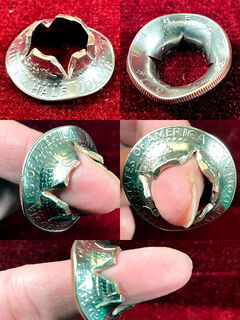
For a trick to be new, it needs to have changed two of the three of these. I think that’s a good baseline, however things definitely can get murky. Let’s talk about David Roth’s Karate Coin trick. The effect is that you throw a coin in the air and as it falls, you stab your finger through it, leaving it impaled on your finger.
The original version used a coin that had a hole punched out in it. Then at some point Gary Oulette put out the New Karate Coin that hand a coin that hand the center that looked like someone had shot a bullet through it. This only changed the prop and very slightly, the method and routine are unchanged. I will say that this prop is an improvement on the original coin used in the Roth routine, which was simply a coin with hole in it. At the end of the original trick you end up with a coin that magically has no center. The New Karate Coin addresses this, but I’m not sure it makes it a new trick. I guess it’s more like a new prop for an existing trick?
Now, let’s get to another version of the trick which is Doug Bennett’s Lickity Split. The effect and method are the same, the prop has changed. Here’s what it looks like:
Is this a new trick because they coin has been impaled sideways, or an new prop for an existing trick?
Honestly I don’t know the answer, I think Doug’s version is very slightly a different trick than Gary’s version. It’s very slight, like you would add a word or two to the description, but don’t think it makes it a new trick.
All of that said, I personally think that both of the versions of the Karate Coin are improvements over the original and have merit, I’m just not sure how to categorize them.
The sound guy is late getting to my stage, so I took a picture of my audio set up, just waiting for the XLR cords to plug into their PA.
I use three channels on the soundboard. One is for a handheld mic, the next is for my headset mic and the final is for my music.
Here’s a breakdown of the gear that I use: Sennheiser G4 camera mount wireless mic packs. Mogan headset mic (not shown) Shure SM58S handheld mic LTI laptop di box MediaStar Iphone 7 with showcues Lightning to USB adapter
That’s what I use for my audio.
One of the important things is the handheld mic that has an on/off switch. The reason for that is so the sound person can leave that channel on during the show, and I flip it on or off on the mic. If it doesn’t have a switch, the sound person will mute it on the board when it’s not in use, then have to turn it on when it is. That can give a bit of lag where they have to realize it needs to be on and then physically have to turn it on. I don’t like that, I prefer the mic to be on when I need it to, and to avoid the awkward moment of someone talking into a mic that’s muted.
When I was a teenager I came across a copy of Michael Skinner’s Intimate Magic book. In it he teaches his legendary Ball and Vase routine. Basically it’s uses the basic ball and vase trick that comes in most beginners magic kits and turns it into a solid magic routine.
Then there’s Mike Gallo’s The Ball and Vase routine, which I think I’ve encountered decades ago, but never really did. I recently found the set for the trick with instructions and learned it.
This trick is fun to do, and I think it’s better than the original Skinner version of the trick. With it having no gimmicks aside from an extra ball, it’s really practical. The only problem for me is that it doesn’t quite fit my close up performing style. also it requires a table, and all of my close up had to be able to be done without a table. Sometimes the non-tabled version of the stuff I do will lack a phase or uses the audience’s hands as a makeshift table. Unfortunately, neither of these is an option for that.
Recently my wife and I went to a concert in the park in the town we live in.
The thing that drew my eye was that the band had a guitar case open for tips.
Personally I think this is tacky. I know what things like concerts in the park pay and they don’t need the tips. Watching the show, the amount of tips they got was negligible, when split over 4 people, maybe $15 bucks per person. Yeah, I get that that’s gas money…or you could charge what you need to make for the gig!
Another option would be to get some merch, sell stickers, CD’s or whatever.
How does this apply to magic? Simple, if you’re getting paid, don’t solicit tips.