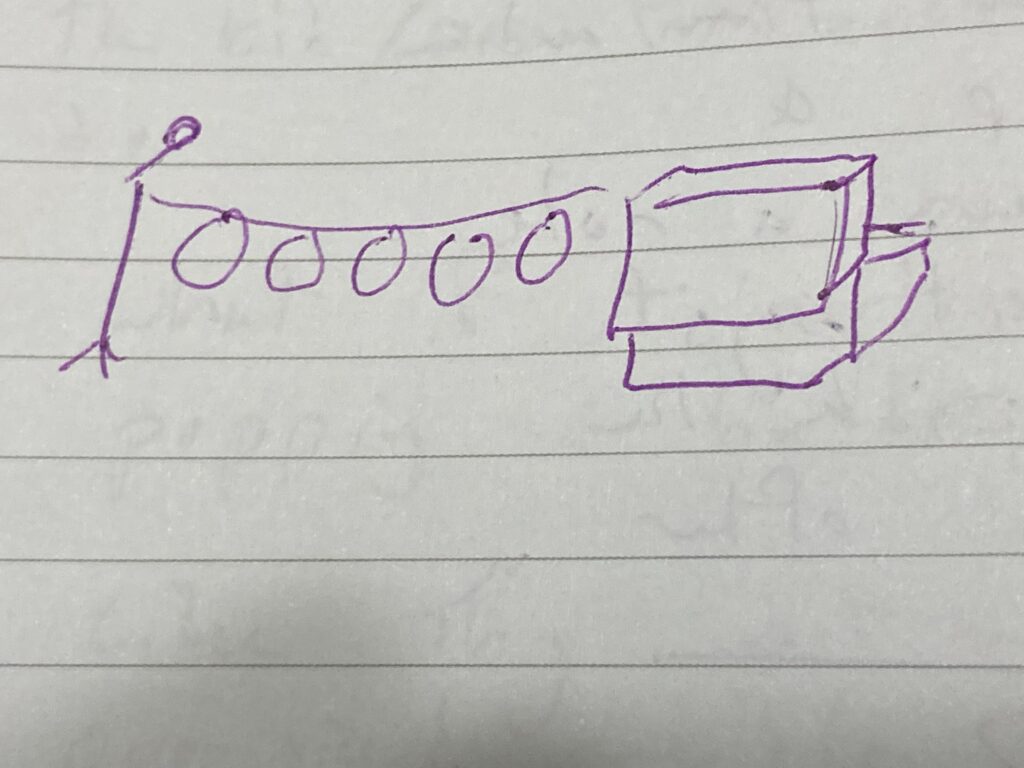
I don’t know why, but I’ve been fascinated by the Phoenix Ace move. I don’t know the official name of the move but this is the one where you have a multiple cards held as one and you palm off the stack leaving one card visible. I think it’s really more of a stage more, but I’m trying to come up with uses for it where you’re palming off of the deck.
One I’m playing with uses an outjogged double card that’s in the middle of the deck. Another one is this one below:
I don’t think this is something I’d ever really do, but it’s fun to play with. I think that maybe if I keep playing, something useful will happen with the move.
Over the last month or so I’ve been trying to get through the book King of Conjurers: Memoirs of Robert-Houdin. This is the biography of Robert-Houdin and for me this is a hard read. It’s probably that it was translated from French and it’s not the best translation is what’s making it a hard read.
It’s an interesting book and one that I feel I should read at some point as everyone loves to quote Robert-Houdin as saying, “…a magician is an actor playing the part of a magician…”
While reading the book, I found this advice (bottom paragraph) about working slowly:
I think he’s right in many instances, but not 100% of the time. Yes, working slowing has it’s place, and most magicians could benefit by working a little bit slower. Someone like Hans Klok whose style working fast works for him.
I’m heading out to a show in a bit and I’m going to try to slow it down a bit…
Last night I went out to see the band The Interrupters and one thing I noticed was that they use a lot of things to tell the audience what they want them to do. This is something that in my show I try, but subtly. After watching this show, it made me realize that asking an audience to do something isn’t bad. It can be repetitive, but not necessarily bad.
Something like telling the audience how to respond when a trick happens is effective, because sometimes they don’t know how to respond. If you want people to clap along to a song, you need to tell them.
I need to reevaluate my show and look at places where I’m not getting the desired audience response and try to find spots where I can tell the audience what to do!
One thing about performing outdoors is that the weather can make pulling a crowd very difficult. Last week at a fair, on Sunday it rained hard all day and attendance was really low during the day. I had the last show of the night and my show started an hour before the fair closed, so there was literally no one on the fairgrounds!
The picture above was taken from the stage about 5 minutes before my show’s start time. The challenge is what do you do? I probably could have called off the show and the fair would have been OK with that. Personally I will stand on stage and talk for however long my show is supposed to last. I can usually make something happen, but I wasn’t optimistic about a show happening.
Right after show start time I was on the mic working on jokes, and two people walked by and I started talking to them and got them to sit down and did some informal magic for them from the stage.
At this point with less than an hour left in the fair and a break in the rain, some other people started to venture out of the buildings, and about 15 mins into my show I actually had a crowd!
It wasn’t the biggest crowd I’ve ever had, but I did end up getting about 90% of people who walked by my show to join the crowd, so that’s HUGE!
The moral of this story is always work hard on stage and don’t “phone it in”.
For years I’ve been interested in the book Body Magic by John Fisher. I like the idea of a book of tricks that just use your body, however the older edition when they popped up was priced usually at $100+ and I wasn’t that curious about the contents.
It was republished a while ago and I finally picked up a copy:
I’ve only flipped through the book and it’s not quite what I expected. There’s more than physical magic, there’s some things like mnemonics in there and some math stuff. I’m not saying that those are bad things, but expected it to be all physical, not mental stuff.
I’ll probably have a different opinion once I actually read it!
Recently I saw a show and a performer did a trick with a Rubik’s Cube. The trick was good, the routine was good, but there was a bump in the road. The person that was brought onstage knew how to do a Rubik’s Cube and that led to some awkward moments where the performer didn’t really know what to do.
The performer handed a mixed cube to the person from the audience and asked them if they could solve it. The person from the audience said, “YES” and started to speed solve it. The performer stopped them from doing the solve and moved on with the routine.
Personally I think the performer missed a great moment where the person from the audience could have really shined! Let them have their moment, and celebrate it! Once they get the glory you can move on with the routine. Being a generous performer, you get all credit for what the person from the audience does, plus the credit for whatever it is that you do!
One of the thing that drives me nuts on social media are magicians complaining about people asking them to do gigs for “exposure”. The people are super offended that someone asks, however that’s the way that charities operate, by donations. You are a business, and they ask businesses for donations, you should be flattered that they consider you a business!
I will agree that the promise of exposure is usually an empty promise as they think you’ll do all of the work to get the exposure. It shouldn’t have to be that way and it doesn’t have to be.
A long time ago I did an “exposure gig” and was passing out my cards, etc and after the gig they had a meal for me. It was the volunteer meal, not what people attending the gig were served. Everyone was eating steak and salmon and they gave me a ham sandwich and bag of chips. That’s when I decided that was never going to happen again.
The next day I wrote up a document and converted it to a .pdf that details exactly what the charity has to do if they want me for free…but beyond that, how they have to treat me.
Now when they call me for “exposure gigs” I tell them that I would love to help them out and I’ll send them a .pdf to see if we’re a good fit. The majority of the charities that contact me after seeing the .pdf tell me they can’t do what I’m asking for, and that’s fine. It’s putting into their head what exposure actually is. The few that accept my terms are exposure gigs where I actually get exposure and a ton of it that translates into paid gigs!!
Instead of being offended, spend an hour and write up what you think is a fair trade in terms of promotion. Then when they ask, say “yes”…on your terms!
-Louie
Want the Charity .PDF? Save yourself some time and use the one page .pdf that has my expectations for “exposure” gigs as a starting point!
For $5 I’ll email you my expectations .pdf and you can use that as the template for what you send out to help you survive exposure gigs!
Frequently in magic groups on Facebook someone will say they want to sell a trick and want advice. There’s a lot of bad advice (in my opinion) that is then given. One of the things is to go straight to Penguin Magic with the idea, however they usually won’t produce your idea, you’ll need to make it and send it to them. Last time I looked into it, their terms weren’t the most friendly to the creator. You were making product, sending it to them and they would pay you as sold.
A better approach would be to go to Murphy’s Magic and pitch the idea. If they like it and want some of it, they’ll be a couple of options, like you could sell them the idea, they could help you with manufacturing, or you could just sell them the finished product.
Of course by that point you should have done your homework and know how much it costs you per unit to make, and how long it takes you to make them in quantity. Also if you’re self producing, you’ll need to be able to fund making the first batch of your trick as most accounts are on NET 30, so you won’t get paid for a month.
Then you need all of your collateral, so ad copy, art, instructions, etc. Usually you’ll have some of this done before you pitch the idea, but not always. For example my Take Out Box was something that was in my show for a while, so I had tons of video of it that I could pitch it with. Once I had interest, then I went out and started getting all of the other stuff in line.
Personally I’ve made a choice to not mass market thru big magic distributers for most of my products. My reasoning is that going direct thru magic shops I’m able to make more per unit and since I hand make almost everything I sell, it makes more sense to sell a few less units, but make more per unit!
When I was in the Detroit area last week I went to the Henry Ford Museum and there’s the original Oscar Mayer Wiener Mobile there.
This car is super cool, and I’d be excited to see this version on the road now, but they kept improving it and it get better and better ever few years.
I’m sure my show is “good enough” but I try to keep improving. Last week I added a joke to a routine that I’ve been doing for over 15 years! I’ve also cut a lot of bits that have aged out of the routine over the years.
I never think of any routine as finished, there’s always things to add/cut.
One of the things that I noticed in the pictures of me performing at the Oddities and Curiosities Expo was how small I looked on that stage!
I’m guessing the stage was 16 -20 feet wide by 8 feet deep. That isn’t that big, I’ve definitely worked on stages that size or bigger. However the pictures I’ve seen really remind me how much bigger props matter.
Yes, you can fill the stage with personality, but you if you’re presenting a magic show and they can’t see the magic, your personality will only carry it soo far. At some point you’ll stop being a magician and become a stand up comic or monologist.