Here’s a trick from the book Ginosko. It’s called Blackjack for Brother John and it’s a packet trick that has a story that has a very 1980’s packet trick feel to it. That’s not a bad thing, but it feels like something Nick Trost or Emerson and West would have put out with novelty cards.
It’s a great story packet trick, and you only need four cards to do it with. That makes it impromptu, just pull the cards from the pack and you’re good to go. I would probably palm them out and remove the cards from my pocket, as you start by showing four of the same jack.
Last month I was at an AirBnB. I was sharing the house with a bunch of the other performers at the Ohio State Fair. Behind the painting on the walls we found strange “Alien Postcards” from October of 2016
The first one was behind the paint of an apple, then we started searching the AirBnb and found the second one inside of a picture of Groucho!
OK, so that’s what happened in real life, now how do I turn it into a bit for my show?
I started by telling the story.
I’m staying at an AirBnB with some amazing performing, acrobats, jugglers…and a mime. He’s not even performing here. But that guy never shuts up.
One night I was looking behind the paintings and found some “alien postcards”. When I mentioned it to my wife on the phone she said, “why were you looking behind the paintings”, not “what’s an alien postcard.
I was looking for my keys.
Here are the postcards. On the front they say, “Materials deployed for reflective and connective purposes”. On the back this one says, “Thank you for signaling that you are anticipating my transmission”.
The other says, “Thank you for sending the signal that you are invested in receiving this signal…You’re going to die…JK, LOL LOL…but seriously, we’re watching…no parties!”
So now I’m searching the AirBnB for cameras, and you know what I found? My KEYS!
That’s the story. I’ve embellished it a little bit added some punchlines. The nice thing about being in a house with other performers is that we could workshop the story a little bit.
The next step is going to be figuring out what to do with this. Is it a little stand alone bit, or is it a segue to something else. Like a trick with a key and/or postcards?
One idea is to have borrow a key, cover it up with a handkerchief and have that held by someone in the audience. Then 5 postcards are shown, each has a place where I’ve found my keys. These could be funny places, like in pie, or whatever. One is selected, and the key disappears and ends up inside of the postcard.
The last couple of weeks I started working on a Balls In Hat routine that I learned from Jimmy Talksalot. It starts with two in the hand and one in the pocket and ends with a nine balls coming out of your hat! It’s a really solid routine!
You can see parts of it in this reel from the fair I was performing at:
There’s a ton of great info and routines on Jimmy’s Substack. There’s free info as well as stuff for subscribers. It’s $8 a month to subscribe and totally worth it to read and watch all the content he has up there. The magic and essays are focused on street magic, but there’s a lot to be learned there if you don’t do street magic.
I’m still working on the Linking Pin and Thumb Tie routine and it’s slowly making progress. I started this in mid-February, however I’ve only done it about 30 times. For me that’s a pretty fresh routine. I haven’t figured out where all the moments are.
I wrote a couple of new jokes and changed it so there were three magic effects in the routine instead of three and took it out to an open mic the other night. It can be challenging at a bar open mic when it’s in a big room and there are 13 people there and only two of them are actual audience members, the rest are comics waiting to do there time onstage. In my opinion most bar open mics are to figure out how to do something onstage and just work that part out, you’re not there to try to have your set crush. Yes, you should try and ideally it’ll crush, but you should be bringing things that need work, not polished material.
Here’s bad video with bad audio of the trick:
The trick went well, but more importantly the new jokes worked and I added another penetration, so there are four instead of three in the in the routine. There’s actually normally one more at the end that I didn’t do because I “got the light” and had to wrap up.
The intro to the trick I think needs to be tightened up and be a bit more clear. That comes with time and rewriting and reworking. I think by the end of the summer this will be a strong piece in the show!
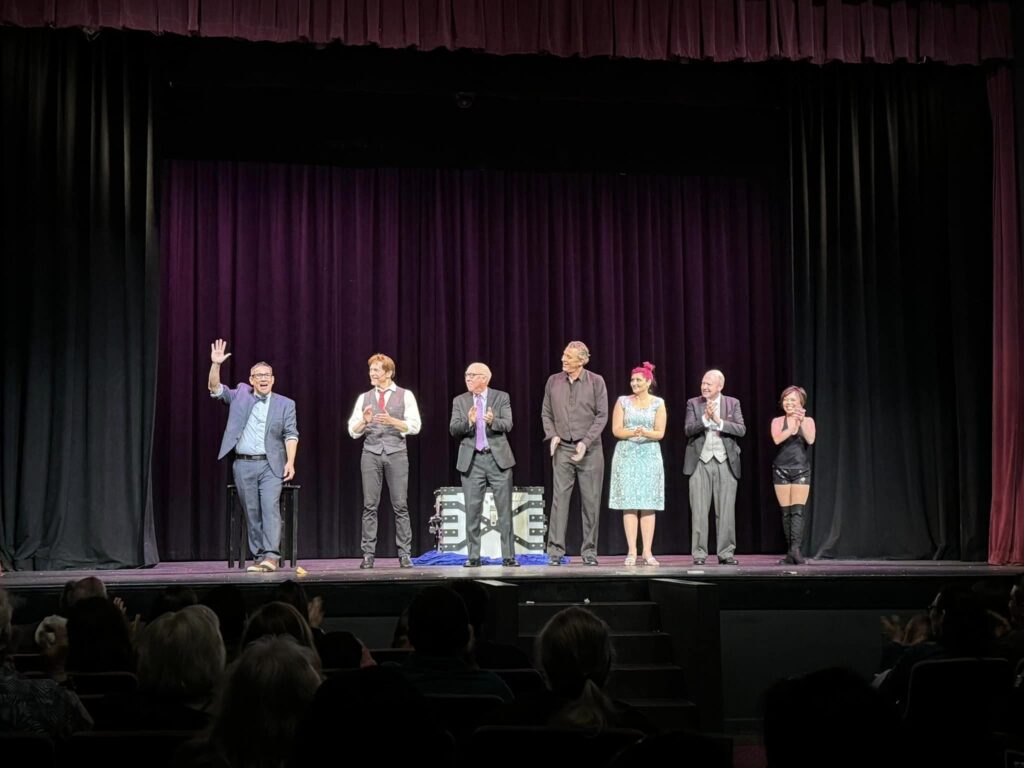
A few weeks ago I performed in a show called Poof Too! in Hermosa Beach, CA. This is show with stage magicians and one close up magician. I was the MC in the show and had a performance spot in the show.
It was great performing with David Zirbel, Simone Turkington, Mark Furey, Shawn McMaster and Alexander Great & Pamela! Everyone was super professional and great to deal with as an MC and fun to hang out with! When I was approached to be in this show by Dennis Forel, the first thing I asked was “is it a fun show”, not how much does it pay. Personally a fun show is more important to me than money (don’t get me wrong, I still gotta pay the bills).
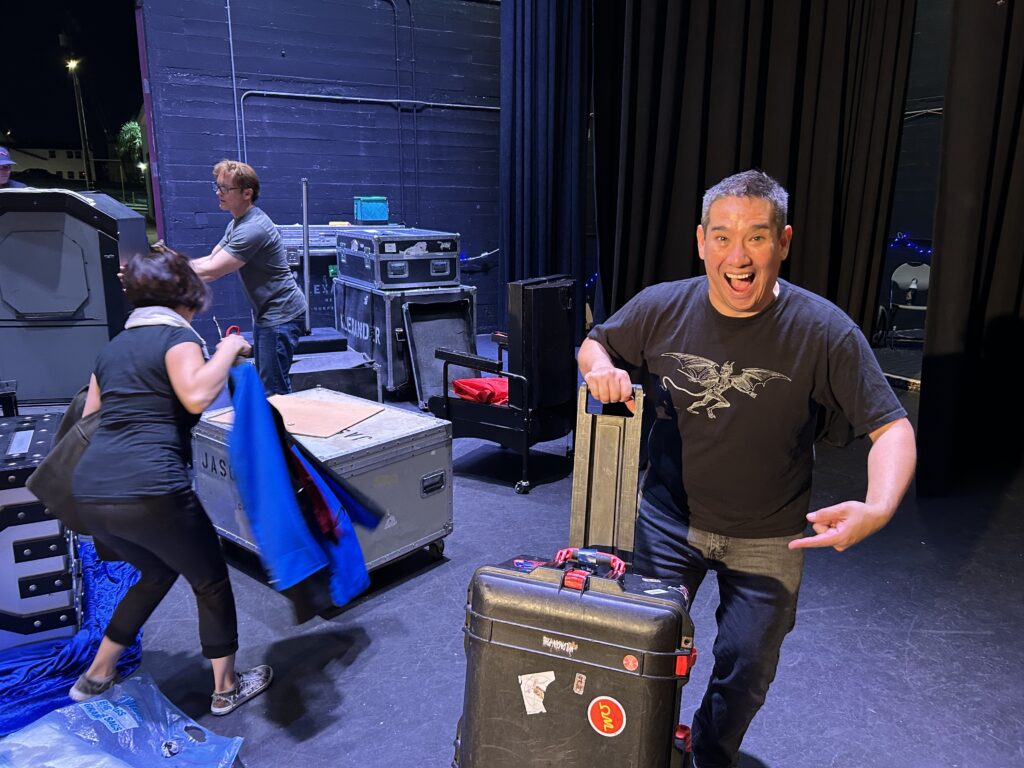
I’d been doing comedy gigs before this one and in a comedy club I have a lot of gear. However a show where the illusionist is packing up crates of huge illusions, and I just wheel my case out, I feel like I have nothing!
I love performing with other magic acts. One thing I did years ago (close to two decades ago) was to start to work on a show that I can do when I’m sharing the stage with other magicians and not have to really worry about duplication. Sure there will always be things that no matter how different they will seem the same to an audience. A rope trick will usually feel like almost any other rope trick no matter how different it is. For me, just trying to have unique or less common tricks in the show makes my show much more versatile.
I was browsing through reddit and came across a post with an picture of an old bread slicer:
I immediately made a connection to a prop that I assumed was simply a strange magic prop. The bread slicer resembles Lester Lake’s Disceto that was put out by Abbott’s Magic!
A quick internet search shows that bread slicing machines were invented in the 1910’s and Disecto was put out in 1942. It’s entirely possibly that the Disecto was trying to mimic a common object.
Crazy.
It’s also interesting that if it’s supposed to be a bread slicer, that people still use a prop that mimics something that used to be something people were familiar with, but hasn’t been common in my lifetime.
This is why it’s important to look at our props or lines and take out things that people aren’t familiar with. A good example of this is when I hear a comedy magician use a line about someone’s picture in the post office. That’s something that really hasn’t existed in my lifetime. I’ve encountered it once in my life about 10 years ago in a small town. I do know the reference from Bugs Bunny cartoons, but those were made decades before I was born. Because of this I don’t find the “post office joke” funny or something I can relate to. Look at your show and remove old references whether they are verbal or physical objects.
Here’s a packet trick from the 1980’s that I came across.
I think Nick Trost’s Mexican Monte is a pretty solid routine. Here’s me doing the routine and my thought on how to improve it:
It’s really a small change at the end, and I think Nick really nailed it with this one. I’d change the patter, but it’s good and worth checking out if you find one at a magic swap meet!
I do a card trick that I call “choices” where the audience narrows down cards by eliminating them until there is one card left and that matched a prediction that I have made. The overall presentation is about me making bad choices in life, and honestly from a presentation standpoint doesn’t need to be a card trick, it could literally be anything that’s narrowed down.
Since it doesn’t need to be playing cards, I was trying to think of what I could replace them with and decided to use postcards.
By switching props from jumbo cards to slightly smaller postcards I can add an additional way to show the postcards all to be different. I should note this routine at its bones is essentially Al Koran’s 5 Star Miracle. One of the things that I added to the postcards was to cut them short, so I can do a riffle display to show them all different.
This little bit allows me to show them a bit more freely. The postcards are soo visually different that if I spread them all in a face, I think the repeating pattern would be more obvious than with playing cards.
Now I need to make a choice and figure out if I want to keep the presentation as is, or try to write something new.
Every year I post this trick on Thanksgiving. It’s a good example of adding a theme to a trick that already exists.
The base routine was something that I had read in a Jim Steinmeyer book. For holidays, look at what you already do and look for logical connections then make the trick!
There’s a common street performer “trick” to unite the audience and it’s call and response. If you’re not familiar with what that is, it’s typically used when the performer says something like, “Would you like to see another trick…say YES!” then the audience responds by saying YES.
This an effective technique uniting the audience, they’re doing something together and it helps them start to become an audience and not just a bunch of individuals. This is especially important for an outdoor show where you may have a transient audience. Another thing it does is forces the audience to invest energy into the show. The more they are invested in the show, the more they will stay and watch the show…and like it!
I like the technique, but I personally don’t like how most people do it, they’re doing it simply because it’s effective. There’s no real purpose besides filling a hole in the show because you don’t have a segue to the next routine.
When I use it in my show, I give it a bit of meaning. In my Drawing in Ball of Yarn routine, I do it to have the audience vote on whether I should buy the person’s drawing. It accomplishes the same thing and just telling the audience to say “yes”, in fact it actually moves the show forward!
With a little bit of thought, you can find ways to use this technique to move the show forward, instead of a hack bit.