Here’s the first videos of what I’m calling A Toast To Nick Trost. These are videos where I do a trick from The Card Magic of Nick Trost as written, and then I do a variation of the trick that I’ve come up with. Usually this is just adding a move or theme that didn’t exist when Nick came up with the trick.
Here’s Nick’s Observation Test:
And here’s my updated version of the trick:
Here’s a quick tutorial of my version:
I think what I like about my update is the final display of the cards face up, then flipping the cards face down to reveal the color change!
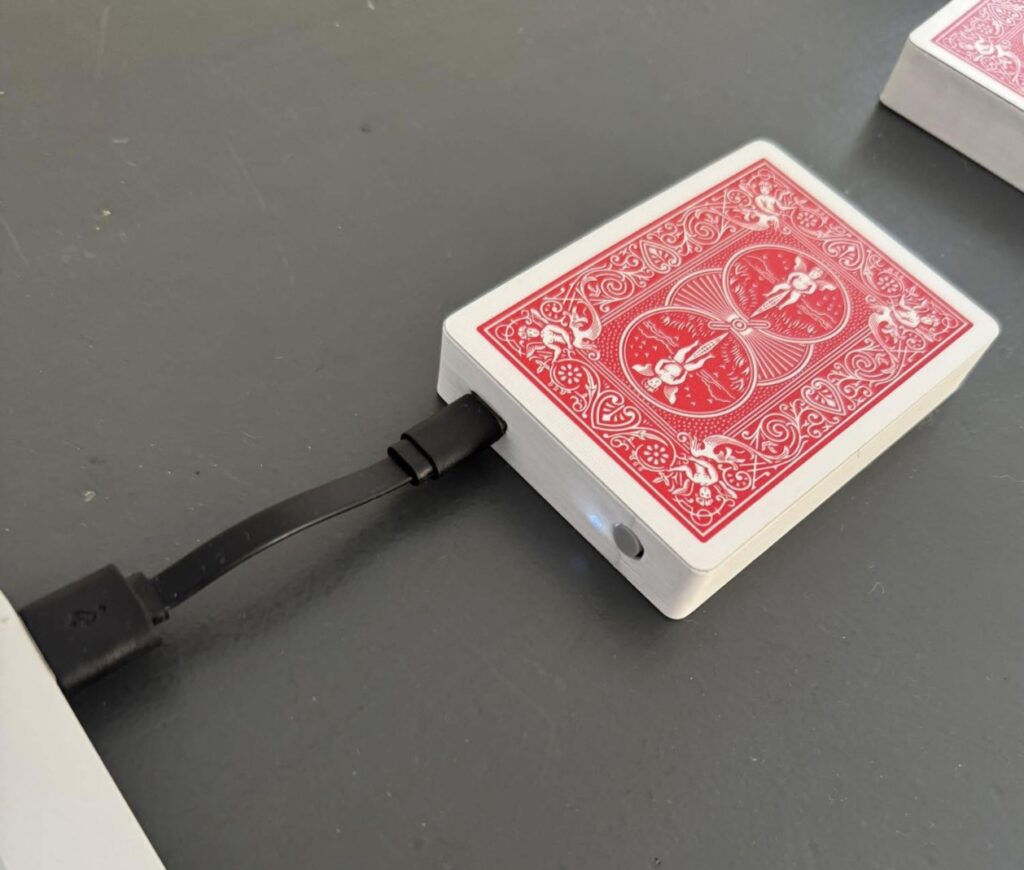
Are we at the point where this is modern card magic:
I’m trying to decide whether I’m a grumpy old man afraid of change, or if something like this is a step in the wrong direction. Sure, you can do a cool trick with this deck, but is this what card magic needs?
Are we at a point where someone asks you to show them a card trick and you can’t because your deck isn’t charged?
Nick Trost was a BEAST! He was a pioneer of modern card magic. I’m rereading The Card Magic of Nick Trost. One of the things that I’m doing is learning the original routine and then trying to update or add something to each routine. I’m only four tricks into the book, which has 122 effects!!!
The second trick in the book is the 7 Card Count and after Nick’s original routine there’s a Rollins-Hamman-Longe variation of it. The first trick is good, but this version is better!
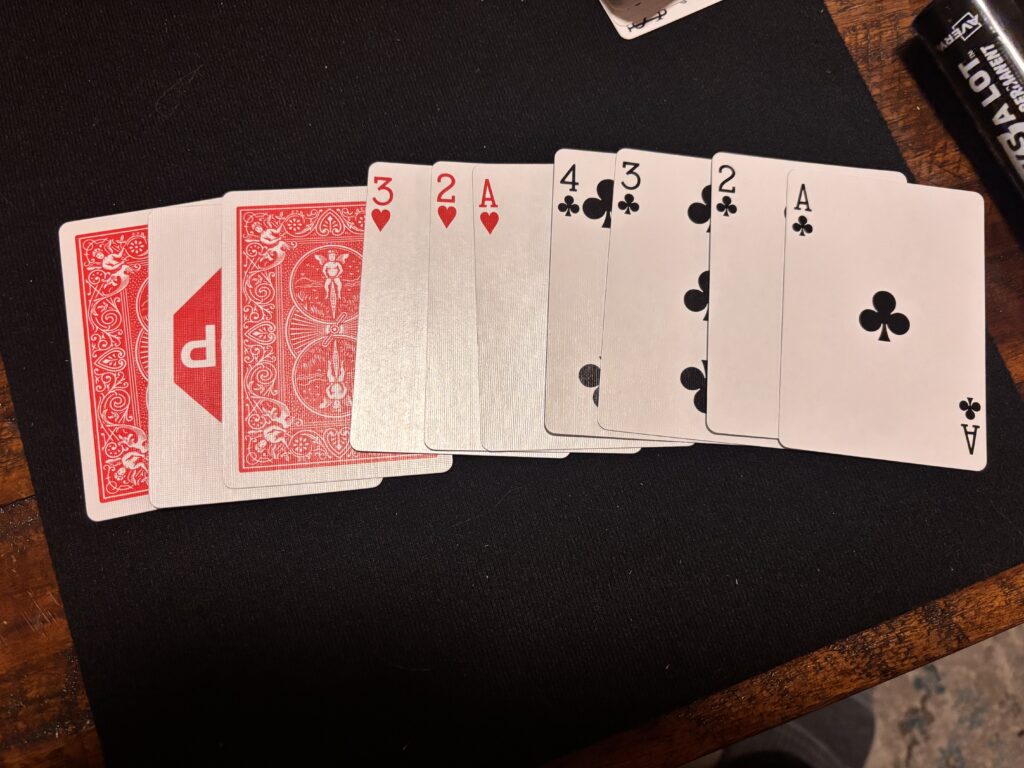
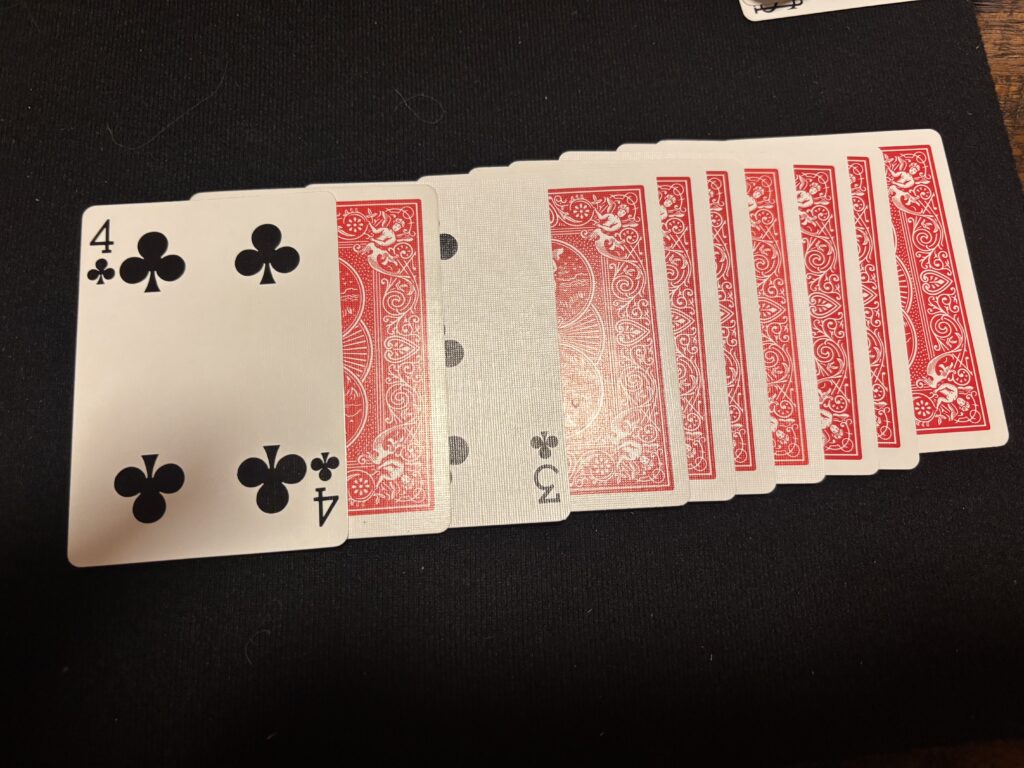
I did come up with a variation on the original, but also a variation on the variation! If you have the book, it’s the exact same set up and routine, except these are the card, and the final display is slightly different.
The card second to the left has a picture of a stop sign, but it could just be a blank card that says “stop”.
What this setup does is change it so each card that’s eliminated reappears in the packet. Also, I like the 1-2-3 of each color to sell the premise of only using three cards of each color.
Right before the final display, you’ll have three face up black cards, and you’d normally put them on the bottom, in this case put them face down on top. Next, pull the three red cards one at a time off the bottom and deal them face up on the table. Then deal the top three cards (black) face up onto the table, and that will leave you with the final (stop) card face down in your hand. Say, “This never works, we might as well stop now” and then reveal the final card!
The only downside is this trick is no longer impromptu.
I have a bunch of cards from a FA-KO deck, but I don’t have the booklet. One of the cards has a picture of a stop sign on it, and I started playing with it and this is what I came up with:
It’s pretty basic; the first is a second deal, and the second is the drop force.
I’m just “meh” at a second deal; if there’s no heat, it’s fine. One thing I noticed that’s a tell with most magicians that they’re not dealing the top card is when the hand holding the deck swings back and forth. I think that movement is magician’s thinking: “the big motion hides the smaller motion,” and I guess it does, but it doesn’t look right. I’ve noticed that when I try to keep my hand holding the deck static, my second deal flies by more magicians than when it moves.
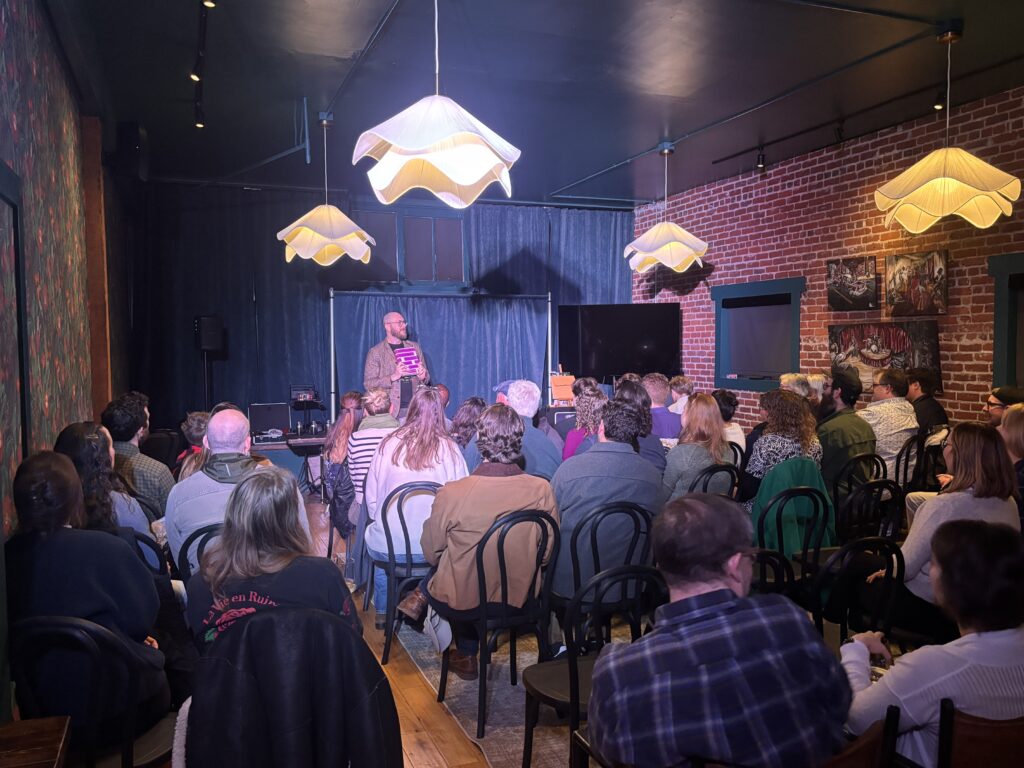
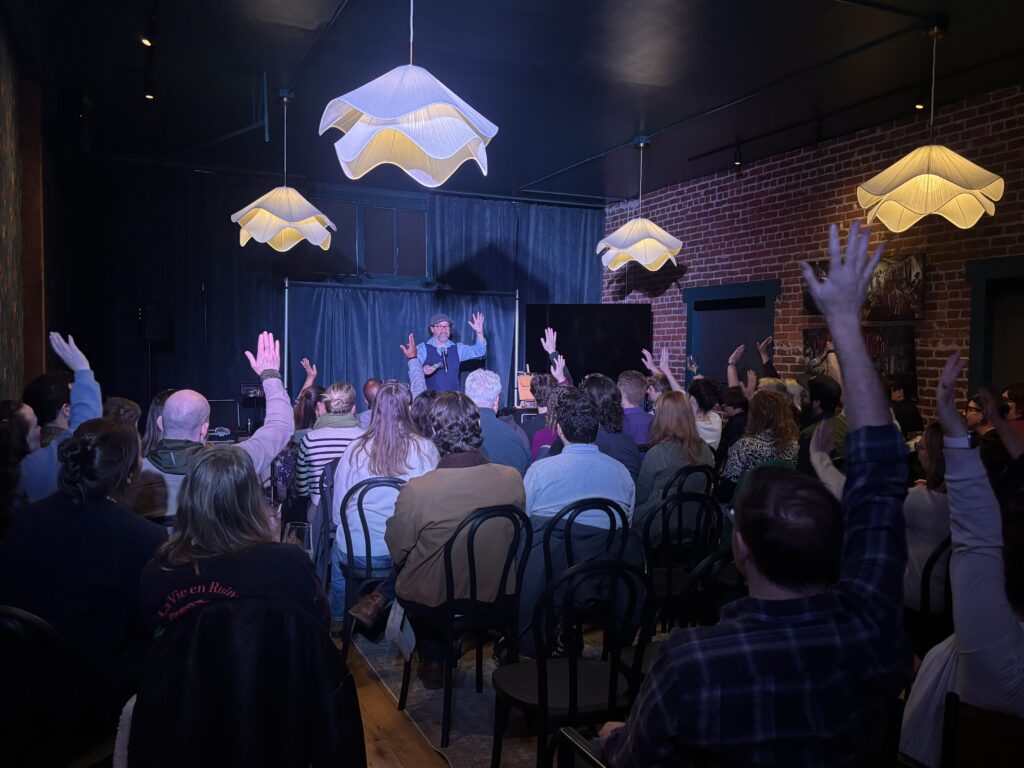
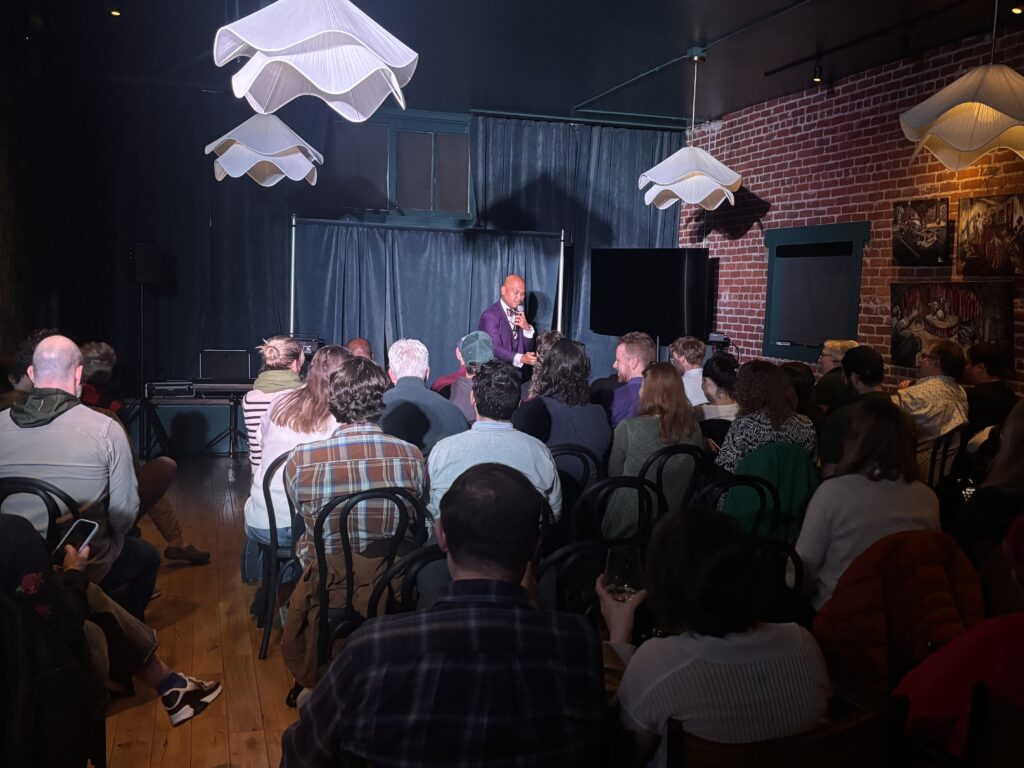
A couple of nights ago, I went out to see Magic Uncorked in Portland, OR. This show happens every few months at a wine bar called Ora et Labora. It has close-up magic in the bar, then a parlor-style show in the event space.
Unfortunately, I didn’t really get to see any of the close-up magic as I rolled in a bit late. I thought it started at 7 pm, not 6 pm, however Jacob Grier showed me a cool card trick in the hands triumph as everyone was moving from the bar to the event space.
The show is hosted by Dave Gregory, who, along with his wife, owns the wine bar. Dave is a great host, and does a trick to open the show and after intermission.
The first half of the show is done by John Stevens. John does a solid show and one of the highlights for me is the version of 100th Monkey he did! Most of the versions of it that I had previously seen fell flat, but not this one! The only other version I’ve seen was the one Darren Brown did at the Cort Theater on Broadway.
This month’s show had Jonathan Molo as the headliner. I’d briefly met Jonathan somewhere in CA (probably Fresno) a few years ago, so I was excited to see his show. Jonathan puts on a fun, high-energy show. The show’s frame is really his family, which is a super relatable throughline!
One thing I noticed was that both John and Jonathan use handheld microphones rather than headsets. More and more performers are moving away from the headset mics. It takes a bit more skill to use a handheld mic as a magician, however, it allows you to have conversations with people onstage and easily get them mic’d.
The magic review site Magic Orthodoxy has a blog about getting started performing magic for people you don’t know. It’s called Talking to Strangers and I was a guest on it!
A while ago, I made a set of natural shells and then made a silicone mold of them. I used that mold to make a bunch of resin shells for a shell game workshop. One of those resin shells recently got 3d scanned and I’ve started printing them!
These are a great beginner set or set to throw in your backpack to carry around and not beat up a nicer set.
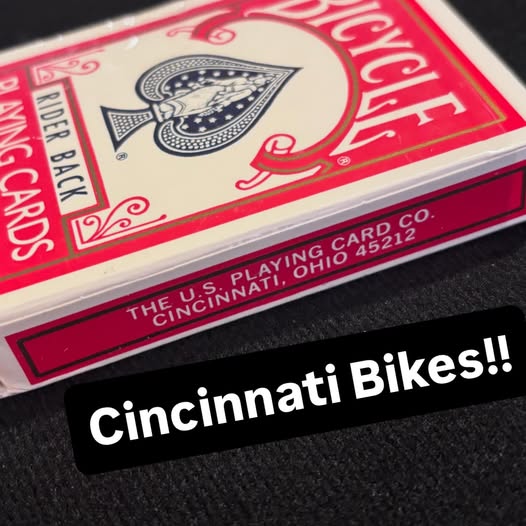
My favorite playing cards are Old Stock Bicycle Playing Cards from Cincinnati. As I travel I find sealed decks in junk shops and always try to buy them. Sometimes people want way to much for them, but usually I get them for about $2 a deck, and never pay more than $3. Over the years I’ve filled a bin of them!
These decks faro beautifully out of the box! They also last longer than the Bicycle Cards that are currently sold. I don’t use these for shows, they are for practice / play for me. When I have a good deck, I’m more motivated to practice than with a deck that’s inferior.
For shows I use new decks, these are good for about an hour (or one set), which is fine because so many cards will get destroyed in that set that I replace the deck each set.
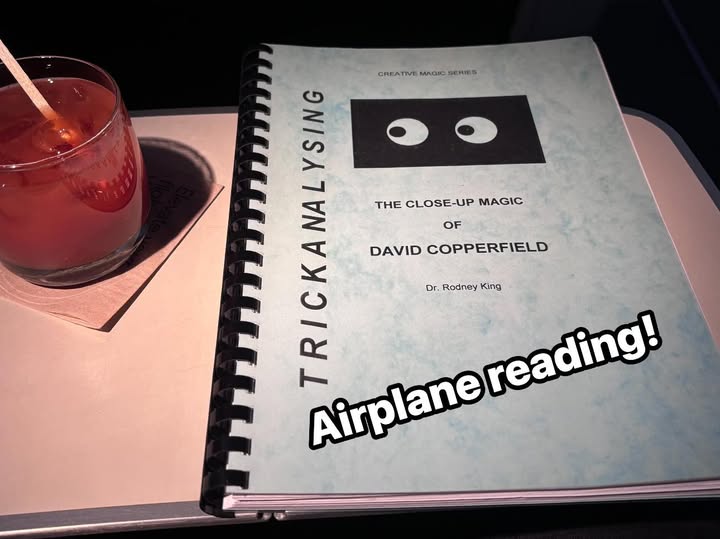
On a flight I read the book Trickanalysing The Magic of David Copperfield. This is a book from 1997 that goes through 20 of David Copperfield’s close up magic routines that he’s done on TV. This book is about the theatrical elements in the routines, not about specific methods.
The first 2/3’s of the book is the author going through and breaking down what’s theatrically happening in the routines. The final third of the book digs more into the author’s definitions of the theatrical devices used and how they could be applied to your magic. Then at the end, there are some worksheets for you to go through your magic and see what you’re using, or could be using.
Honestly, I don’t know how I feel about this book. I didn’t dislike it, however, I’m not in love with it. It was definitely interesting, but I’m not sure how much of the Trickanalysing system that I’ll personally be using. It is always neat to read about someone’s system.