This episode we’re joined by the multi talented Kiki Hood! You know Kiki from the Fremont Philharmonic Orchestra which is one of the Moisture Festival’s show bands.
This week Kiki tells us about locating rare books, how to super charge a kazoo and what a Panto is! This is a super fun interview that you’ll love!
Today I’m starting day four of the doing the new school assembly show. The show is called Incredible Idioms and is at, language and literacy themed shows. This is very different from themed shows that I’ve done in the past. This one has a flow all the way through it. The way it’s written, I can’t easily swap out routines in the show. I really like the way it flows.
In the past with school assemblies, I’ve always had a section where I explain the rules for the audience. This show doesn’t have that, and so far the kids are behaving really well. I think I owe this to the scripting of the show and that there aren’t really any dead spots. There are slow spots, but not really any dead spots.
The warm up to the show is an alarm clock that I put a remote control into and it rings whenever I want it to. This prop is used as the warm up, a running gag and a trick in the show. The trick is that it vanished in a devil’s hank. In my test shows, that clock vanish really fell flat, and I felt that the audience knew the clock was in the hank. The first couple of days in the tour I really focused on making the vanish work for me. It turns out I wasn’t show the back of the hank after the vanish. Once I added showing the other side of the hank, the trick started to hit much harder.
That’s the fun of tours like the one I’m going, it gives you a lot of time to work out problems in the show.
There are two things that are surprising me about performing for kids on this tour. The first is the lack of rules that I have to go over and the second is that I’m not needing to coach applause. I don’t know if it’s me as a performer getting better, or if it’s them being used to watching TV shows where people applaud for variety acts.
I figured out that the first real magic trick in the show I do is a production of a tennis ball. If I display it and just freeze, they will clap. This is done with no coaching or bits that tell them how to respond. It’s kinda blowing my mind that they are doing it on their own.
I’m closing the show with the vanishing birdcage and I’m getting kids to jump up to their feet and clap…also without any coaching. I’m essentially getting partial standing ovations from kids at a school assembly. I will say that my routine for the vanishing birdcage is structured fairly well, with how it’s paced and with the music cues. Also unlike most vanishing cage routines, my has a reappearance. It’s just the bird that reappears, but it’s a release of the audience’s tension and gives them a moment where they know they are supposed to applaud. I will say it’s the structure of the routine and not the routine that is what’s getting the reactions. The routine is just okay.
I’m working on the routine this tour and it’s getting better, but still has a lot of work that needs to happen. Most of the new bits I’ve been trying have been falling flat. This is just a case of continuing to write and hopefully it will eventually stick.
Last night I reviewed the video of the first show of this tour and calculated my laughs per minute. I came in at 1.57 laughs per minute or about three laughs every too minutes. Normally my goal is about 3.5 LPM’s, however this show has more content than my standard magic and comedy show.
I think my short term goal is going to be two Laughs Per Minute, but ideally getting this close to three LPM’s.
If you’re a comedy magician and don’t know your laughs per minute, you need to know them. I’m always amazed by how many comedy acts I talk to and when I ask what their LPM’s are, they either don’t know or say a crazy number like 10. To put it in perspective a stand up comic is in the ballpark of 4-6 LPM’s, maybe as high as 8. You need to know the actual number that you’re getting. Once you know this, it allows you to improve.
The way to figure out your LPM’s is to record your show and count the laughs. Then divide the length of your show in minutes by the number of laughs and you get your LPM’s.
Another metric is “reactions per minute”, so this is more than just a laugh. It could be applause, the audience going whoa or whatever. Having a metric allows you to set a goal.
I started the tour on Monday and had to cancel all of Tuesday’s show because my radiator had a hole magically appear! I had to do some sweet talking to the mechanic in a small town to get him to fit me into his schedule. It helps that his grandchild was at my show, and liked the show.
I’ve often said that magic is problem solving, so is magic on the road. In my first show on this tour I use Phil Smith’s Quinta Force and did the very basic math incorrectly in my head and forced the wrong object. With some quick thinking and a solid foundation in magic and mentalism principles I was able to make the trick work and no one knew that I had majorly screwed up the trick!
The moral of today’s blog post is that you need to be flexible, not just in your magic show, but in life.
I’ve completed day one of the school assembly tour. The show went better than I expected. One way that I worked on the show was listening to recordings of it while I drove my car. This is a very effective way to learn a show. It’s also a great way to work on the show. While listening to the show you will hear bits where you need filler or it will spark ideas for bits.
After the first two shows, I learned that my audio needed some tweaking, it needed to be louder or quieter at different spots.
Another thing I’ve notice is that my style for school assembly shows has really changed. I’m lower energy, but still fairly energetic. I also am not doing rules for the kids and for two shows it seemed to work. We’ll see how it plays out in the long run.
I also noticed that I have two tricks that are virtually the same trick in the show. Both are essentially a one out of five prediction, but both are presented very differently and also 30 mins apart in the show. I don’t think anyone notices that they are the same effect.
I’m also thinking that next week I’ll be doing the show with just a hand held microphone and not a headset microphone. This will allow me to set up quicker, but also I need to keep up with my handheld microphone technique.
I took this tour to work on stuff and I’m definitely doing that! There’s only one trick in the show that I’ve done in a show before. -Louie
Today is the first day of the school assembly tour and the first full performances of my new show called Incredible Idioms. This show is themed about the language we use and it’s been a lot of fun to work on.
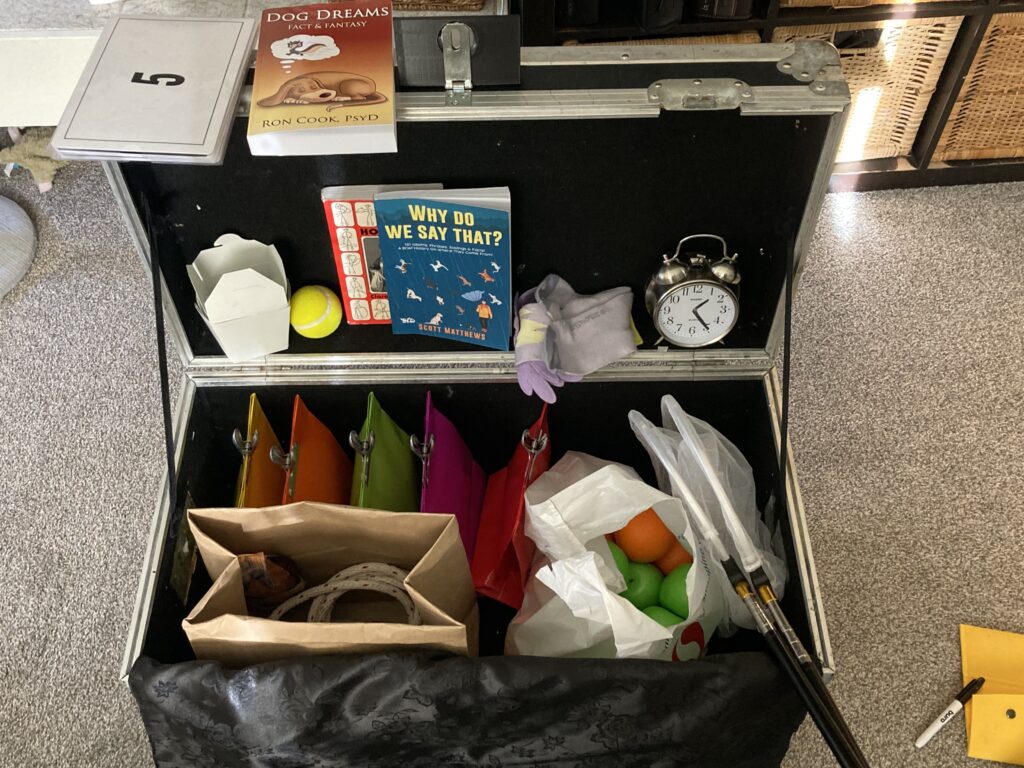
The whole show fits inside one case and here’s what it looks like:
Unfortunately it doesn’t really travel set up. It’d be nice to just open the case and go, but there’s a lot of crushable things in there AND that picture doesn’t show things like my mics and audio cables which need to travel in the case.
The show is going to probably go through a lot of changes over the month of performing it on this tour. This is where the work comes in. I need to record, at least audio record and hopefully video record as many shows as possible and review them as often as possible. This is how a show gets good in a short amount of time.
One thing I’m not is a huge magic collector. Sure, I have more stuff than what’s in my current show, but I don’t have a ton of stuff in bins that’s not used (there are a couple of bins, just not many).
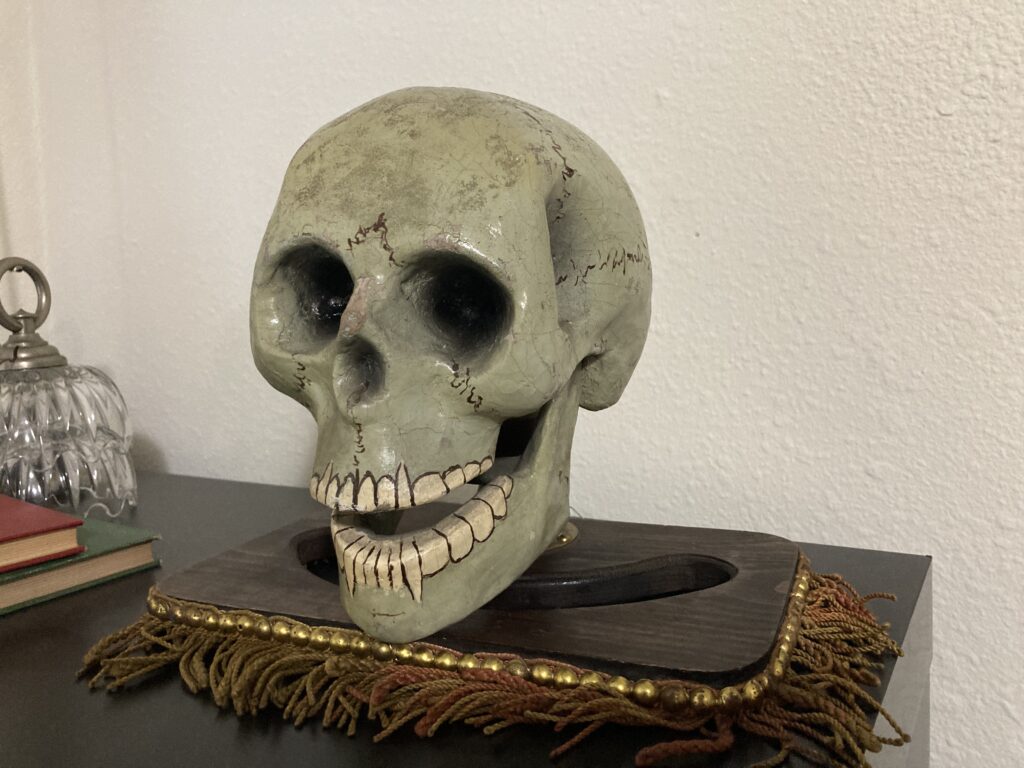
One of the things I’ve wanted for a while as a display piece is a talking skull. Not the more modern ones that look like they are made out of a plastic halloween skull, but an older paper mache one.
I got this one at a Potter and Potter auction for a price that I was willing to pay for it. It didn’t come with instructions, and luckily Abbott’s Magic Company sells them for $4. It’s super clever how the gimmick works, and I would have figured it out…eventually. I’m thinking I might change it to a remote control, so I can make it talk on the shelf in my office.
I like this on my shelf, and I’m glad I picked it up!
Over the summer I worked with a balloon show, and his show is a great illustration of why it’s important to use the stage. If you are standing in front of the stage, it does help you mentally with the energy exchange with you and the audience, however you sacrifice visibility.
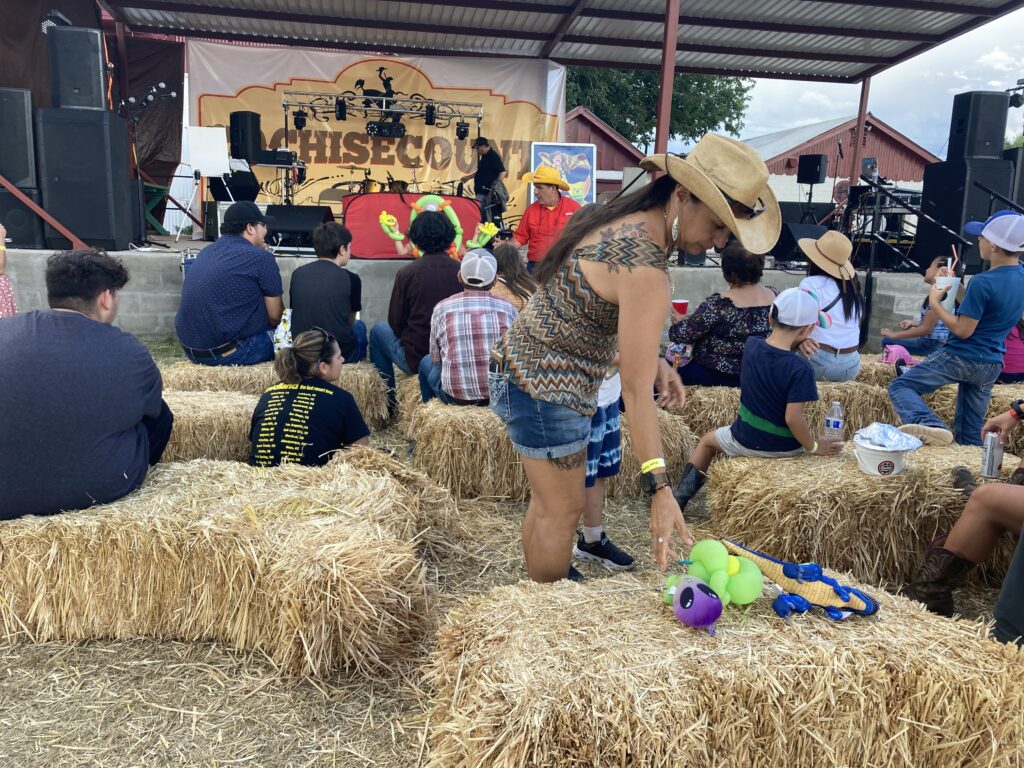
Here’s how the show looked from the 4th row at the audience’s eye level:
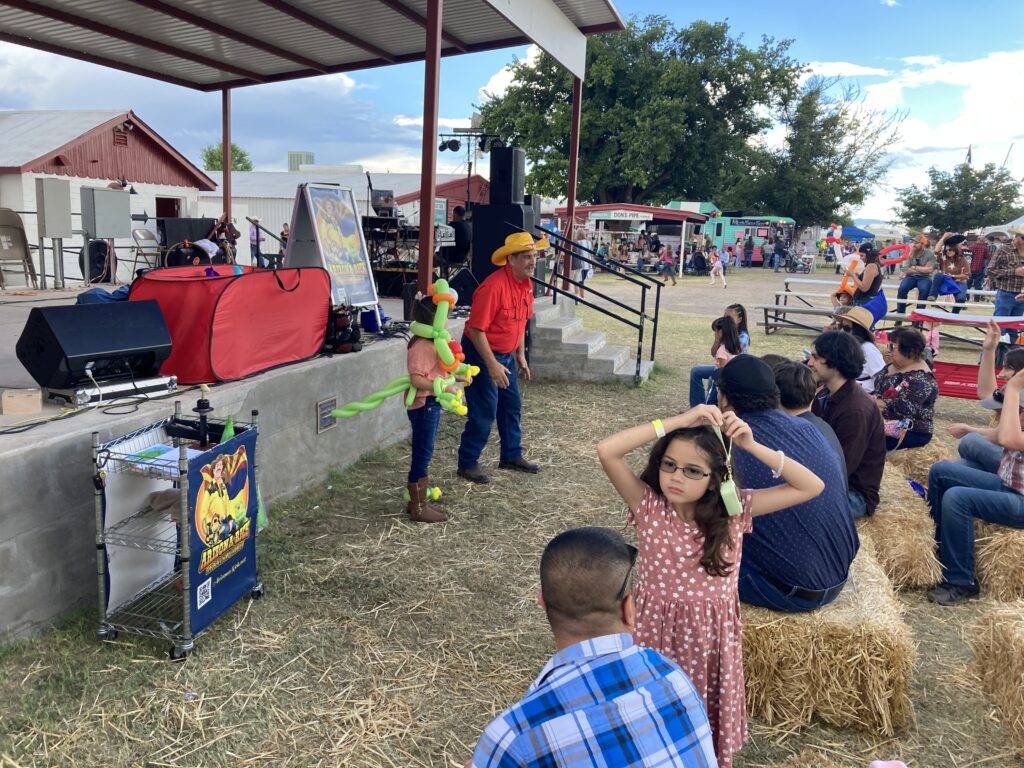
You can’t see much, and the way the audience in the back filtered out, that confirmed that they couldn’t see. Here’s what the show looked like from the extreme side:
There’s a lot more going on in the show that the audience a couple rows back can’t see. If you are on the same level as your audience and they aren’t sitting directly on the floor, everything needs to be at your armpits or higher. Any lower and it just disappears when you’re in the 3rd row or further back.
This post should be a reminder to audit your show and look for places where things aren’t visible to the audience when you’re performing on the floor. Visibility is why Axel Hecklau’s Just a Cup is superior to most chop cup routines, the action isn’t stuck on the table…and you aren’t stuck behind a table!!
I’ve been working on a trick for my platform/stage show that’s essentially an invisible deck. Well, it started out as an invisible deck and has gone through a lot of changes and doesn’t really resemble a traditional invisible deck routine.
The effect is that the audience eliminates half of the cards over and over until there is one card left, and that card matches the prediction.
I’m working on a platform version of it for my carry on luggage magic show. This will end with the card in an envelope in my wallet. Here’s video of an early test of it:
This is essentially Mark Oberon’s Bang On, but modified so that I only need two wallets and can show the back of the card as it comes out of the wallet.
This routine is really no longer the invisible deck or the Bang On routine. It’s now a mix of methods and you couldn’t do the trick how I do it with the standard props that come with either of those tricks. To me this is what more magicians should be doing. Taking standard tricks and really making them their own, not just with adding a joke or “filtering it through your personality” but actually changing the trick to fit your artistic vision.
Got out there a make actual art, not paint by numbers art.