With the conversion to virtual shows, I’ve been tweaking routines that I already do to make them stronger in a streaming show. I recently wrote about how I’ve switched the loads of my Cee-Lo dice trick from using my pockets, to not going to the pocket at all.
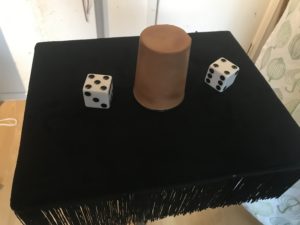
One thing that I noticed was that depending on the angle, my dice cup which was black would sometimes disappear on the black table top. This isn’t desirable, so this morning I recovered it in natural tan leather. This makes the cup more visible and the whole routine easier to watch. An unexpected bonus to this is that the large dice actually appear a smidge bigger next to the tan dice up than the black dice up.
If you’re starting to do some virtual shows, look at your props and see what disappears to the background, then take steps to make it more visible. Changing the color of the outside of a cup was something really simple and took less than 5 minutes to do.
One of my favorite routines is my Cee-Lo cup and dice routine. When I sat down to put the routine together, I really thought out what I wanted it to be. I didn’t take someone else’s existing routine and alter it, I built the routine from the ground up…and am still adapting it.
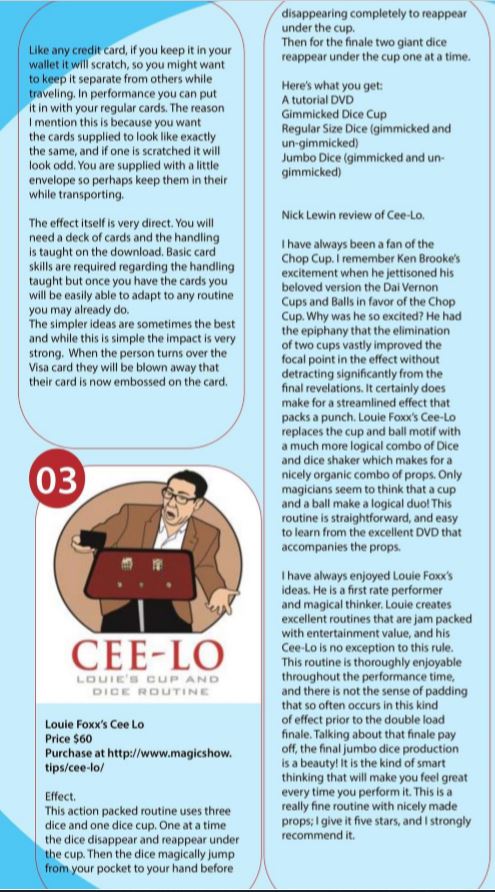
It’s nice when other people recognize that you’ve got a good routine. Cee-Lo was just reviewed in Vanish Magazine. I love how Nick mentions that the routine doesn’t feel like there is padding before the two jumbo dice loads.
Honestly, I wish I could bang out creating routines like this. One of the nice things about when I was putting this together is that I was performing on the “fair circuit” and doing 3 shows a day, plus I could do it before the show, after the show, or pretty much anytime I wanted. Having all those opportunities to test out different sequences in a very short amount of time really helped tighten up fast!
Not too long ago I picked up a copy of The Truth in Comedy which is about doing improv. It’s an interesting book, and I’m about a third of the way through the book. One of the main concepts if trying to find the real moments and not shoehorning jokes into a real moment.
A real moment is always more interesting than a prepared joke. I very much agree with this. In the past I’ve been more about getting to the joke and forgotten to play. I try to be good about playing, but it doesn’t always happen.
The hard part is when you have a routine that was built on audience interaction, however the real moments have become so predictable, you are just jumping joke to joke.
For me a good example is my card catch routine. This was built on playing with the audience and for the first about 50 shows it was a lot of playing. Then I noticed the routine became very scripted, people pretty much reacted the same way the whole routine. Once I realized what the routine was becoming, I started working to phase it out of the show for a bit.
It’s been a while since I’ve had the routine regularly in the show. Occasionally I’ll do the routine and it’s playing much better as I’m able to get back into the moment during the trick. It was hard taking the routine out of the show, but it’s made the routine better!
I’ve been making tricks that I do is to make them more “bullet proof” on camera. One of the things that I’ve done is to use a gimmicked table to avoid going to the pocket to ditch or to steal things. This is changing how I think about a lot of close up magic.
One thing performing for the camera and not live close up is that it’s hard to get your face and table in frame at the same time. That is when you use a traditional table height, which is about weight height. You end up with either a very wide shot and it’s harder to see the action or just the tabletop and your crotch in frame.
Personally I’d rather people see my face open space on the table. In the past I’ve done a couple things, first having a smaller table top that’s slightly higher than normal helped. I also try squat down to physically get my head closer to the table. This is uncomfortable and wouldn’t want to do a whole show this way, but it helps allow me to get my face in the video.
Here’s an example from video of mine:
My daughter invented part of this trick a couple of years ago.She makes me pay a licensing fee to perform the trick!…..#magic #magictrick #cupsandballs #sleightofhand #dicetrick #nocameratricks #magician
You’ll see in the video above that the table is at about belly button level, instead of at the bottom of my crotch. What I’ve recently done is raise my table up to a couple of inches below my armpit and shrink the size of the tabletop. That makes it a lot easier to show both my face and the tabletop!
For me when I perform, I want to have my face in frame as much as possible, that’s just as important as the magic. Sure there are times when you want to focus on the trick, but for me the overwhelming majority of the time, I want my face also in frame. Keep in mind, this is for a static one camera video, when you have a moving or multiple cameras, you have more options to show your face and highlight the magic.
One of the things I’ve never really explored much was using a gimmicked table. The main reason is that it doesn’t really work in the venues that I perform in. I rarely have an audience that’s just in front of me, so the stuff hanging off the back of my table would be visible.
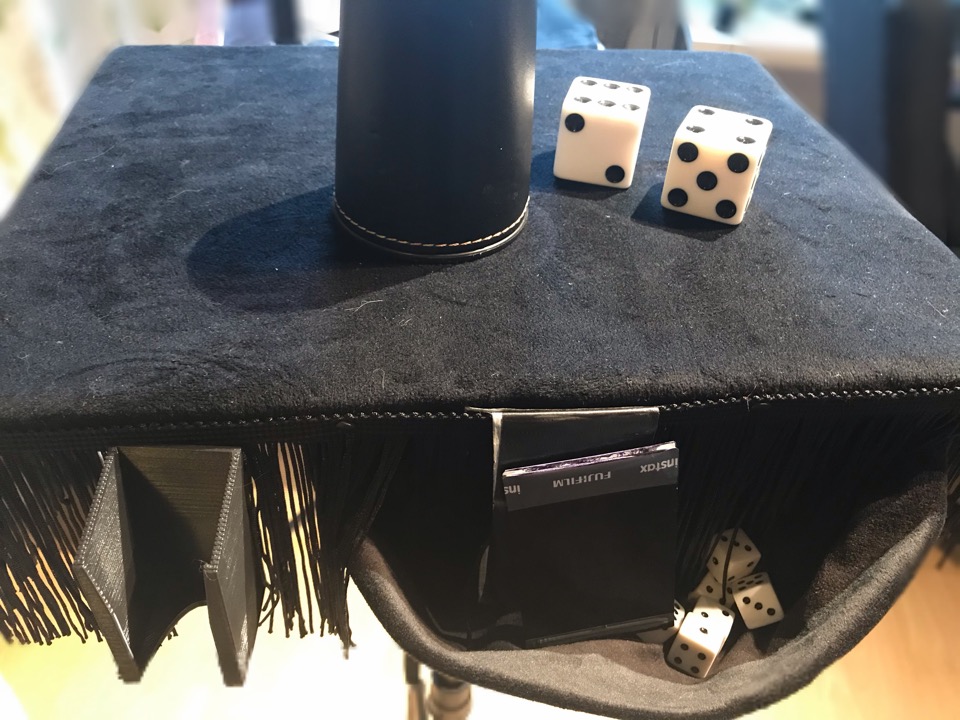
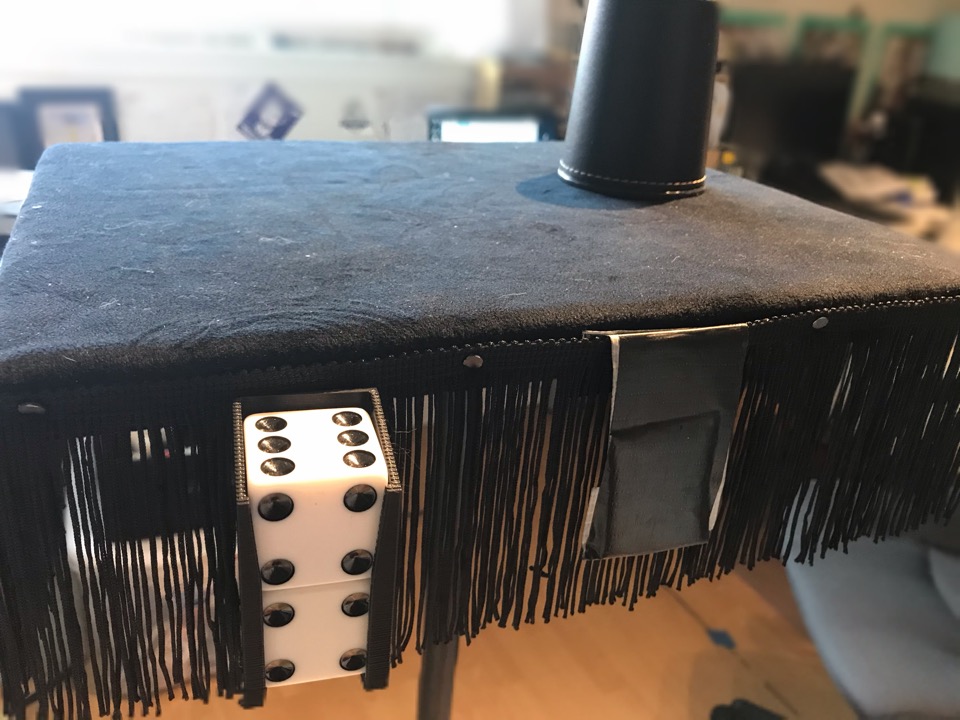
Yesterday I 3d printed a dice holder and it worked great. This was to avoid loading from my pocket. Then it got me thinking that I should remove the “two in the hand, one in the pocket” sequence from the routine so that I don’t got to the pocket at all. That would make the routine more deceptive, so I made a servante to ditch the dice into:
I was playing with a new routine and I’m liking it. I’ve come up with an interesting ditch of the one of the dice, that’s built upon something that I saw Tom Stone do at a lecture. It’s a way to get rid of one of the dice without having to put my hand on the table’s edge. It was part of his talk on “crossing the gaze” and something that’s stuck with me for years.
The new routine is starting to figure itself out, but it’ll be a bit before the sequence starts to get finalized. I’m happy I finally built this.
I’m excited that my table dice holder that I was 3d printing yesterday turned out and works great! It’s for the final two dice production of my Cee-lo cup and dice routine. Here’s the finished holder:
The holder has a notch in the bottom for my finger to contact the bottom of the dice and then to lift straight up to load them into the cup. Here’s this loading procedure in a test video:
This is way better than loading from the pocket for video! I’m glad I spent the time to make it and wasn’t okay with doing it the way I’ve always done it.
One of the tricks I’m adding to my virtual magic shows is Cee-Lo which is my cups and dice routine. One of problems going from an in person show a virtual show is that you can’t move the audience’s focus around as easily. At one point in the routine I need to load the cup and doing it in the room with people there is super easy, however it’s much harder with the focused eye of the camera.
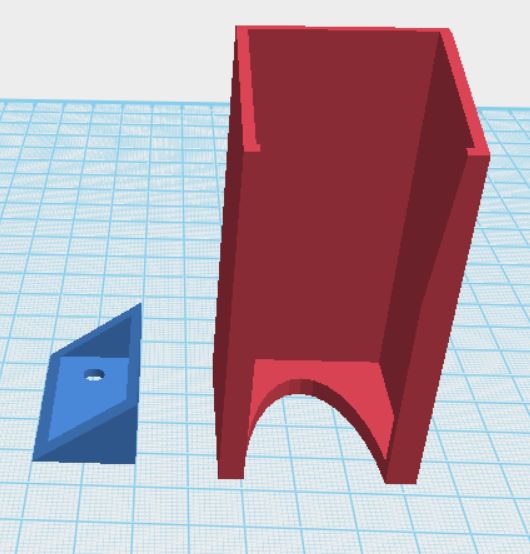
Normally I would load this from my pocket, however that won’t work for the reason above. What I’m going to do is load from the table. I designed a holder for the dice and they will slide up into the cup from behind the table’s edge.
This holder is currently printing out and I’ll try it out later today. This is something that I normally couldn’t use in my live shows because I perform in conditions where people can frequently see behind my table. This is one of the interesting things about working on a virtual show, I can use techniques that don’t work for my in person show.
Yesterday I wrote about using “fishing techniques” on streaming magic shows, you can read the post here. Today I’m going to deal with a specific trick. Let’s not forget that I think that if you are doing a trick where you are asking questions to figure out what someone is thinking of, you need to have something physical as your prediction. That makes it harder to back track and figure out the method of the trick.
Okay, let’s get to the trick. I just got mine in the mail a couple of days ago and have done it a few times already and it’s playing great. The trick is John Kennedy’s Mind Power Deck!
If you aren’t familiar with this deck, you can show it to be normal, have someone memorize a card and with asking just a few questions you can tell them the card they are thinking of. It’s great! The trick has a built in cheat sheet, but I simply printed out a flow chart and taped it to the wall behind my webcam. This is easier to read that the hidden in plain sight cheat sheet he gives you.
How I add a physical prediction to the trick is I have an envelope that I’m holding in my hand before the trick. The envelope ends up having the card they are thinking of in it. Having the card in the envelope makes it so that someone can’t say, “the magician just asked questions until he figured out the card“. Unfortunately that’s the logical solution that a non-magician would come up with and the correct one. Always add a physical prediction!
There are some amazing tricks in magic, one of them is the lottery prediction. It’s the answer to the question everyone gets (even if you aren’t a mentalist), which is “can you tell me the winning lottery numbers“.
There are a lot of solutions, and the best I think is Cesaral’s CUPP. The cool thing about that is at the end the audience is left with a physical lottery ticket they can keep. Right now I think there are several that use a picture of you holding the lottery ticket. Honestly I don’t think this has the impact of a physical ticket, because the easiest way for an audience to guess how it works is actually how it works.
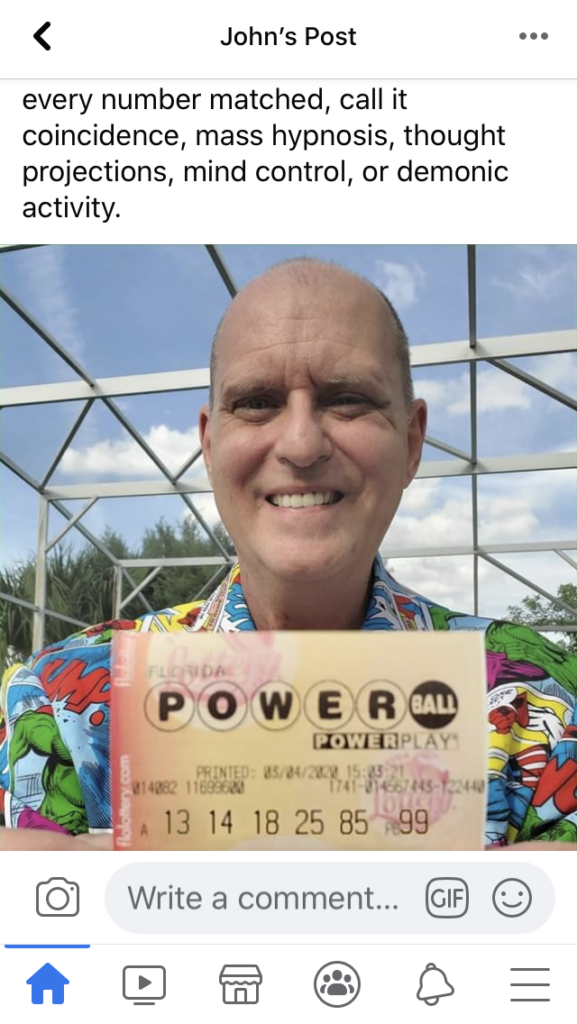
This picture came across my facebook feed of someone doing a digital lottery prediction:
Here’s the problem with it. He’s using a prop (lottery ticket) that everyone is familiar with, but he’s using it wrong. Tons of people play the lottery, it’s a very popular game and because of that people know the rules. In Powerball you can only play numbers up to 69 for the first five numbers. That means that the 85 on that ticket would be impossible to play. Then the last number, the 99 is in the power ball position, which you can only play up to the number 26.
There have to be people who notice that. It’s a simple thing to fix by giving people a number range. I did the lottery prediction in my show for a couple of years, it’s not hard. That little bit of realism makes the trick soo much stronger.
That’s something that drives me nuts, when someone uses a prop to customize their show, but they know nothing of the prop. Look at how most people do the mismade flag…it’s very disrespectful to the flag.
If you use a prop that is something in real life, learn about it!
Sometimes things pop up on my Facebook Memories and I forget how long ago they happened. I just had this picture show up:
This was from the debut of a new trick. Essentially it’s a card sword, but instead of using a sword, it uses an inflatable dinosaur costume! This picture was taken 3 years ago, it doesn’t feel like I started doing it that long ago. I created this trick for a library tour and did it over a hundred times that summer. Then the trick made it into my school assembly show, and I’ve even done it on TV!
This particular trick is a great example of taking an existing trick and altering it soo much that it’s no longer recognizable. I could do this trick in the same show that someone does a tradition card sword in without a feeling of duplication.
That’s my end goal, to be able to be in any show with other magicians and not have to worry about duplication. Sure a vanish is a vanish, but they don’t have to be done the same way.