Pics to Jumbo Card.

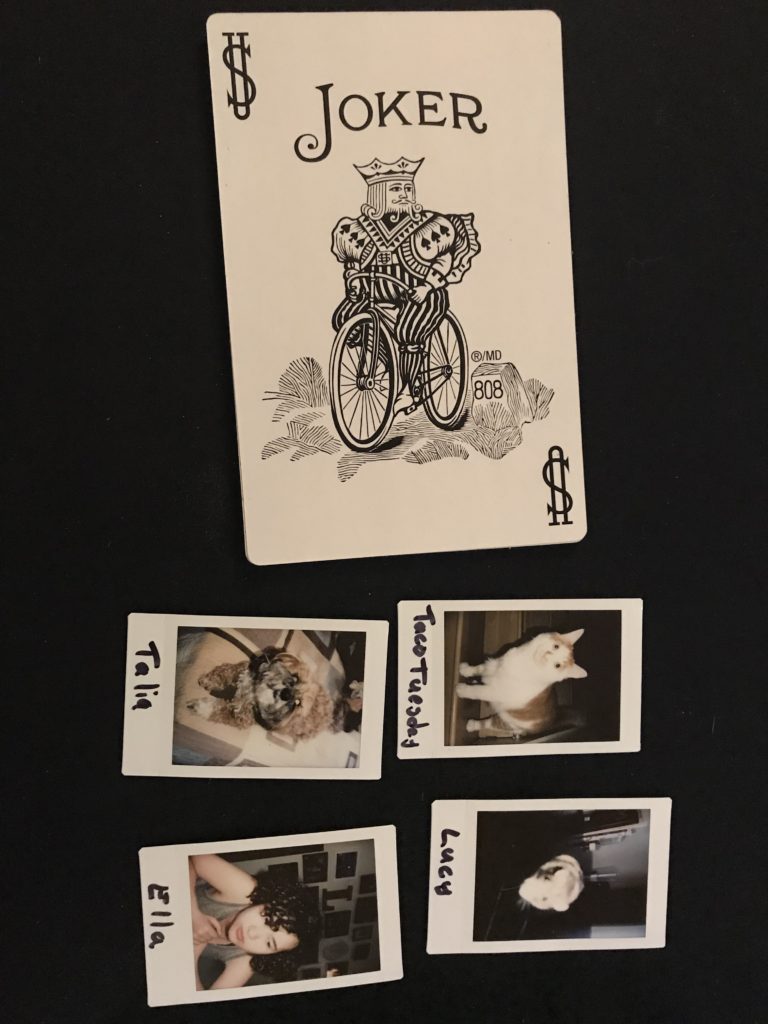
The last couple of days I’ve been writing about doing Goshman’s Cards Thru Newspaper and how it morphed to Cards To Jumbo Card. Today we’re going to talk about the next leap it’s taking, and that’s starting to get rid of the cards. In place of the four regular cards, I’m using Polaroid pictures of my daughter and our pets.
Magic trick

The cool thing about these is that they are slightly smaller than playing cards, which makes a lot of the sleight of hand much easier! The nice thing about coming up with a method that doesn’t use a duplicate, they pictures could be of people from the audience, or of a company’s products, or whatever.

Once again, the video below wasn’t intended for people to watch other than me. It’s a “proof of concept” video that was for me to watch and see how well everything worked and also to remind me of what I was doing.

Things are starting to come together, but there’s still one thing I don’t like, and that’s the jumbo card. Tomorrow we’ll talk about how I got rid of that.

Color Change

The other night while watching TV with the family I was fiddling with a deck fo cards and came up with a strange color change. There’s a lot wrong with it, and in its current state it’s not a good color change.

The main problem with it is that it’s not good for video. I can see the flash that happens when you palm the card being hidden in a live show, but not on video. Also there are better ways to do a color change.

It was fun to play with.

The Penny Solution…

In yesterday’s blog post, I mentioned it took a bit of work figuring out what to do with the penny in the trick where a penny changes into two silver dollars. The challenge was that the coin change happens immediately, however I need to keep the coin hidden for the whole routine. Based on the conditions I posted I can’t just ditch it as my hands need to remain in the frame. Adding to the problem is that I also have two coins finger palmed the entire routine (until the end).

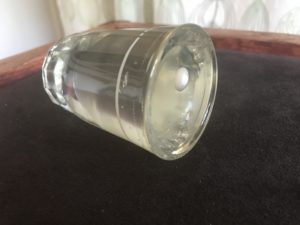
Penny shell magic trick


The solution I came up with, which should have been pretty obvious was to attach attach a magnet to the penny as the silver dollars already have magnet in them. I took the penny shell from a Dime and Penny set and used teflon tape to hold the magnet.

I figured using a shell would allow the penny to sit flat on on the silver dollar. The flatter it sat, the less chance there would be for me to accidentally knock it off, and it won’t rattle as the coin moved.

The “penny solution” brings me back to something Nick Lewin always says, I love how elaborate this 30 second coin routine has become!

Conditions on a Coin Routine…

The last couple of days I created and refined a coin routine. Here are the two routines and the conditions:

Initially the conditions were:

  • Viewed from the front
  • Done for the camera
  • No table
  • Face must be framed

I will say that I initially fudged the face must be framed because I put the coin in my pocket, however there’s still action by my face as that’s where my right hand stays holding a coin.

After coming up the first version, I added a couple more conditions:

  • Hands stay in frame
  • Usable in a LIVE show with video projection
  • Able to set up quickly

With the second set of conditions, I’m thinking about actually using the routine. In the second version, I’m playing the the camera for the two times the coin disappears from one hand and reappears in the other, but it will still work live. The set up quickly condition is huge, I need to be able to reach into my case, grab the coins and be good to go.

Then there’s a small challenge with the condition of my hands not leaving the frame. I have the stupid penny to keep hidden after it changes into the two silver dollars. It sounds simple, but was a pain to figure out how…until I came up with a very simple and obvious solution to holding out the penny for almost the whole routine.

The next step would be to start to work on a verbal routine, or at least intro, to get more than 30ish seconds out of the routine.

Continuing Creating a Coin Routine…

The coin routine that I started yesterday started with a penny turning into two silver dollars. One silver dollar repeated traveled from the pocket to the hand and for a finish one of the silver dollars turned clear. It’s a decent routine, however after playing with it, I added a couple more conditions (I’ll write about the conditions tomorrow) and here’s what the routine changed into:

The first big difference is the routine is about 17 seconds shorter. I took the coin going from the pocket to the hand, that I felt was pretty redundant after I did it more than twice. It doesn’t feel as impossible with a coin as it does with a ball. It’s interesting that the routine started with a billiard ball manipulation premise, however moved away from that.

The ending with both coins turning clear makes more sense than just one of them doing and the final display of one in each hand is better.

Working On A Coin Routine…

A bit ago I noticed some coins on my desk, and figured I’d start playing with putting together a quick coin routine. To start the routine I gave myself a few conditions that it had to adhere to and I’ll get to those in a future blog post. Here’s what I put together:

When I started playing with the coins one thing that I quickly realized is that I could almost do a billiard ball manipulation routine with them. Once you have the initial change from a penny to two silver dollars, the routine is essentially Percy Abbott’s Perpetual Ball routine.

Next up the routine needed an ending. I don’t think that producing 4 or 5 silver dollars would have the same impact as producing 5 billiard balls. Luckily a clear coin caught my eye and I threw that into the mix. I think it gives it an ending.

Shell Game Ending…

If you read this blog or follow me on social media, you know I’m not the Three Shell Game. I’ve come up with several original takes on the classic trick, which is great for a routine that’s basically been unchanged decades. I just built an ending for the shell game that I think is pretty cool.

Before I tell you what I did, let me tell you the two types of tricks that I think are usually the most lazy ways of being creative with magic. They are items that are hollow and turn solid and items that turn into glass (or clear plastic). Yes, there are execptions, like when Jerry Andrus and Danny Korem first did the Omni Deck. If you take a marker an turn it clear…great, but unless you have a really original take on the switch, it’s just a color change and no different from turning the marker from red to black.

So now, let’s get back to the shell game. Personally I’ve never done the ending where the shells turn solid. Why? I don’t think it makes sense. It’s a kicker ending that’s not really logical and doesn’t really move the ending forward. It’s too different from what has happened the whole time. It’s a “what?” moment because it thinking of the audience has to shift a lot from what was happening the whole routine. It’s almost like it’s the beginning of a new routine.

How did I fix the solid shells? I took it a step further. I used it as the starting point for another effect. Here’s how the routine plays. You do a few shell sequences, then cover a shell and pea with a shot glass. They are mixed around and guess where the pea is. When they lift the shot glass, then the shell, they see no pea, and then they discover the shell is solid. Now it’s a mystery they just discovered. They will turn over the other two shells to check them, and they are solid as well. Having them discover the solid shell is soo much better than you revealing it.

Now for the new ending:

When they look at the shotglass that’s sitting on the table, they see the pea under it. When they pick up the shotglass, they realize the shotglass is solid! The pea is embedded in the solid shotglass!

three shell game

This is a solid (pun intended) ending for the solid shell game. It takes the routine one step forward to an ending that’s more logical than just the solid shells.

Magic Shop Jam!

On Friday of last week I pitched in and helped out at Market Magic Shop in Seattle for a couple of hours. A couple of magicians came out and we jammed a bit, it was a lot of fun! One of the things that we were goofing off with was pressed pennies. Here’s a trick … Continue reading “Magic Shop Jam!”

On Friday of last week I pitched in and helped out at Market Magic Shop in Seattle for a couple of hours. A couple of magicians came out and we jammed a bit, it was a lot of fun!

Magic Jam

One of the things that we were goofing off with was pressed pennies. Here’s a trick with one:

It’d be an amazing giveaway if you had your own custom penny made, or better yet a quarter and did the trick and gave them away. The initial cost would be crazy, but would be a giveaway that they’d keep!

What’s Wrong With That Act…

Recently I saw an act that is everything I dislike about how people perform magic. They lacked technical skill, knowledge of the trick and presentation. For me it was a trifecta of what I don’t like. This act did the “Sands of the Desert” trick. This is a trick where you have a bowl of … Continue reading “What’s Wrong With That Act…”

Recently I saw an act that is everything I dislike about how people perform magic. They lacked technical skill, knowledge of the trick and presentation. For me it was a trifecta of what I don’t like.


This act did the “Sands of the Desert” trick. This is a trick where you have a bowl of water and you swirl your hand in it and the water turns black. then you dump different colored sand into the bowl and swirl it up. Then you reach into the bowl and pull out handfuls of dried sand that’s all the same color. For the finale the water in the bowl turns clear.


First of all, the performer couldn’t do the trick. It’s not a hard trick to do, and they lacked the technical skill to do it. It was pretty crazy to watch. You really should practice it before you do it in a show. You not only need to know the “sleight of hand” but how and why the props work like they do. That’s super important, knowing why something is shaped the way it is, or how to hold it.


As far as their presentation goes, it felt like they were trying way to hard to put meaning to something. They tried to use the trick as an analogy for the universe. That’s fine, but it lacked conviction and authenticity. It felt like they asked someone to write a script and they read the script. If you watch Jeff McBride do his stuff, you feel that he believes it and he’s trying to open your eyes to something, not just saying big words. He puts his heart into it, but that’s also Jeff, and a piece of who he is.


Put yourself into your tricks, put your heart into it and put your time into it. Dive into the props, the sleights, learn the history of the trick, learn as much as you can about and the story you’re telling. That will come through in your show.

ACAAN???

One trend in magic that I’ve noticed lately is that whenever someone puts out a new gimmick, or principle one of the routines they come up for it is an Any Card At Any Number. The problem with this is that none of these are truly an ACAAN. as there’s a limitation at some point. … Continue reading “ACAAN???”

One trend in magic that I’ve noticed lately is that whenever someone puts out a new gimmick, or principle one of the routines they come up for it is an Any Card At Any Number. The problem with this is that none of these are truly an ACAAN. as there’s a limitation at some point.


A good example is the Mental Dice that just came out. You are using the dice to get information, but unfortunately with 3 dice you can’t make any number between one and fifty two. You could use one die for the tens place and the other for the ones place, but that still won’t get you all the numbers from one to fifty two.


In the book Body Mentalism, which teaches a really cool technique for forcing a person, one of the effects is an ACAAN. Unfortunately it’s really an Any Card at Number, there’s not a free choice of number. It’s very limited, in this method. I’m all for brainstorming ideas and including them, but people need to stop passing off a Card at a Position as an Any Card At Any Number.

Body Mentalism by Juan Pablo Ibanez

I may be a bit biased as I’m a fan of the ACAAN trick, and have done it on TV, my live show and published several variation of the trick. It’s one of those things that in my opinion have a very specific set of rules for it to be an ACAAN.