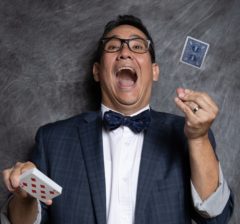
In a few days on 10/23/20 at 8pm I’ll be performing on The CW’s Masters of Illusion television show. When I had the opportunity to pitch them some routines, I chose things that had some unique visuals. Tricks that weren’t just a card or coin trick, but offered something more.
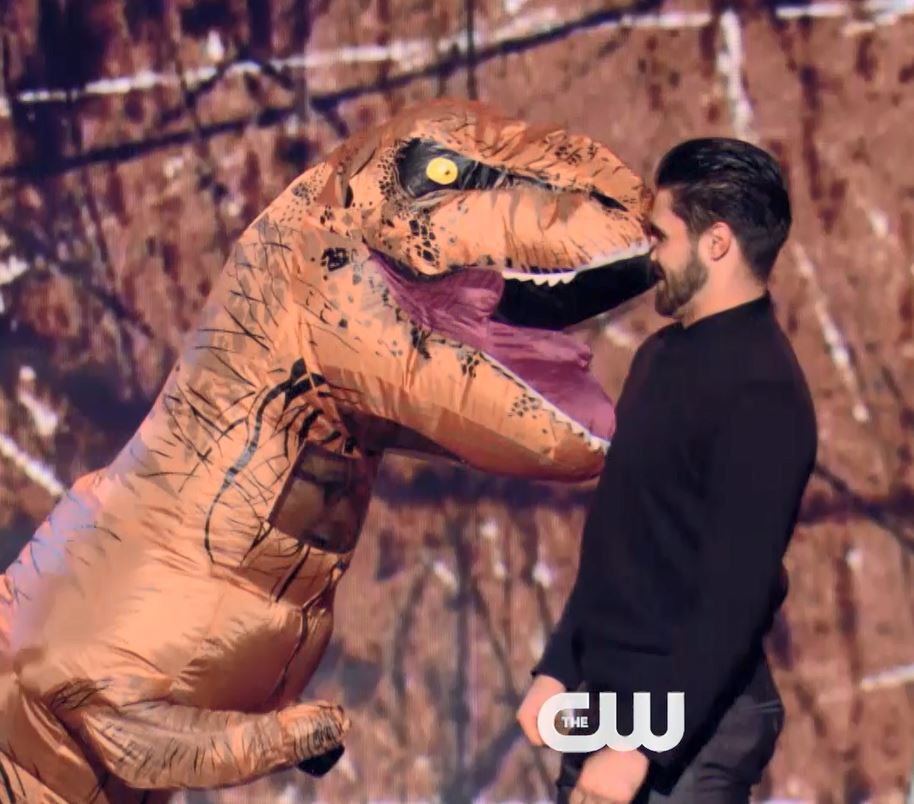
One of the tricks that I pitched to the producers of the show was the card trick that I do with a dinosaur costume! It’s a very unique trick visually, and it’s just a fun routine.
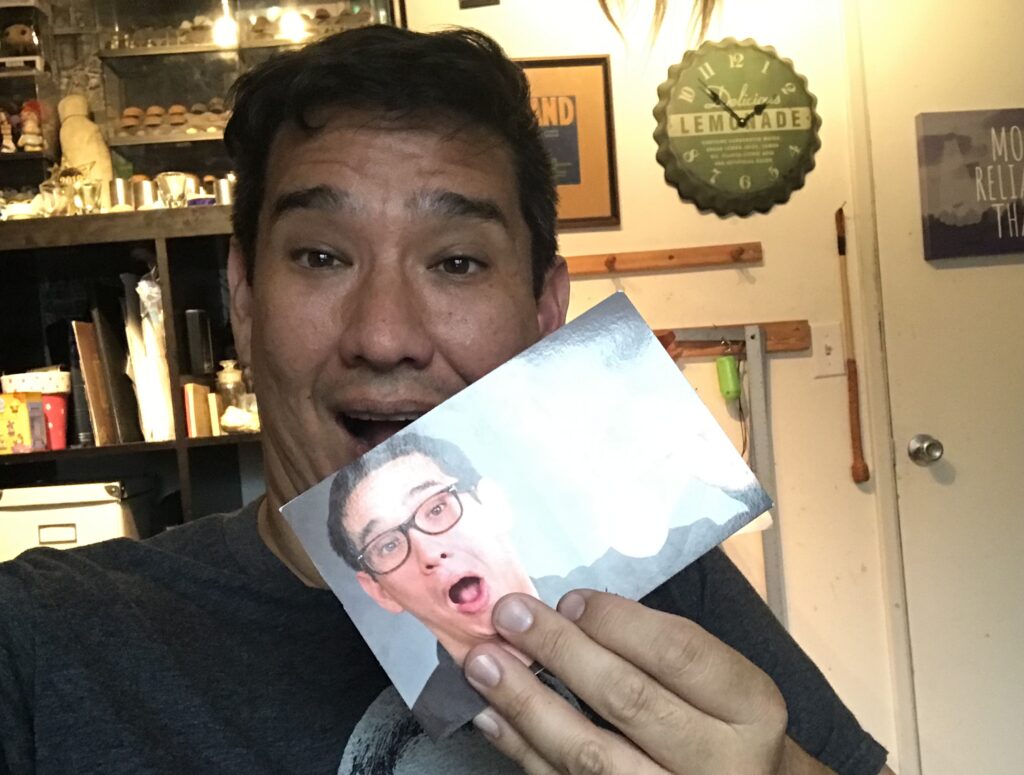
Look at the picture above, look at my face inside the costume. I’m having a blast! That’s something that I think is important, even though no one can really see me, I’m performing as if they can see me. More importantly, I’m having fun! That fun is project to the audience, even though they can’t see me!
Whatever you do, have fun. Fun is the secret sauce that makes or breaks most performers.
Way back in the pre-pandemic days when I had a new Idea I would go to an open mic and try it out. I’m not a huge fan of trying something out at a virtual open mic, as it’s hard to get the overall feeling if the idea is good. In front of a live audience you can get a vibe that there’s something there, even if the trick flops. It’s hard to get that from a virtual show.
A couple days ago I did the Boston Magic Lab to try out the Torn and Restored Postcard I’ve been working on. Here’s the tear and restore sequence:
After rewatching the video, there’s a lot that it needs. One thing it needs a magic moment for the restoration. Something like hitting it with a lighter, but not that as I don’t do fire. Another thing is needs is a good way to ditch the torn postcard.
The nice thing is that I can probably fix both of those. If I reach into my case to grab a lighter, I can ditch the torn postcard. Now that motivates the ditch and gives me the magic moment. I’ll need to find something other than fire.
A possibly solution is using Bizzaro’s Non-Toxic trick which is a vanish of glue. I pour the glue into the folded post card to “fix it”, open it and show the glue is gone and the post card restored. I’m not sure how I feel about mixing two effects at the same time, the vanish of glue and restoration of the card will happen at the same time.
I’ll need to play with it more. I think there’s something there…
The Impuzziblities books are great, I’m into my second one and recognize some of the stuff from Jim Steinmeyer‘s other books that I have. It hit me last night why I wouldn’t do most of the material in the books. It’s pretty simple, they are too procedure heavy. Most of the tricks like if you just did the formula you’d get the same results. Jim in beginning of one of the books mentions they are puzzles, so I’m not knocking him or the books for that.
What they tricks in the books need is a physical effect to stick the trick. That takes it out of being a puzzle. Yes, it’s cool when the whole audience has the same card, or is holding up the same hand, but it isn’t an amazing magic trick.
Here’s an example I thought of last night:
There’s a coin trick in one of the Impuzziblities books where you have a row of four coins (dime, penny, nickel and quarter) on the table. Through a bit of procedure a coin is picked. You eliminate one (the quarter) by putting it into your right fist, leaving three coins on the table, one of which is the coin they are thinking of. Then a little bit more procedure and they are thinking of a new coin. You put the remaining coins into your fist with the quarter. You then open your hand and all the coins had disappeared except for the coin they are thinking of, which is the nickel. Your hands are complete empty aside from the nickel.
As far as method for the coins is pretty simple. Use a 21 cent trick coin set and you’ll need to switch the quarter with one of the nickel shells with a Bobo Switch from Modern Coin Magic. You do the switch very early on in the trick , you have a ton of time to ditch the quarter. You will need to tweak the trick a little bit from how Steinmeyer wrote it to force the nickel instead of the penny. Or you could do it as written and end with a dime and penny set, using a click pass get rid of the nickel and quarter.
I think adding the physical trick to the verbal instructions moves the trick a bit more from the puzzle side to the magic side.
For years I’ve been a huge fan of Jim Steinmeyer, I love his books. I remember reading his Afghan Bands routine in the first Magic Magazine that I ever bought, and have been a fan ever since.
For some reason, I’ve never bought or read his Impuzzibilites books. They’ve been out forever.
I just picked up a full set of the nine books and I’m having a good time reading them. One of the things I love about Jim’s books is that the routines are fleshed out, it’s not just how to do the trick.
What’s cool about Jim’s books is that 99% of the material I will never do. A lot of his stuff is too procedure heavy for my style, however it all inspires me. I makes me want to be better.
In my heart, I’m a card guy. I love watching good and bad card magic, and I love doing good and bad card magic. However, I’m at a point in my life where I also understand not everyone loves card tricks. With that in mind, many card tricks can be easily converted to things that don’t use cards. Of course you lose the convenience of being able to carry one prop (pack of cards) that you can use for multiple routines.
Recently I saw a virtual show and someone did the move from Paul Curry’s A Swindle of Sorts. This move is a false shuffle where the audience sort of decides how the cards are shuffled. The show I saw they used it for a sympathic cards effect. Here’s Michael Close doing a similar effect:
That got me thinking about what else could be used that aren’t cards. I’d seen Murray Hatfield of a version with envelopes, that I think ended up with his phone number, then inside the envelopes were words that formed a sentence. then it hit me, I don’t think the objects need to have uniform backs for this to work. That opens it up to things like gift cards or money.
Hopping on the idea of money, I wanted money that’s visually different, so bills from the USA are out. That got me thinking of using currency from a variety of countries. Turns out getting money from other countries that aren’t in circulation is really easy and they’re petty cheap on Amazon:
I ended going to a local coin shop to get mine. I bought 3 sets of 10 bills, so I have enough to do a matching trick, plus an extra set. I think I may buy a pack from amazon if the trick starts to go anywhere so that I can have more variation in my bills.
Yesterday we handmade a progressive anagram from five words. If you didn’t read yesterdays post, go and read it, or this won’t make a lot of sense. One thing I didn’t like was that the first YES or NO question have a 60% chance of getting “No” answer. Using the same method to make the progressive anagram, by eliminating the vowels first, but this time examining the vowels, we’ll get a better sequence.
here are the words:
Beer Agreement Heat Bowel Touch
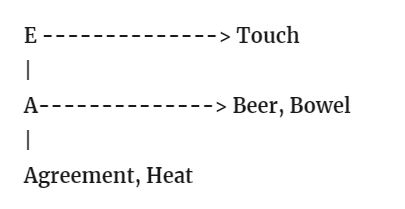
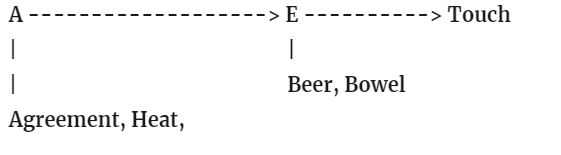
I noticed that all of them have an E except for one word. If we eliminate the E first, we’ll get an 80% chance of a YES. If we get a NO, we immediately know the word. This is way better than yesterday’s layout. Here’s what today’s flowcart for the same words looks like:
E ————–> Touch | Beer, Agreement, Heat, Bowel
I’m going to eliminate another vowel, I’ll do A, as the only other vowel that’s used in the words is O, and that’s only in one word, which would give me a 75% chance of getting a NO answer. The A will give me a 50/50 chance.
At this point we have two pairs of words, so we just need to find a letter that’s only in one word of each pair.
While essentially the same as the progressive anagram from yesterday, this one is slightly better as the odds of getting a YES on the first letter are better and if you get a NO on the first letter you immediately know the word, which is a huge advantage. Also there’s only one word where you’ll would get two NO answers, where in yesterday’s flowchart there were two instances.
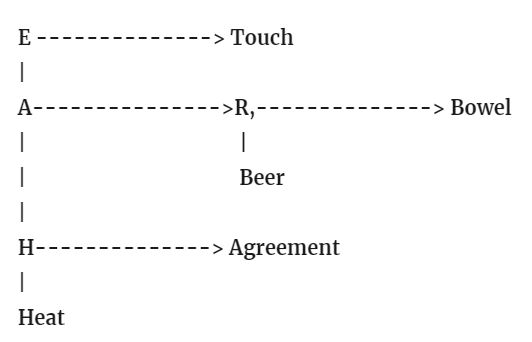
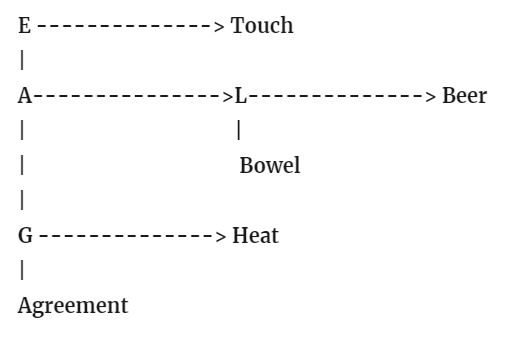
Now let’s compare this to the what a computer will come up with. I plugged the same words into a progressive anagram generator and here’s what is spit out:
Essentially the computer came up with the same solution as I did today. the difference was we chose different letters for splitting the last two pairs, but that’s arbitrary. The nice thing about the computer is that it did it in one try, and in about 1 second. Knowing to do it yourself is a solid back up and you understand the process a bit more.
With moving to virtual magic shows, I’ve been playing a lot with progressive anagrams. If you’re not sure what a progressive anagram is, the basic effect is someone is thinking of a word. You then ask if a several letters are in it and based on their “yes” or “no” answers you can determine the word. Essentially it is a flowchart that uses a process of elimination from a list of words. The flow chart and based on YES or NO answers to whether the word has a letter you will either move down the list or to the right.
If you get a YES, you move down. If you get a NO, you move to the right
That’s it.
Normally I use an online progressive anagram generator to create these flowcharts. For fun, I thought I’d try to figure out how to create them myself. Since I use them a lot, I’ve noticed a few things that are the basis of how I do mine. I’m going to hand make a progressive anagram.
The first thing we need is a list of words. I used an online random word generator and using 5 words. The words it gave me are:
Beer Agreement Heat Bowel Touch
I’m going to start by eliminating vowels, so I’ll start with the A.
Currently my flow chart looks like:
A -> Beer, Bowel, Touch | Agreement, Heat
Remember if they say YES you move down and if they say NO, you move to the right.
I’m not the biggest fan of having a 60% odds of getting a “no” answer on my first question. For the sake of simplicity to explain the easiest way I’ve found to do this, we’ll keep going with the A.
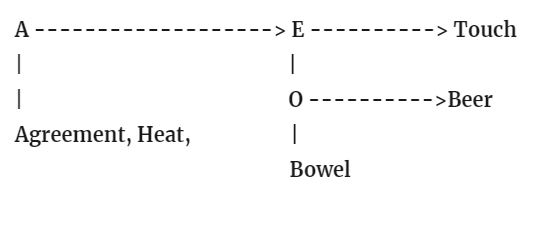
For the next question, if we will eliminate the E, so the flowchart will look like this:
Now we have two sections, each with two words we need to figure out. It’s a simple matter to figure out a letter that’s only in one of the Beer/Bowel pair or in the other set of two words. We’ll start with the Beer/Bowel. Let’s eliminate the O, and the flow chart will look like:
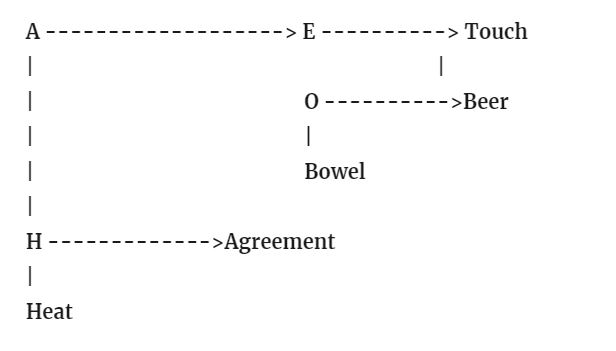
Then we’ll find the letter that’s only in of the Agreement/Heat pair. That letter is H, so here’s the final Flowchart:
And there you have it, we hand build a progressive anagram.
In May I started worked on a trick that was my version of Albert Goshman’s Cards Thru Newspaper. You can search for those blog posts, but it shows how the trick progressed from the original Goshman trick to what I’d now consider an original magic trick/routine.
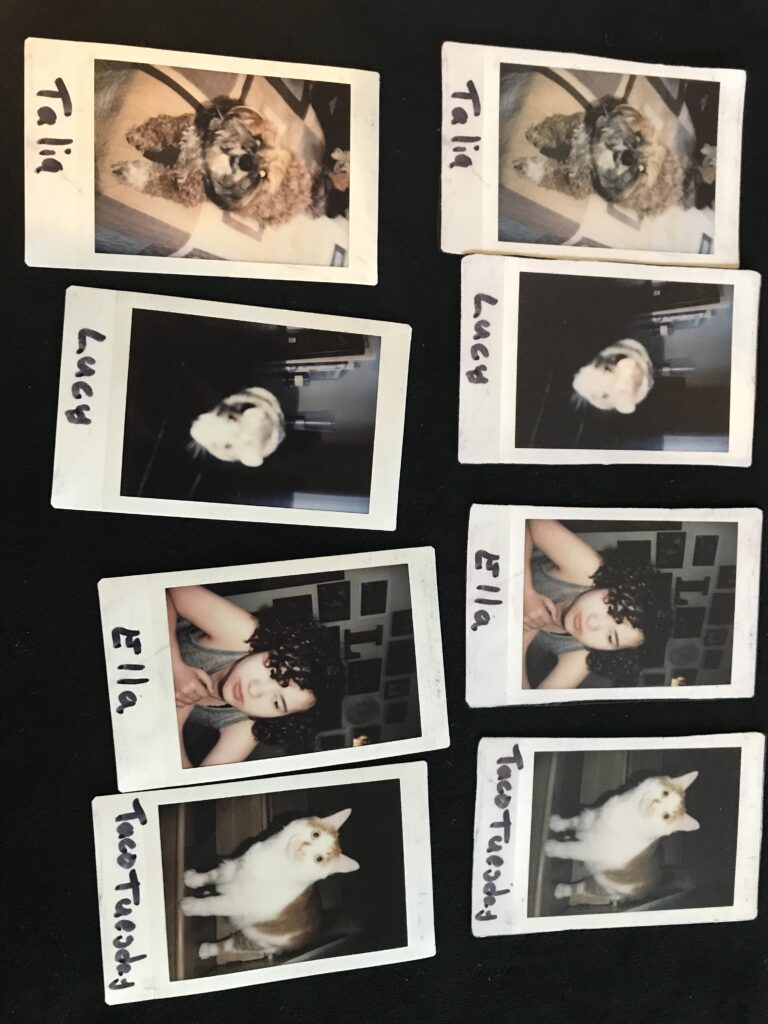
Essentially the original trick is that four cards appear one at a time and reappear under a folded up piece of newspaper. I took out what I didn’t like, the cards and newspaper and ended up using an envelope and four polaroid pictures. The pictures disappear and reappear under the newspaper.
It’s been five months since I started working on it, and really, it should have progressed further, it’s been slow going, mostly because of laziness on my part and not putting in as much work on it as I should be. I’ve been doing it as “preshow” for some virtual shows, but really I should be out at virtual open mics doing it and working it in.
I did recently make a change. I’ve been using this trick in pre-recorded virtual shows lately and a problem the trick had was the problems is that the Polaroid pictures are soo glossy, that they are hard to see on camera. They reflect too much light, and you can’t see them clearly. I took some brochure paper and printed the Polaroid pictures onto that paper. It’s a semi-gloss paper, so while it’s shiny, it doesn’t reflect nearly as much as the actual Polaroid picture.
The row on the left are the real Polaroids and the right are the copies. When they are side by side you can see the copies are a little less vibrant than the originals. However without a side by side comparison, you really can’t tell.
Keep working on your magic, even if you’ve been doing a trick for years and it’s a polished routine. There’s usually still improvements that can be made. Sometimes these are small improvements that no one will really notice, but these little things add up!
When I started out performing magic as a kid, I never thought I would really become a magic creator. I loved performing and loved performing new things I’d read in books. As time progressed I went from creating original patter to then going for original routines and methods.
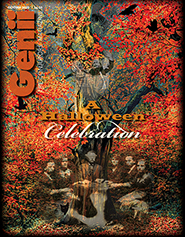
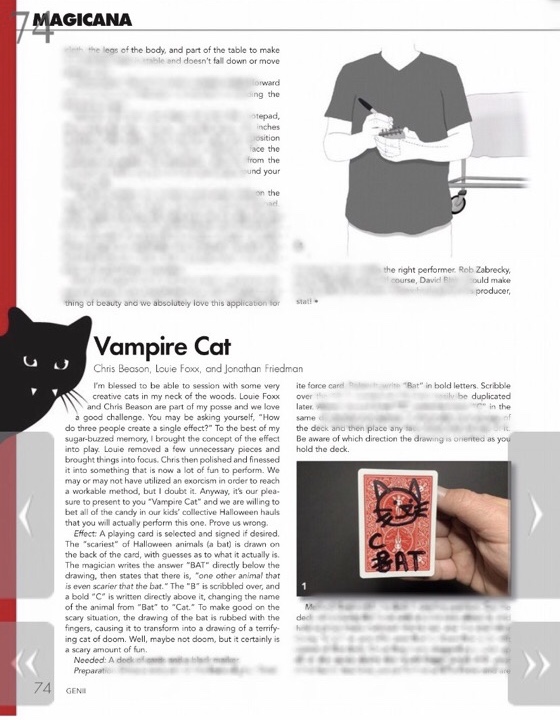
While I currently write for Vanish Magazine, recently I’ve been in Genii’s Magicana column twice. The first time was for a trick I created and now as part of a trick that I helped work on.
It’s a fun trick called Vampire Cat that uses a deck of cards. There’s a group of us that get together and have little magic jams where we work ideas and brainstorm. This came out of that.
I love it when I’m working on something and things happen quickly. The connections between problems and solutions are quickly found. What started not too long ago with me and a couple of friends ripping up playing cards, quickly became a solid method. Then in my quest to make it play a little bit bigger, I think I hit on something to make it bigger, but also a presentation hook!
I was looking for some of the Phoenix Parlour Cards that I have around here somewhere, and a stack of postcards I send out as “thank you cards” caught my eye. I took one and gimmicked it for the torn and restored card, and it worked!
The cool thing about using postcards is that they are bigger than the Phoenix Parlour Cards, and they are really easy to gimmick (much easier than playing cards). Also if this is something that I’ll be doing in the show, they are cheap and easy to get.
This brings me to something that my friend Robert Baxt always tells me, which is, “can you do it with anything other than playing cards?“. He’s right. I’m a card guy in my heart, but he’s 100% correct, it’s almost always better with something other than playing cards. Also by moving things away from playing cards, you free up a slot in your show to use playing cards. I know freeing up a space for a card trick is not Robert’s intention, but is also means one less space for a card trick!