
Sequential Twisting…

Well, I was just on another long flight and I was playing with the Twisting the Aces that uses the false count of four cards that hides the card that is second from the top. I’ve been calling the count the Second From the Top Elmsley Count, but I think I’m going to call it the Runner Up Count as it deals with the “second place”

Click here for the routine for Twisting the Aces

While I was on the flight, I got to thinking about how I bet the spectator doesn’t really remember which aces have flipped over and which haven’t. What I mean by that is if you stopped in the middle of the trick and asked which two aces haven’t flipped over, I think most people couldn’t tell you. That’s a problem with the Twisting the Aces premise, the audience is taking your word at what’s flipped or hasn’t flipped.

While I was on the plane I started to play around with the handling to be able to do it with an Ace – 2 – 3 -4 instead of four aces. Luckily I was able to do that with pretty minimal changes to the handling.

Here’s the handling, and the changes have been added in bold:


You start with an Ace, Two, Three and Four in that order face down in your left hand.

GET READY: Have the cards in a fan and gesture towards a person from the audience. As you do the gesture, your right hand takes the top two cards and the bottom card, leaving the second from the bottom card in the left hand. Your right hand then sets it’s cards on top of the single card in the left hand.

  1. Triple turn over to show the “top card”.
  2. Kill your wrist and turn just the top card over.
    -The position of the cards are: face down – face up – face up – face down
  3. Do the “Thru the Fist Flourish”, but don’t flip over the packet.
  4. Do the Runner Up Count and this will show the first face up ace. When you count the fourth card, DO NOT put it on top of the packet in the right hand, but but under the top card.
  5. Do the “Thru the Fist Flourish”, but don’t flip over the packet.
  6. Do a regular Elmsley and this will show the second face up ace.
    -The position of the cards are: face down – face up – face down – face up
  7. Do the “Thru the Fist Flourish”, and secretly flip over the packet.
  8. Do the Runner Up Count and this will show the third face up ace.
  9. Do the “Thru the Fist Flourish”, but don’t flip over the packet.
  10. Do the Runner Up Count and this will show the fourth face up ace.
    As you do the count, leave the final ace out jogged.
  11. Strip out the final ace and put it on top of the packet face up
  12. Half pass the bottom card as you spread out the packet to show the three face down bottom cards (this is the Asher Twist move)

That’s it, a simple displacement at the beginning of the trick and then one displacement after the first count and it will work with a set of cards in numerical order. While this is essentially still Twisting the Aces, I’m happier with this now that I was a few days ago.

-Louie
Hanging Out…

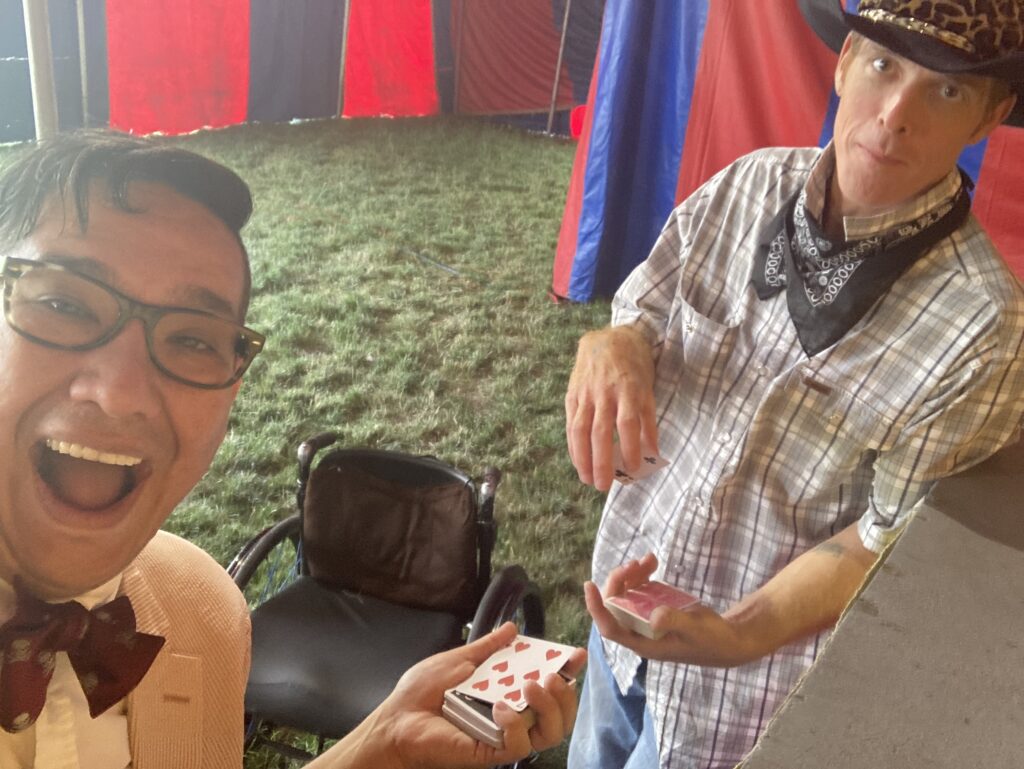
Whenever I’m out doing shows, I always try to spend time any magicians that are in the audience. Sometimes I don’t know who is a magician, so I apologize in advance if I don’t hang after the show.

I am still very passionate about magic and really enjoy watching and learning it. If you come out to one of my shows and be sure to mention you are a magician. Sometimes I don’t have time to hang after the show…but if I am available, I always love to jam for a little bit!

Still Working on the Invisible Deck…

It hit me yesterday while I was doing my version of the invisible deck was that my version is not about the card, it’s about the two cards matching. That’s a huge distinction when it comes to making it play big. If you’re performing on stage with the invisible deck, the audience needs to know it’s the card that was named. In my routine since it’s a prediction, they only need to know that the two cards match. That means they only need to be able to tell the cards look the same from the back of the audience.

To make it play bigger, but still use a normal size deck, I have a few options. I could use a jumbo index card, which I personally don’t like. I think they look funny. In the past for stage work, I’ve used GIANT INDEX cards. These are cards that don’t have the pips in the middle, they are more like flash cards. These also look funny, but I like they way the look more than Jumbo index cards. The final option is to use the Phoenix Large Index Cards. These are normal looking cards, but the pips and indexes are 50% larger.

I just ordered some of the large index cards. I’m going to make a gimmicked deck and give it a try when I’m back at the fair on Wednesday. I’m guessing it will play slightly better, I don’t think the difference will be huge, but better than how it’s been.

I also figured out the optimum number of cards to do the trick with. I need to do the trick with 16 pairs (32 total). That’s going to eliminate evenly from 32 to 16 to 8 to 4 to 2 to the final card. I’m hoping that 32 cards will still play like a full deck from the stage. We’ll find out…

-Louie

More Invisible Deck Work…

One of the tricks I’m working on right now at the fair is my version of the Invisible Deck…Well my version of Vernet’s 52 B’wave. The effect is a selected card is in a second deck face up, has a different colored back and the rest of the deck is blank.

Because of my method for the trick, I know what the selected card it without looking at the face. Yesterday I said the name of the card without looking at it and someone in the audience called me on it. I played it off as saying I did look, and they must not have noticed. I need to do an exaggerated look at the front of the card. I also need to do a streamlined elimination of the cards. Right now I’m splitting the cards in half and eliminating half at each split. I need to figure out the least number of splits. Like maybe doing it with a 45 or 48 card deck instead of a 52 card deck make it go a little bit faster?

I’m figuring out the beats and how to make it play better with the audience. After the first reveal of the card upside down, I’m flipping the card they chose over, saying they aren’t an exact match, as that’s from a blue deck and I’m holding a red deck. I then flip the card in the red deck over to show it has has a red back. The change from just saying, “and it has a different colored back” to explaining why it would have a different colored back is giving me a stronger reaction.

I’m liking how this plays better than the traditional invisible deck where they simply name a card. It involves a lot of people from the audience, and they can see the cards that they are making a choice of. While it’s dirtier than the traditional invisible deck method/effect, it also eliminates the top explanations on how the tricks works:

1. Everyone picks the _____
2. It was set up with the person in advance

While neither of those are how the traditional invisible deck works, you really can’t argue them.

Trying the Inivisble Deck Plus…

A couple days ago I wrote about an idea I had for a method for the invisible deck, but had a kicker where the card had a different colored back and then the rest of the cards were blank. This was inspired by Vernet Magic’s 52 B’Wave card trick.

I’ve been doing it at the fair I’m performing at, and I took a quick video of the first time I did it:

There’s a couple things I need to work on. The load to the deck in my pocket is very clunky. Right now I’m trying to square up the card with the back of the deck. I don’t think I need to do that. I think I just need to get it fairly close the the deck, and then can align it as I’m pulling it from the pocket.

People seem to react to the three beats of the trick. I wish I could come up with a one deck way to do it with jumbo cards. As it is right now, if I was doing it in a big room, I’d need video projection for it to play big.

Invisible Deck Plus…

In the past I’ve played with using an invisible deck in my show. The issue I have with it, is that it’s a pretty standard trick. I want to layer it with having something more than just an upside down card. In the past I’ve come up with a method where you can have more than one card picked (no force) and they are all upside down. In my show right now I’m using a variation on Vernet Magic’s 52 B’wave.

The 52 B’wave effect is the named card is upside down, has a different colored back and all of the other cards are blank. I really like this effect, and I think a booker that has seen the invisible deck will be able to tell the difference. What I don’t like about it is that there is a force of the color of the card.

I was kicking around ideas for it, and I think I have come up with a method that I like better than Vernet’s 52 B’wave. Here’s how the effect will play, you show a deck of cards and hold half in each hand. The audience chooses a half to eliminate (no forces are used in this) and you put them on the table. You then split the remaining cards in and half chosen to eliminate and repeat this till you have one card. The elimination process happens with the faces of the cards to the audience. You then reach into your pocket and remove a deck of cards. Inside that deck is one face up card, it matches the one selected by the audience. The card is not only the only card face up, but it has a different colored back, and the rest of the deck is blank! Not that I would do this, but at the end of the trick, the deck is ungimmicked and could be examined.

OK, for method it’s a combination of a gimmick, and sleight of hand. I haven’t tried this yet, but I’ll going to give it a go during my preshow at the fair tomorrow!

-Louie

Five Card Surprise…

Here’s another packet trick that I got from a collection of magic that I’m revising. Today it’s Five Card Surprise, and there was not creator listed on the packaging. It’s sort of like an illogical princess card trick.

Here’s the video of me doing it the original way as written, then doing a revised version for a real audience:

This trick suffers from trying to make it easy to do. What I mean by that is the card selection is you simply telling them what card to take. I think it not being a choice weakens the trick a lot. The simple addition of a force of the card (any force) greatly improves the trick.

The A.C.T. Card Trick…

Here’s the second video of me revising a packet trick that I got with a collection of magic that I acquired. Today’s trick is the A.C.T. (another card trick) by Bill Pryor.

Here’s a demo of the trick as written, then how I revised the trick:

The big problem with this packet trick is that the whole effect is a “kicker” without the initial ending. What I mean by that is that you start by asking someone to think of a card, but you never reveal it. You need the initial effect for a kicker to really work. I think at the end spectators will still be thinking, “what about the card I was thinking of?”

Also I don’t think the gags are strong enough to carry the trick past you never revealing the card they are thinking of.

Four Card Monte…

Recently I ended up with a collection of magic tricks and in that collection there were a bunch of packet tricks. Most weren’t very good, but that got me thinking about trying to improve them. The first one that I tried was called 4 Card Monte, and there are a lot of packet tricks with this title, so don’t judge them all by this one.

Here’s the effect as written in the instructions, then the effect reworked by me:

The trick as written is pretty bad, and doesn’t make much sense with the addition of a fifth card at the end. I think my version where there’s only four cards shown the whole time makes more sense. The addition of the kicker ending really adds a punctuation to the end.

One thing I think that’s important when you get a magic trick is to not discard because you don’t like the trick as written. Play with it and see if you can make it work!

Ideas Anytime…

Whenever I get an idea for a magic trick, I try to take some sort of action immediately. Sometimes this is simply writing down the idea, sometimes this is trying to actually work out the idea. Yesterday I was making breakfast for the family and was cracking an egg and had an idea for this:

It started with me thinking, “I wonder if you could do spellbound with an egg…” which is better than a coin for a couple of reasons. One, it’s a natural thing that people have seen (white and brown egg), most people have not seen a copper coin that’s the size of a half dollar or silver dollar…also most younger people haven’t really see or handles a half dollar or silver dollar. While those two coins are real objects, they are still unfamiliar objects, where an egg very commonplace. The second reason is that there’s a perception of eggs being fragile, thus harder to manipulate (or gimmick).

I’ll need to tweak it a little bit, but after trying it once, I think it’ll be a good trick!