Menu Pause by Max Maven

In Max Maven‘s book Thabbatical, and reprinted in Ansology, there is a trick called Menu Pause. This is a trick with a menu where the spectator orders food, and you have an envelope with money that’s equal to what they spent on dinner. It’s a clever trick, but having a nice menu never made sense to me. I changed the menu to look like a menu that’d be at a food stand at a fair, and changed the food from a fancy restaurant to what you’d get at a fair.

magician holding a menu

I did have to tweak the pricing on the menu items for this to make sense with the current pricing of these items. This menu is a good example of easy prop building. What’s in the book is 30+ years old and doesn’t reflect what a menu would look like now. By updating it and theming it differently, I have a much better prop and one that lends itself to a different presentation than what’s in the book.

This trick isn’t a showstopper, but a fun little trick. I’m not sure how I’ll use it in the show. It might end up as a preshow sorta thing.

-Louie
Splitting Dollar Bills – History

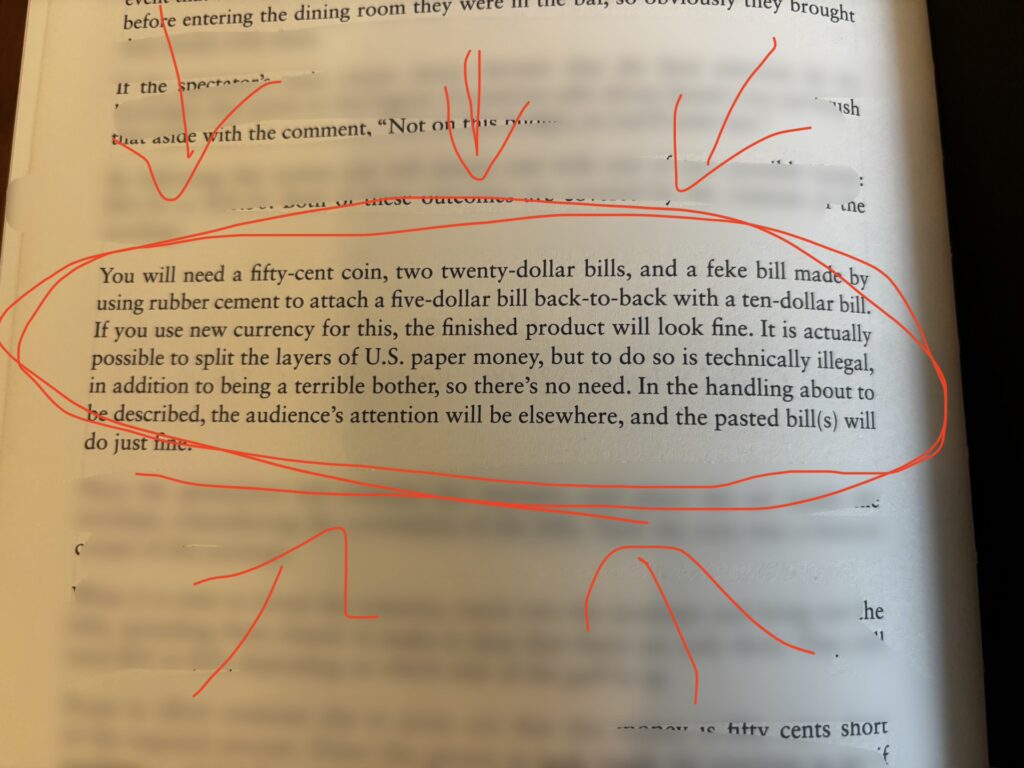
Splitting dollar bills (like splitting cards) has gained popularity in the last decade. I honestly thought it was a new thing, however I was reading Ansology and in Max Maven’s book Thabbatical from 1994 he casually mentions it!

text in mentalism book

Unfortunately he doesn’t mention HOW it was done back then, but I can’t imagine its too different from how we do it now. I’m also very curious WHO was doing it back then.

-Louie

Out of Sorts by Max Maven

As I’m working my way through Max Mavens book Ansology, I think my favorite trick in it is called Out of Sorts. This is a trick where a spectator thinks of a card and they never say it out loud, then after a few shuffles, You then tell them what their card is and where it is in the pack.

I’m really liking this trick, it can be done hands off or with the dealing done yourself. I was trying to think of a way to do it so that it wasn’t a card trick and I came up with a way to do it with postcards. The postcards I’m using are national park postcards.

8 Postcards

If you are familiar with the trick, you know you need pairs of cards. In the picture above, you’ll see that the postcards are kind of in pairs in columns. Once you know one, it’s pretty easy to know the other. The challenge with this specific set of postcards is that the writing isn’t very big. I think if this is something I was going to pursue, I’d find something with a larger print of the name of the place.

Using these postcards the method doesn’t change. If you have the book, I recommend looking into the trick out of sorts, even with playing cards it’s still great!

-Louie

Max Maven’s Ansology

On Monday, I went in to have hand surgery. It’s a trigger finger release; hopefully, I will have full use of my middle finger on my right hand again! Before the surgery, I ordered the Max Maven book, Ansology. The night before surgery I started working through the book. This book is a combination of several previously published Max Maven books along with a little bit of new commentary.

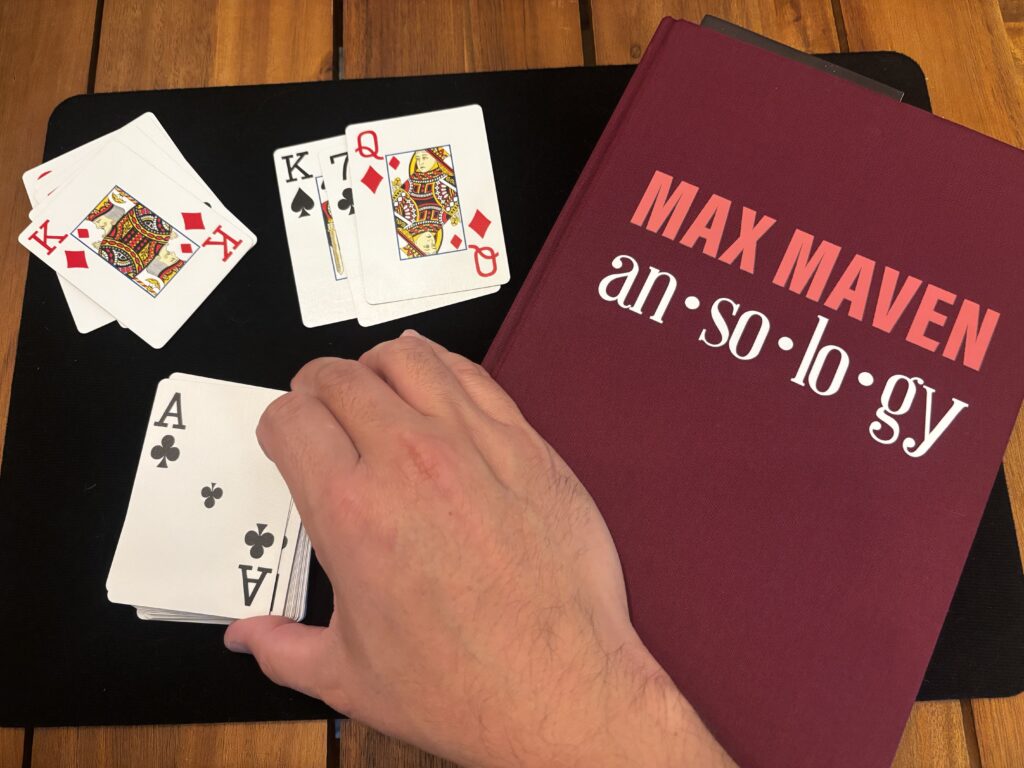
A hand with cards and a Magic book by Max Maven

The nice thing about this book is that it doesn’t rely on heavy sleight of hand for most of it. So I’m able to work through a lot of this stuff with only one hand. So far two great tricks I found are Abacus and Out Of Sorts.

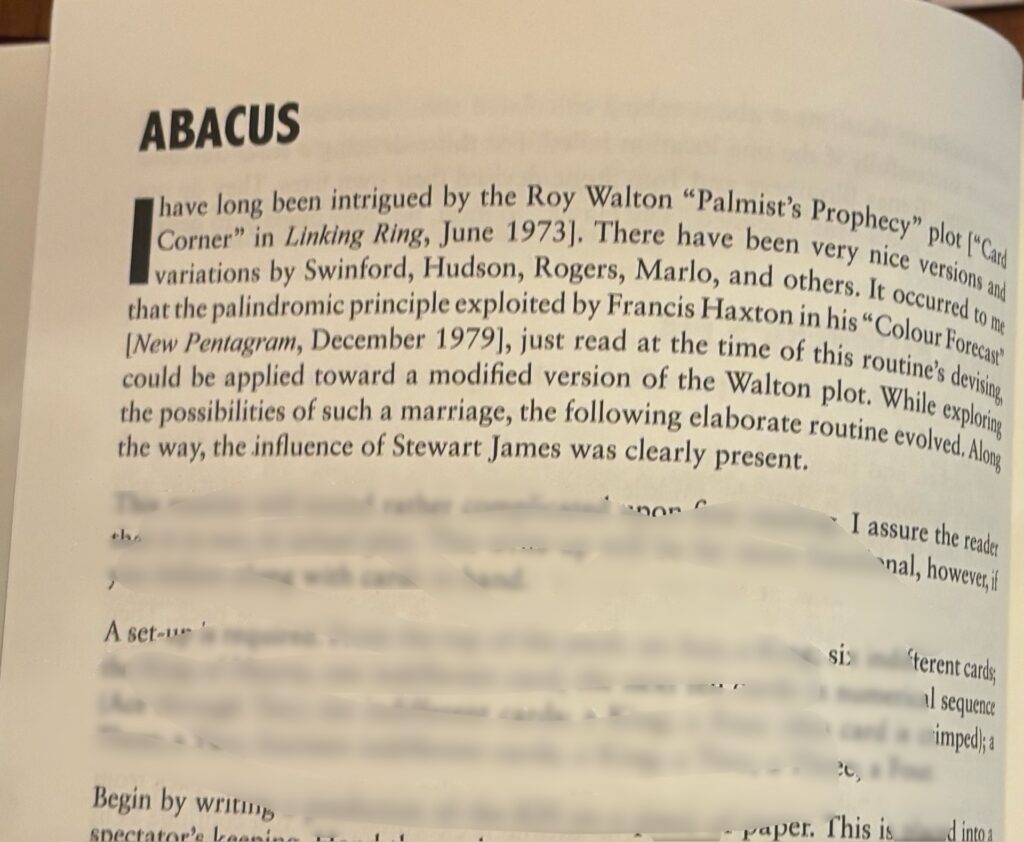
Abacus is an epic trick with multiple endings; it feels very modern, even though I think the trick is like 40 years old. The only drawback is that the trick uses a full deck setup, so for this trick to work, you’d really need a deck switch before you do it.

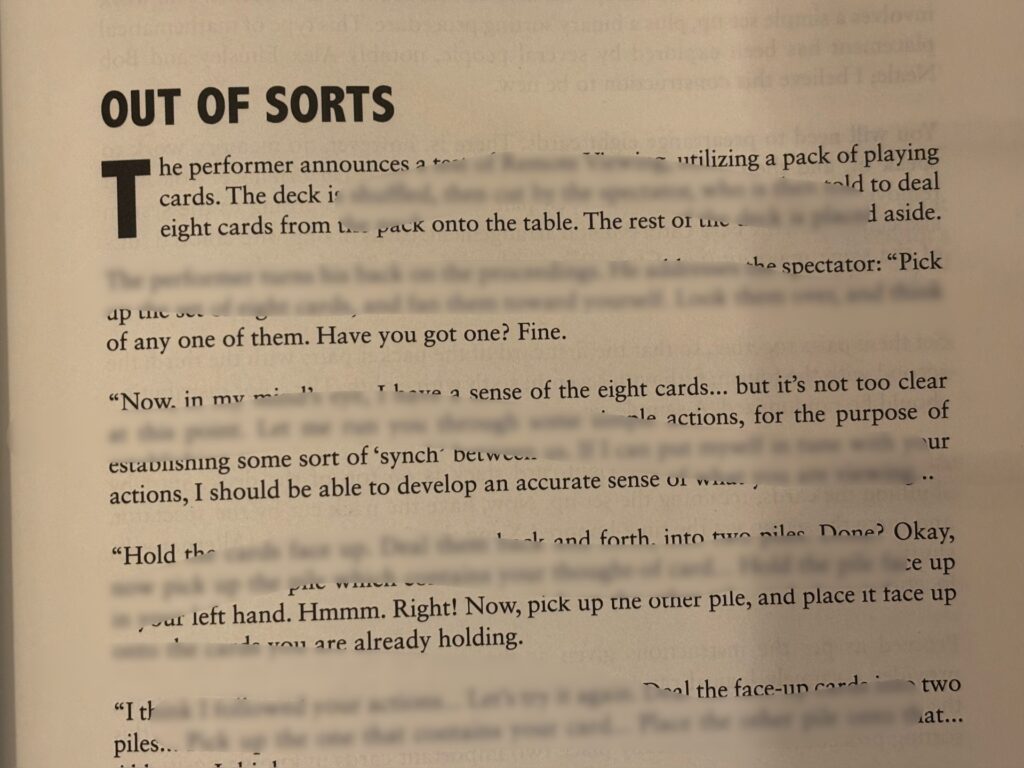
Out Of Sorts is a great hands-off card trick where you not only tell the audience where their mentally selected card is with your back turned, but you also tell them what it is. This trick does have a bit of procedure up front, which I’m not a fan of; however, I think the payoff makes it a real head-scratcher. I think this is going to be my go to trick right now with only one hand.

I’m looking forward to going through more of the book. I’m familiar with one of the books that’s contained in this anthology Of previously published Max Maven Books. This style of magic, which relies heavily on procedure, math, anagrams, and very light sleight of hand, is great for me right now!

-Louie

Progressive Anagrams…

Soon after I got seriously into magic I picked up a copy of the book Thabbatical by Phil Goldstein (Max Maven). It’s got several progressive anagram tricks in the book. If you don’t know what a progressive anagram is, it’s a way of figuring out a word that someone is thinking of by asking them if certain letters are in the word. Everytime you get a “NO”, you move to a new list. In a good list, by the time you get to the second “NO” you know the word.

The huge problem with using a progressive anagram is the person needs to be able to spell the word correctly in their head. Sure you can have them take the word off of a list, but I think that takes ways what makes this type of trick work, and that’s that you don’t need any props.

The other challenge is that you need to memorize a flow chart of letters and words. It’s not super hard, but it does take work and you need to keep in practice. However, right now with use all stuck at home and doing magic over the internet, you can easily do progressive anagrams without memorizing anything! The way to do it is to simply print it out and put it someone outside your camera’s field of view. No memory work, it’s plug and play!

Premonition…

One of the card magic plots going around right now is a “Card To Pocket” that’s done in the style of Eddie Joeseph’s Premonition. Right now Max Maven’s Pocket Nightmare and the Other Brother’s Card To Pocket are just coming out. The trick is a card is selected, the cards are gone through and there … Continue reading “Premonition…”

One of the card magic plots going around right now is a “Card To Pocket” that’s done in the style of Eddie Joeseph’s Premonition. Right now Max Maven’s Pocket Nightmare and the Other Brother’s Card To Pocket are just coming out. The trick is a card is selected, the cards are gone through and there are only 51 cards, their card is missing. It’s then produced from your pocket.

Last night I was reading the book Concertos for Pasteboards and there’s a Card to Pocket by Roberto Giobbi called A Case For Premonition. This one uses one normal deck, which is a huge advantage for me than the two marketed ones. The disadvantage is that I need to deal the cards instead of letting a spectator go through the cards. Personally I think the condition of the audience dealing is a that impresses magicians more than non-magicians (in most cases).

After working through the one in the book, I did a couple of tweaks. There’s a moment where you need to spread through the cards to find selected card that had just disappeared. I didn’t like that, so in the dealing process I deal them a bit sloppy and side jog the card before the selected card, which lets me find it without spreading the cards. The other thing I changed was the need for a cull palm. Instead as I pick up the deck I do the pass that’s used in Bob Farmer’s Bammo Card Walloper to bring the card to the top and simply palm it.


I’m excited to try this out on real people to see how it plays. I think this will be one of the tricks that I do as part of an informal card set. I always like reading a trick and immediately know that if I change a couple of things it will work with my body vocabulary.