Shell Game Ending…

When I perform and have tried doing the solid shell kicker, it never played how I’d like. I think there’s a disconnect between the shell game and when the solid shell is reveals, it’s a little out of left field. I was playing around with an ending as a topper to the kicker of the solid shells that I found in an old notebook of mine.

You can read this post about it from about a month ago.

I don’t think I ever posted video of it. Here’s the first version of it. I need to remake it, but you get the idea

I’ve done this a few times over a livestream and so far it’s playing really well. I can’t wait to try it out for real people, whenever that will be!

Practicing Progressive Anagrams…

Awhile ago I wrote about using progressive anagrams for streaming shows. Here’s a test show I did with the routine that was written up in those posts:

I should have handled the envelope a lot less, I’m way too fidgety with it. That and scripting it out better would have tightened it up. One of the cool things about right now is that there are soo many of these live stream shows you can get on and work out the bugs to routines before you take them in front of a paying audience!

Final Loading Sequences

Many years ago I remember watching a VHS tape with Dan Fleshman who did his Fleshman Flash as part of his cups and balls routine. This is a cool loading move for cups and balls that is a virtually invisible way to load two balls into the cups.

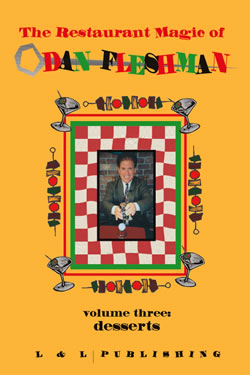
It looks like he teaches the Fleshman Flash on The Restaurant Magic of Dan Fleshman DVD vol. 3.

dan fleshman magician

I remember rewinding that VHS tape over and over, the move was virtually invisible. Early on, that got me thinking about loading sequences and how you need to do more than simply put something into your pocket and steal it out the load.

Here’s and early version of my Cee-Lo Trick and at the end you can see the how the load of the second jumbo dice isn’t from my pocket.

And here’s another loading sequence that I’ve put together:

I think that varying your loading procedure is important. If they all come from the pocket at you put things away, it’s still surprising to an audience, but not as amazing. The more you go to your pockets the easier it is to backtrack. Start to think of clever ways to sneak the large production items in that aren’t all from the pocket.

Force Dice…

Many years ago I made up some force dice for a couple of magic lectures. These dice force two numbers on command. I’ve had a few of unsold sets kicking around my office for a few years. About a week ago I was jamming with some magicians over Skype and we were talking about forcing items online. I remembered these dice and how they’d make a great way to for an object in a virtual show.

Here’s a video that I made that explains how to use them in a virtual show:

The cool thing about these dice and gimmick is that you can let the person change their mind after the first roll and reroll. That makes it seem super fair, however it doesn’t change how the force works.

The leftover batch of dice sold out immediately after listing them for sale. The demand was there and I made a second batch and those also immediately sold out. I may make another batch of the dice and gimmicks in the future. If you’re interested in a set of the force dice, contact me and I’ll put you on the list.

Mismade Bill!

In my magic lecture I talk about how you should be taking your magic one step further than what’s already out there. This is especially true if you are doing stock magic tricks. One of the twists I’ve put onto a standard magic trick is my finish to the Midmade Bill trick. It’s a trick I call Splitting Image, it was just reviewed by a magic reviewer:

With everything I do, I try to move it a step beyond where the store bought version is. This is advancing the act, simply doing sponge balls doesn’t.

Polaroids to Envelope

For the Polaroids to Envelope magic trick I’m working on, the last technical step is to clean up the handling. The initial handling had three Tenkai Vanishes, which is fine, but redundant. I also think that if you do the same false transfer over and over, you need a convincer to show both hands empty.

Here’s the tweaked handling:

One thing that I decided with showing both hands empty was that I didn’t want to make both hands being empty part of the vanish. I wanted to show both hands, just not show the dirty hand as a “moment” of the trick. In the video you’ll notice that I show both hands as I turn the envelope over.

The technical end is finished for now. The technical part is something that may evolve over time, and something that’s never completely done.

Color Change

The other night while watching TV with the family I was fiddling with a deck fo cards and came up with a strange color change. There’s a lot wrong with it, and in its current state it’s not a good color change.

The main problem with it is that it’s not good for video. I can see the flash that happens when you palm the card being hidden in a live show, but not on video. Also there are better ways to do a color change.

It was fun to play with.

Original Magic!

I found the trailer for the upcoming season of Masters of Illusion and you get to see a trick I invented at the 27 second mark:

One of the great things about creating original material, not just presentations is that when you are pitching acts to a TV show you don’t have to worry if something has been done before. This applies to more than just TV, it’s a huge advantage for variety shows as well. You don’t need to fight over who gets to do what trick.

Original content is king!

Conditions on a Coin Routine…

The last couple of days I created and refined a coin routine. Here are the two routines and the conditions:

Initially the conditions were:

  • Viewed from the front
  • Done for the camera
  • No table
  • Face must be framed

I will say that I initially fudged the face must be framed because I put the coin in my pocket, however there’s still action by my face as that’s where my right hand stays holding a coin.

After coming up the first version, I added a couple more conditions:

  • Hands stay in frame
  • Usable in a LIVE show with video projection
  • Able to set up quickly

With the second set of conditions, I’m thinking about actually using the routine. In the second version, I’m playing the the camera for the two times the coin disappears from one hand and reappears in the other, but it will still work live. The set up quickly condition is huge, I need to be able to reach into my case, grab the coins and be good to go.

Then there’s a small challenge with the condition of my hands not leaving the frame. I have the stupid penny to keep hidden after it changes into the two silver dollars. It sounds simple, but was a pain to figure out how…until I came up with a very simple and obvious solution to holding out the penny for almost the whole routine.

The next step would be to start to work on a verbal routine, or at least intro, to get more than 30ish seconds out of the routine.

Continuing Creating a Coin Routine…

The coin routine that I started yesterday started with a penny turning into two silver dollars. One silver dollar repeated traveled from the pocket to the hand and for a finish one of the silver dollars turned clear. It’s a decent routine, however after playing with it, I added a couple more conditions (I’ll write about the conditions tomorrow) and here’s what the routine changed into:

The first big difference is the routine is about 17 seconds shorter. I took the coin going from the pocket to the hand, that I felt was pretty redundant after I did it more than twice. It doesn’t feel as impossible with a coin as it does with a ball. It’s interesting that the routine started with a billiard ball manipulation premise, however moved away from that.

The ending with both coins turning clear makes more sense than just one of them doing and the final display of one in each hand is better.