
Three Card Monte Sequence

One thing that I like about the Three Card Monte is that it automatically engages the entire audience. It’s a game they all can play with being the person playing it. That’s why I think things like the 3 Card Monte or the Three Shell Game are perfect for virtual shows. The level of engagement is great!

Here’s a video from a practice session:

I’m working out the sequence, right now it’s:

  1. Mix and the money card is in a different position
  2. Set aside a non-money card, do the mix and the money card is now the one set aside
  3. cards change so the two non-money cards are now the money card and the money card is now the non-money card
  4. all cards change into jokers

There’s a lot of magic that happens in that sequence. It’s a pretty amazing sequence, and basically using the three card monte premise as a presentation hook for card color changes.
Copentro Like Routine?

After playing with the coin trick from yesterday’s blog post, it hit me that I could do something similar to Bob Kline’s Copentro trick. If you’re not familiar with the trick you can see it here:

Essentially the difference is that Copentro has a base for the cup and then typically a stand the holds the coins to allow them to vanish. Using the coin vanish / production from yesterday (plus something else), I can now do the Copentro trick eliminating the base and stand.

Here’s a proof of concept video (nowhere near a final version):

The routine and the moves still need some practice, but I think it has the potential to be a solid little routine.

An Old Idea…

A couple years ago I was playing with using black 2.0 paint to make a coin appear. The problem with it was that it really didn’t work in an in-person context for the show. Well, in the current world of virtual shows, I can control performing conditions in the room I’m in, so I’ve started playing with it before.

Here’s a test video:

Personally I like the production more than the vanish. I like how there’s a “pop” to the coin when it appears. Now I need to figure out what to do with it and how it will be used.

Test Firing the Cannon!

Over the last couple of days I designed and built a tiny cannon that will shoot out a flea in a flea circus. I picked up some flash paper and finally got to try it out and it worked! It’s always a good feeling when something translates from your head to a physical prop easily.

If you’re not 3d printing props, you are really missing out. Basically within 3 hours of chatting about making a flea cannon I had one in my hand. The video below has a little overview on the 3d printing process as well as a demo of the flea cannon.

If you don’t have a 3d printer, you are really missing out!

3D Chop Cup Routine

One of the Facebook groups that I belong to is a Magician’s 3D Printing group. It’s an interesting group, a few people in it are making some cool stuff. Recently someone asked if anyone had made a chop cup before. I mentioned that I had and made stack of nested cups as a final load for it.

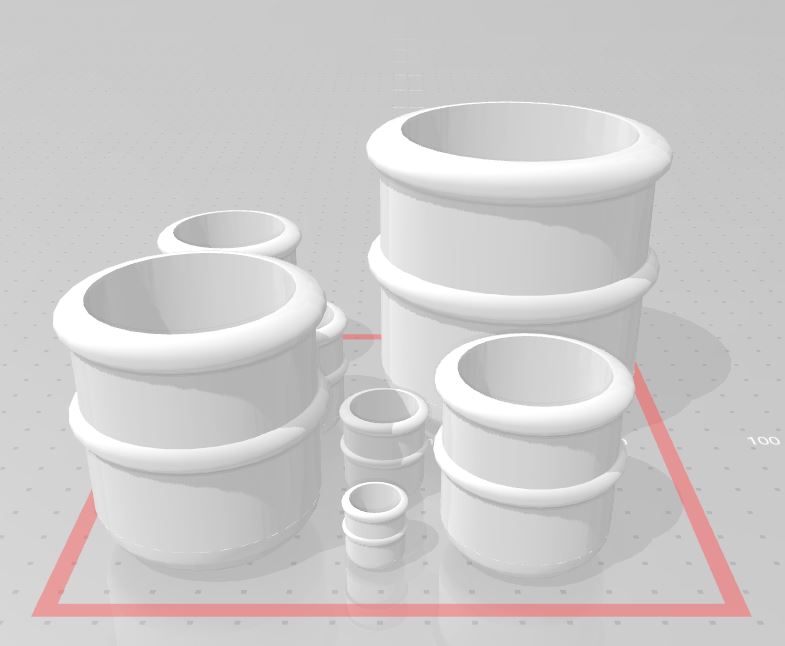
I no longer have the set of cups, but here’s an idea of what they looked like:

nested cups and balls final production

This set was 100% inspired by Gary Ouellet‘s column Fulminations in Genii Magazine where he had a series of nested cups as the ending for a cups and balls routine. This led to my Russian Shell Game trick, which is a Three Shell Game that ends with a ton of shells on the table.

The fun thing about the time we live in, is with a little bit of tinkering around, you can make virtually any prop you’ve ever wanted with 3d printer!

A Gag Saves the Show!!

Right now some of the only live, in person performing that’s available to do are masked, no contact, socially distant, small group magic shows. These are magic shows for kids. The big challenge with these shows is wearing a mask when performing for younger children (ages 3-5).

One thing that I’ve added to the show is a prop that I built for a show a couple of summers ago, but the routine never played well. The prop that I build are Remote Control Chattering Teeth!

I started out using them as a warm up, which is right out of David Ginn’s book Comedy Warm Ups for Children’s Shows. However, I quickly moved the routine deeper into the show, and it’s not a warm up, but part of a full routine that I was working on.

The teeth are now used in the Silk to Peach routine, and that routine has built out into a 7 minute routine full of laughs! I’m glad I dug the teeth out again and started using them!

Vanishing Birdcage For Younger Kids…

Not too long ago I was doing a virtual show for a summer camp. They wanted me to do one live show and that show would then be shown to the other classes. That’s fine, however they gave me the youngest group first. Normally I’d recommend doing one of the older groups first, but given the current state of shows, I can’t be too picky.

Once I knew I was going to be performing for the youngest kids, I figured I’d play a bit more. I’ve been wanting to figure out how to present the Vanishing Birdcage for younger kids, and looked at this as a chance to work on that. I really didn’t have anything preplanned, aside from the vanish.

I put the whole thing together as I did it. The hand towel I normally use to wipe my sweat, and just grabbed it and produced the bird from it. Then playing with asking what it ate, and manipulating it a bit like a spring puppet. I’m glad I got just over 3 minutes out of it, without really planning anything.

Hopefully if I sit down and do some writing I’ll be able to get 4 mins out of it! It’s fun to be using my Take Up Reel in shows right now!

New Book Day!

Today I’m starting to read Paul Romhany’s book Stand Up Magic. He’s my editor over at Vanish Magazine, and I’ve been a fan of the stuff that he puts out before I started writing for Vanish. It’s all solid real world stuff.

I’m one trick into it so far after reading the introduction, etc and he does a great job explaining it. It’s a number prediction and not only goes into the work in great detail, but also covers variations and afterthought on the routine.

What I like about the first trick is that it’s clearly put together by someone who is actually out there working. It’s got a solid method. One thing I’ve learned to be able to spot in books and DVD’s are methods by people who aren’t out there working all the time. The may be great for a one off show (which isn’t a bad thing), but aren’t solid if you’re out on the road performing all the time.

I’m excited to read more of this book!

Magic With a Message…

It’s been over four months since the government essentially shut down the performing arts industry. It’s open in a very limited capacity right now in the USA. Last week was the last week I was able to claim the federal PUA in addition to my state unemployment benefits. Here’s a little video I made about it:

As far as a production goes, it’s a fairly understated shotglass production. The tube it’s produced from is about half the size of the shotglass. However as far as scale goes, it’s pretty small on the screen and the magic isn’t as strong as it could be…but the message is solid.

Flattening The Curve…

The whole virtual magic show is changing what you can do in your shows. Tricks that really weren’t practical to set up in a venue now make sense. Tricks with bad angles now have a place to be performed deceptively.

A few years ago they Stewart Semple came out with the Black 2.0 paint. This is a flat black paint. It doesn’t have a lot of use in a live magic show because it doesn’t trap light like a velvet does, but it turns out it works pretty well in videos.

Here’s a trick that uses Black 2.0:

I think I wrote this trick up in Vanish Magazine a couple of years ago. It uses the 2d of the screen you are watching on to hide the 3d of the “black hole”. I like the idea of switching a flat object for something that’s round and using that space to hold a production.

I really like the idea of hiding the production in plain sight.