
I’m going to try to put together some sort of a routine with the gimmicked envelope that was in yesterday’s blog post. Essentially this is an envelope that you can load things into while it’s closed. There’s not much to the envelope, basically it has a hidden trapdoor that allows you to load it thru the bottom. This post isn’t really concerned with the mechanics, it’s more concerned with what to do with it.
My first idea was for a trick over Zoom. What happens is you show the envelope and have someone name a card and it’s in the envelope. How I’m doing it is having someone off camera load the card into the envelope what the bottom of the envelope is off screen for a second. I’ve done this a couple of times and it works.
My second idea is to expose the camera edge with a fake explanation. You show a side view of the trick and what happens off camera is a “Rube Goldberg” sort of way to find the card and put it into the envelope. I think this is a fun blow off and gives you more time out of the trick. However the trick needs a kicker of some sort to so that it has an ending instead of just a blow off.
Category: Tricks
Gimmicked Envelope…
A few nights ago I woke up with a idea for a gimmicked envelope at about 3:30am. I went back to bed without writing it down. Then an hour later I woke up with the same gimmicked envelope idea “fleshed” out a bit more in terms of a routine. I went back to bed without writing it down again. I got up once more about 90 mins later with a more fully formed routine for the trick and immediately went to the office to build the gimmick!
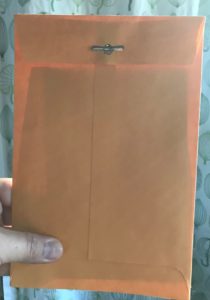
First of all, if you wake up with an idea, you should always write it down. Most of the time if you got back to sleep, the idea is gone. I’m lucky that I work up multiple times with the idea and it wasn’t lost. Here’s the gimmicked envelope with a jumbo card inside:
I’m not sure that an envelope has been gimmicked this way before. Basically what it does is allows something to be loaded into the envelope.
What I like about this is that in the picture above you can clearly see the gimmick. It’s hidden in plain sight, and that’s what makes it interesting for me. Tomorrow I’ll kind of write up the rough routine for it.
Keep Working On It…
One thing that I’ve been working on is learning to cast things in resin. I’ve been doing little projects for people to give me things to do to learn with. One thing someone asked me to do was make the coin for the Silver Extraction magic trick, but with a Silver dollar instead of the half dollar that it’s traditionally made with.
If you’re not familiar with the trick, here’s a dealer demo of it:
The trouble I was having was getting the coin made in resin without too many air bubbles. After a lot of work and learning, I’ve gotten a workable clear resin coin:
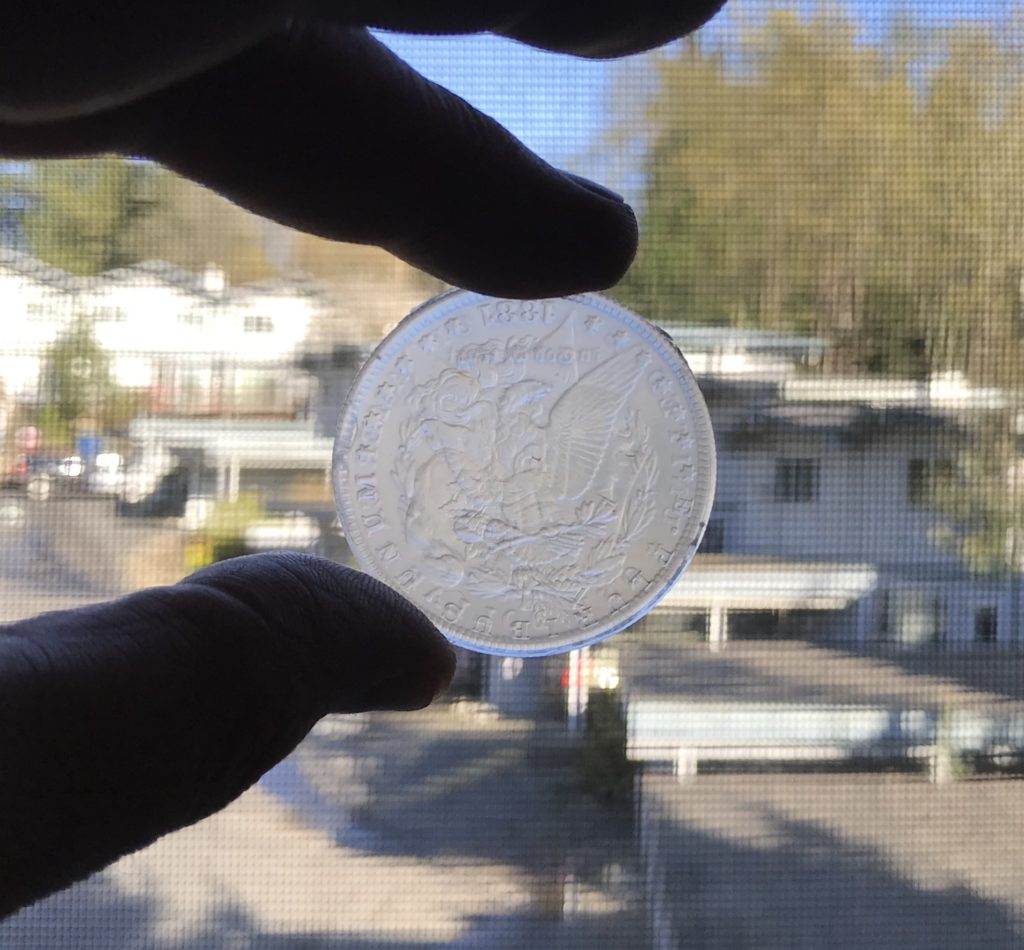
I think if I make another one, I will remake the mold with my newfound knowledge and that will give me an even better result. When I’m learning something new, I love working on projects for friends, as it helps me learn to do thing and try them in ways I wouldn’t normally.
Interactive Virtual Magic
Right now there’s a lot of interest in interactive magic tricks, where someone can follow along from their home, and the magic happens to them. There a principle that I was first introduced to in the trick Fingertip Mentalism from the book Nothing But Mystery by Jim Steinmeyer. Then I found the book Body Mentalism by Juan Pablo explains and explores the principle much more in depth.
Here’s a video I recently made using the principle:
Personally I like the idea of having people post a pic in the comments much more interactive than simply revealing where they are. Also I find a lot of humor in them posting their middle finger, but in my soul, I’m still a 12 year old boy.
Once you know how to do the math, it’s something that you can do anytime. What I like about it is the principle isn’t limited to “do as I do” type tricks. It’s handy to know things like this, it allows you to do some impromptu magic when you have nothing!
Vanishing Bird Cage…
Every now and then there are tricks that you can’t get out of your head. One of them for me is the Vanishing Bird Cage. I’ve revisited it several times over the years, and in the past hit stumbling blocks with it. The birdcage is probably one of the most difficult tricks I’ve worked on. There so much you need to overcome, it’s not as simple as the old magic catalog ad makes it seem.
One of the issues that’s easy to overcome is the issue of doing the birdcage later in your show. This was solved by Billy McComb with the use of a Take Up Reel. It was popularized by Tommy Wonder in Volume 2 of the Books of Wonder. By popularized, I mean people became aware of it. After that book came out, there were still not many people used one, simply because of price and availability. If you could find one or get someone to make you one they’d cost you somewhere in the ballpark of $1,000 or more!
One day I was driving and an idea hit me for a way to produce the second lock of a Take Up Reel on my 3d Printer, I pulled over and drew it on the back of an envelope. After using it and having some other people use it and gotten their feedback, I’ve finally decided to offer them to other magicians.
Here’s the promo:
When something’s in your head, if you keep chipping away at it, eventually you’ll come up with a solution!
Click here for more info on my Take Up Reel or order one!
Best Card Gaff!
One of the coolest card gaffs is the Modern Flap Cards by Hondo. He makes the as a premade gaff, or as a video where you can learn to make your own. The video is the way to go, as you’ll be a lot more versatile with what you can do. There’s a little bit of a learning curve to making them, but it’s really not that hard.
I use one in my preshow video in my cruise ship show, and in a lot of social media videos. I haven’t used them in a live show, simply because I don’t really have a place for them. The problem is a playing card is small, and the change is hard to view from the back row.
It hit me a while ago that you can do the change with the card isolated in a cup. I hadn’t had time to really play with it before the self quarantine, however I played around with it and here’s the card color change change in a cup:
There’s a little bit of knack to do the move in a cup. In a nutshell I’m using the weight of the card to keep the change from happening. It’s all about the angle you lean the card at. I think the next time I make some of the flap cards, I’m going to have a bit less tension, so that I have more wiggle room with the angle of the lean.
The discovery of doing the change in a cup is the direct result of playing with the gimmick and a good example of why you should be playing with gimmicks beyond what’s in the instructions.
To Post or Not To Post…
The other night I was chatting with Matt DiSero about the Bounce No Bounce Balls trick. If you don’t know the trick, it’s a ball that bounces and a matching ball that doesn’t bounce. He came up with a really cool ending for the trick and I made a quick video of it:
Here’s the dilemma I’m having, in the video I feel like flash the palmed ball too much. Should I post the video on my social media or not?
Before you say, “why don’t you just rerecord it?“, let me tell you that I can’t. I had just sold the set of balls, so this was recorded right before I boxed them up. Now before you say, “why didn’t you rerecord it before you shipped them out?“, let me tell you that I couldn’t. I only had one tomato, and with the current self quarantine, I didn’t feel that a trip to the store to buy tomatoes would have been a wise decision.
For now it’s living on this blog. I may post it as sort of a look behind the curtain of how magic tricks develop.
Creative Cup Productions…
Tricks that end with something big appearing are always fun to do. They are (usually) amazing and the big object is an instant applause cue and signal that it’s the end of the trick. The challenge right now with all magic happening over cameras, is how do you load the object?
A couple of nights ago I decided I wanted to do a Cups and Balls type trick where someone couldn’t backtrack on video and figure out where the load came from. First I had to examine how to get the big object under the cup.
There are essentially three ways.
First you can take the object off screen for a second and load the item. This works for a video conference where they can’t rewatch the video of the trick later. Personally I think that magic that’s put out on video should be able to withstand at least one rewatching of the video.
The next way is you can load the large item like you would in a normal show. Unfortunately misdirection on a screen doesn’t work like in real life and while it still may play most of these style of loads will be less deceptive. I’m not saying all will, for example a load coming from under the table while you are sitting will be more deceptive that one coming from the back pocket while you are standing.
The final way is having the item in video’s frame and hidden, and sneaking it into the cup. The Larry Jennings / Ron Wilson Chop cup routine is a good example where the ball is stolen from inside a bag.
I decided to go with the having the item already in the frame as this is the method that would withstand the repeated viewings. That got me thinking about the Scotty York Cups and Balls routine where the cups start the routine loaded with the large balls. I then took the frame work of my Cee-Lo (cup and dice) routine and started playing with the cup loaded from the beginning.
Here’s what I came up with:
To do this trick, you’ll notice I’m not using the chop cup as it’s traditionally used. Normally people use the cup to help make the ball vanish and reappear. In this routine, I’m using it as a delivery system for dice. I came up with a way for it to give me two separate loads of dice. Once at a about the 43 second mark and then at about the 52 second mark for the large die. Making a “progressive loading” cup took a bit more work than just shoving dice into a cup with my hand, but I think it’s more deceptive on video.
Ideally since I’m only loading one die, I’d like to use a larger die as the final production. Due to the self quarantine, I’m limited to what I’ve got at home.
Right now as most of us shift from live performing to virtual performing, we really should be reexamining methods to see if there’s a better way to do things.
Glove Magic…
The other night I was having a virtual magic jam and was showing some of my ideas using surgical gloves. Here’s a few of them:

Gloves are interesting to use for magic because they fit have a built in “black art” to them. Also like water they have rules, they have to stretch, are essentially air tight and things can’t get through them. We can now use those rules to our advantage. The old close up black art tricks with thing like the chinatown half no longer need the black card. You just set the coin onto your palm, and they can see right thought it!
I’m not sure that the use of gloves will have much of a life beyond the next year when all of this COVID-19 stuff hopefully is over. I do think that glove tricks are good social media content right now.
My Cooking Show…
In yesterdays post I showed a gimmick that I was making for a video. This video was made because my brother said I should do a cooking show for our weekly “virtual dinners”. A night before our dinner, I had a ton of ideas and wrote out a rough script, and sent it to a buddy of mine who punched it up. I then built the gimmicks and recorded the show.
Here’s what I made:
At about the 9 min mark you can see the gimmick I posted about yesterday. There’s a couple of other interesting magic effects that happen in the video as well. This was what I found interesting about making the whole video was that the cooking was a frame for magic to happen. It was a built in presentation hook.
It took over 12 hours to make this video, and the sole goal of it was to make my brothers laugh. That’s art, money or longevity of it wasn’t a consideration, it was simply to get a reaction. What reaction are the videos your are posting designed to get?