After The Force…

The other night I finished up reading After The Force by Ron Frost. I think it’s important to keep learning. There are tons of magicians I know that don’t learn magic for fun. They only learn something when they have to, which I think is the wrong approach. I think that magicians need to keep … Continue reading “After The Force…”

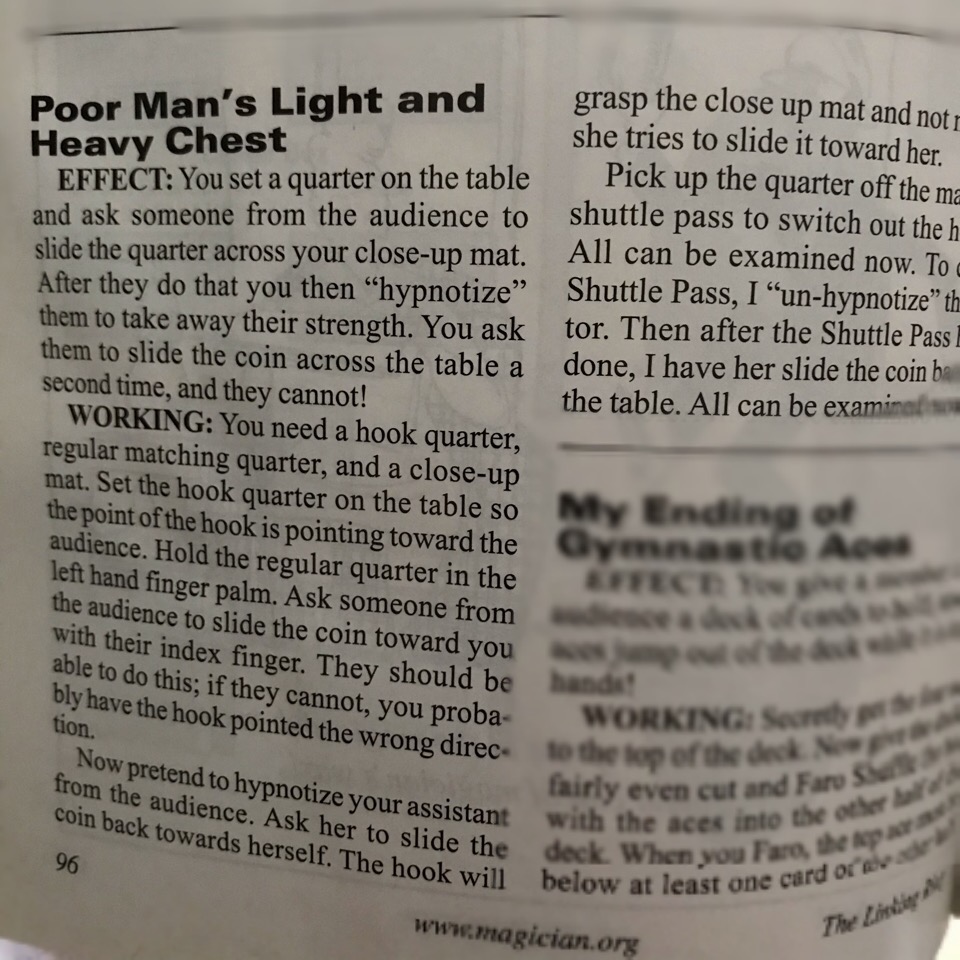
The other night I finished up reading After The Force by Ron Frost. I think it’s important to keep learning. There are tons of magicians I know that don’t learn magic for fun. They only learn something when they have to, which I think is the wrong approach. I think that magicians need to keep on top of techniques and tricks.

image from Vanishing Inc

This book’s title is a bit misleading, I expected just endings to card tricks. The first part of the book teaches you how to force cards in a variety of ways. I agree with Ron’s assertion that the Classic Force is the best force. Then he teaches you a lot of tricks that uses forces, but in the context of the whole tricks. It’s the trick start to finish. Not that it’s a bad thing, I just thought it’d be something a bit different.


I’m glad I read the book, and worked through the stuff in it, however I don’t think anything from it is moving into my working set. It’s not that the stuff is bad, it’s just not for my show. There is one move in the book that will move into my “toolbox” or moves that I use when a situation calls for it. The big thing is to keep educating yourself on techniques and grow as a magician.

Podcast Guest Tips…

Yesterday I wrote about learning to be a good guest for doing media spots. Today I’m going to give you some tips to being a good guest on podcasts. Here’s a quick bit of background, I co-host a podcast called the Odd and Offbeat Podcast and also am the co-host of the podcast for the … Continue reading “Podcast Guest Tips…”

Yesterday I wrote about learning to be a good guest for doing media spots. Today I’m going to give you some tips to being a good guest on podcasts. Here’s a quick bit of background, I co-host a podcast called the Odd and Offbeat Podcast and also am the co-host of the podcast for the soon to be released Moisture Festival, which is the largest variety arts festival in the world.

My role as co-host of the Moisture Festival Podcast is to interview performers from around the world. One thing that has surprised me is how many don’t know how to be interviewed. Here are a few tips to be a good podcast guest:

  • Speak into the microphone and stay on the mic.
  • Come prepared. Ask if they have sample questions, or write out some questions and have answers to these. Even if these questions never come up, you’ve put thought into the interview and that will show in the final product.
  • Don’t think you are interesting, plan to be interesting.
  • Arrive a few mins early to chat with the host(s). That will allow you to relax a little bit and get all the awkward chit chat out of the way.
  • Don’t speak with your hands. On a purely audio medium, no one listening can see you. Also when you talk with your hands, you will be whacking stuff like the table and the mics pic all of that up.
  • Before the recording ask if things can be edited. Especially if you are telling a story and accidentally whack something with your hand, can you start over and have them edit the part with the distraction.
  • Answer questions and don’t ramble. If you are asked a question and you don’t want to answer it, tell them that. Don’t ramble a “non-answer” for two minutes.

Of all of these, the big one is to stay on the mic! When editing an episode, if I have to go in and bump all of your audio and no one else’s audio, that’s a huge pain in the butt. Hopefully you can go out and be a better podcast guest!

Learn To Be a Good Guest…

Every performer if they end up having a bit of success will end up being interviewed at some point. Many of those interviews will be either on video (like local TV news) or audio (like a podcast). Personally I do a lot of shows where I have to do media as part of the contract. … Continue reading “Learn To Be a Good Guest…”

Every performer if they end up having a bit of success will end up being interviewed at some point. Many of those interviews will be either on video (like local TV news) or audio (like a podcast). Personally I do a lot of shows where I have to do media as part of the contract. When you do media spots, you can tell who has done them before and who hasn’t.


Learning to be a good guest on these programs is something that takes a little bit of practice. The easiest way to get that practice is to go on podcasts. Talk to you friends who have podcasts and be a guest.


The nice thing about podcasts is that they are pretty low pressure. Things can be edited, and if your just doing your buddy’s podcast there aren’t as many people listening as who would be watching a local news spot. Learning to be interviewed early on in your career will help out later.


Adding an Ankle Switch…

Currently I’m using Audio Ape to run the music to my show. I really don’t care that people know or are aware that I’m using a remove control, versus a sound guy running the music. I keep the remote on my belt and push it as needed. Pretty simple. Lately I’ve been thinking about adding … Continue reading “Adding an Ankle Switch…”

Currently I’m using Audio Ape to run the music to my show. I really don’t care that people know or are aware that I’m using a remove control, versus a sound guy running the music. I keep the remote on my belt and push it as needed. Pretty simple.

Lately I’ve been thinking about adding a ankle switch to one of my remotes (I have two). Essentially what this will do is allow me to play music without having to push a button with my hands. For me there are a couple of moments where I want a sound cue, but my hands are full and hitting the cue can be a bit awkward.


Yesterday I added an ankle switch to both of my Audio Ape remote controls. It was super easy to do, especially after I found this tutorial:

One of my worries about altering a remote to run off an ankle switch was that I would no longer function as a remote and that I’d need a magnet to run that button. I was surprised to learn that the remote functions normally as well as functions when run with a magnet!

Hold on a Moment…

About a week or so ago I saw a local magic show in Seattle. The show was good and one of the performers asked me for some notes on his performance. The thing I told him, and this is something that I consciously have to do in my show is to pause to display the … Continue reading “Hold on a Moment…”

About a week or so ago I saw a local magic show in Seattle. The show was good and one of the performers asked me for some notes on his performance. The thing I told him, and this is something that I consciously have to do in my show is to pause to display the prop after the magic has happened.


In my show I do a trick where a drawing disappears and reappears inside a ball of yarn. When the drawing comes out, I unfold it and show it to the audience. When I show it, I pause and silently count in my head from one to three. This lets people process what they are seeing.

One of the challenges as a performer is that you know what it happening, so your brain doesn’t need to process what it’s seeing. The audience needs a few beats to figure out what’s going on. Simply holding a item for a dedicated amount of time makes a huge difference in audience reception!

Look at Your Show

It’s the last day of January and I’m reflecting back on what I’ve learned so far in 2020. One thing is that you need to listen to your audience. I have two bits in the show that have gotten unexpected reactions that were unfavorable. Instead of the usual laugh the got a sort of “woah” … Continue reading “Look at Your Show”

It’s the last day of January and I’m reflecting back on what I’ve learned so far in 2020. One thing is that you need to listen to your audience. I have two bits in the show that have gotten unexpected reactions that were unfavorable. Instead of the usual laugh the got a sort of “woah” and pull back from the audience. Both of these bits got this reaction at different shows in very different venues.


There are a lot of performers who will brush off these reactions and attribute them to “snowflakes” in the audience. I think this is the wrong way to go. Personally I needed to try to analyze why the audience reacted the way that they did to see if they were over reacting, or if my jokes were becoming dated. The last thing I want to do is use a joke that was OK to say, but over the years society has moved on and the joke is no longer appropriate.


After looking at both of the jokes in my show, I’m keeping one without altering it. The other one, while I think is OK, I’m going to play around with rewriting it. The problem is that the joke gets misunderstood and that audience projected something that’s not in the joke into the joke. I also feel that the negative reaction I got had more to do with the specific situation of the show than it did with the joke.

More on Projection…

Yesterday I wrote about using projection in my show. The key is to enhance the live action, not to replace viewing it from the stage to the screen. Basically the idea is to have the action happen live on stage and visible to the audience, but then using the screen to verify or highlight smaller … Continue reading “More on Projection…”

Yesterday I wrote about using projection in my show. The key is to enhance the live action, not to replace viewing it from the stage to the screen. Basically the idea is to have the action happen live on stage and visible to the audience, but then using the screen to verify or highlight smaller details.


A good example of this would be a Signed Card to Pocket. The main props which are cards are large and can be seen in a large theater. The signature or specific card number is smaller. Having a screen to project the signed card onto will make the effect play larger.

My idea for working solo is to have a dedicated table with a camera on it and then the projector and screen. In a lot of venues I won’t need to provide the screen, as they will have one already, or I may be able to directly project the image onto a wall behind me. Projecting onto the wall as needed is the ideal situation.

Using Projection…

Lately I’ve been thinking a lot about using projection in my stage show. I’ve been looking at how other magicians and performers are using it. It’s something that can make a lot of difference in how visible something is. For magicians, David Copperfield was the first that I was aware of to use in it … Continue reading “Using Projection…”

Lately I’ve been thinking a lot about using projection in my stage show. I’ve been looking at how other magicians and performers are using it. It’s something that can make a lot of difference in how visible something is. For magicians, David Copperfield was the first that I was aware of to use in it his four ace routine. Currently using video is pretty common.


The best use of video that I’ve seen so far is Darren Brown in his Broadway show Secrets. Most people when it’s used, it feels like you are either watching the screen or watching the performer. When Darren did it, it felt like your attention wasn’t torn between two places. You were watching him perform and the video enhanced it.


That’s what I’m going for, using video to enhance what’s happening. Projection would be used for showing the signature of a card, but not the whole card trick. I think when the action happens on the table and the only way you can watch it is through the screen, then it stops enhancing the live show and becomes the audience watching TV.

Not “Organic”, Organic Props…

When creating magic tricks, there are a few reasons why. Sometimes you’ll have a need to create something, other times an idea will just pop into your head. Then sometimes you will have something, or a lot of something and are trying to figure out a use for it. Somehow I ended up with a … Continue reading “Not “Organic”, Organic Props…”

When creating magic tricks, there are a few reasons why. Sometimes you’ll have a need to create something, other times an idea will just pop into your head. Then sometimes you will have something, or a lot of something and are trying to figure out a use for it. Somehow I ended up with a lot of chapstick and am trying to figure out what to do with it.


I have some issues with using chapstick, the main one is while it’s an “organic” item, it’s as out of place in a magic show as a toothbrush is. Sure you can justify it by needing it, but I can’t think of a ever seeing a performer use chapstick during their show. It’d be like a performer brushing their teeth in the middle of a show. That leaves it to informal situations and the drawback to that is that whatever you are doing needs to be fairly simple is set up.


I have an interesting idea, but it will probably end up as something in a magazine, simply because no one will do it. Essentially it’s a transposition with a signed coin and the lip balm inside the tube. It’s really too much work for an informal situation, and too out of place for a formal situation.

Let the Kid Win!

Last weekend I went out and saw a variety show that had a magician in it. The magician did a “quiz show” type bit between a kid and his mom. In the bit one personal always get the easy question and the other always gets the hard question. In the version I saw the kid … Continue reading “Let the Kid Win!”

Last weekend I went out and saw a variety show that had a magician in it. The magician did a “quiz show” type bit between a kid and his mom. In the bit one personal always get the easy question and the other always gets the hard question. In the version I saw the kid got the hard question and in my opinion because of that the bit didn’t play as well as it could have.


There were a few factors that needed to be taken into consideration. First while he was in a variety show and your opener doesn’t have the same requirement as in a solo show, this was his opening bit. That means our first introduction to the magician was him picking on a kid. The second factor was that the kid was enthusiastic about coming onstage, until he got there, then he looked like he didn’t want to be there.


When you combine those two things, you are going to have a rough time with the bit. If you always plan for the kid to win, the bit will do well the majority of the time as you’ve removed the variables from the bit. If the kid onstage isn’t into it, but he still wins, that’s a win for you. It’s also easier for an audience to like you when you are nice to a kid.