Interactive Coin Force…

Yesterday I wrote about working on an interactive coin trick (read it here). This is the style of trick where the person (or group) follows your instructions and you predict where they end. My version has a physical trick kicker that ends with a vanish of all the coins that the audience isn’t holding.

Today I’m going to talk about the procedure that I’m using to force the coins. I came up with my own force sequence for this routine. If you’ve just read Jim Steinmeyer’s Impuzziblities books, they don’t really teach you how to create your own sequence. That’s OK as that’s not the purpose of those books.

The book Body Mentalism by Juan Pablo Ibanez really does a good job of laying out principle that will allow you to create your own sequences. Right now with these “do as I do” interactive style tricks being very popular, I really recommend you get the book to understand the principle. I think knowing why the forces work is good knowledge to have in your head…even if you don’t intend on creating your own sequences.

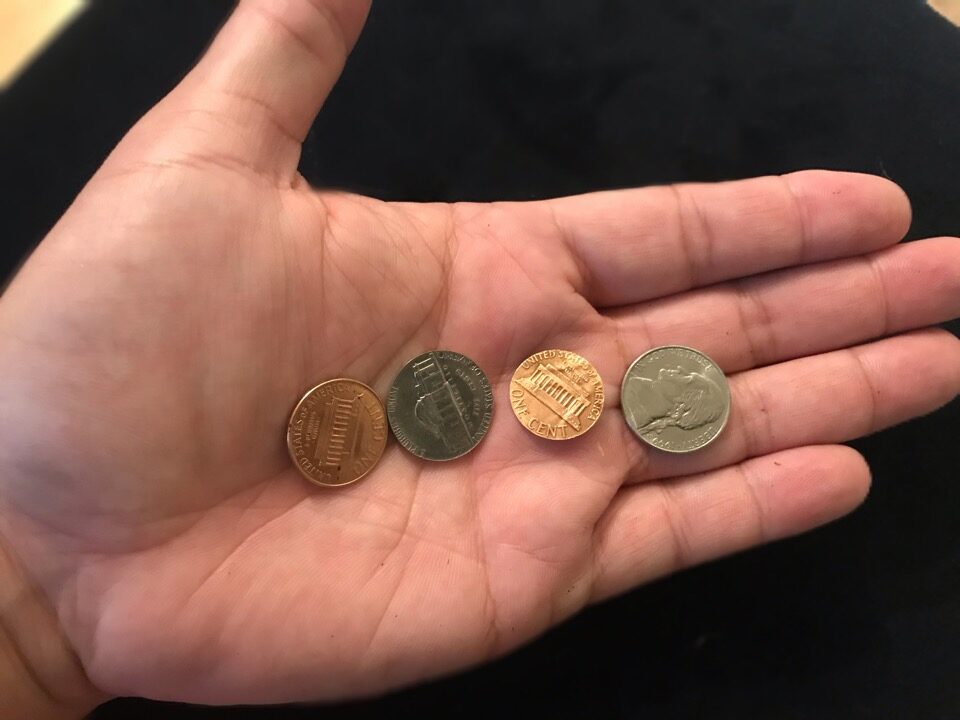
Okay, let’s get to the sequence I came up with for the trick. You lay out four coins in a row, two pennies and two nickels. They are in this order:

Penny – Nickel – PennyNickel

You have them touch any coin, then explain the “rules”. These are you will give them two things to spell, and they move one coin per letter. The first thing they spell is the name of the coin they are not touching. If they are touching a penny, they will spell N-I-C-K-E-L and if they are touching a nickel they will spell P-E-N-N-Y.

Now you have them spell the name of the coin that they are now touching. For example, if they are now touching the penny, they spell P-E-N-N-Y. The coin they are touching is now their new selected coin.

If they followed your instructions they will now be touching a nickel.

This sequence by itself isn’t very strong, but when you add the vanish of all the other coins, it becomes a pretty decent trick.

Interactive Coin Vanish…

One of the things that’s huge in magic right now are the tricks where the spectators at home follow along with what you do and you end up knowing what they are thinking of. I wrote about my thoughts on this recently, and you can read that blog post here. Basically I want to use add magic to the puzzle to make it more magical.

After the blog post, I wanted to come up with an original trick, with an original puzzle. The trick was going to use coins, so I went out a bought a 21 Cent Trick and a $1.35 Trick at my local magic shop. With these two sets added to the array of trick coins I already had at home, it would allow me a lot of options for the routine.

The premise I was going with was a coin would be selected and all of the coins would disappear. The problem I was having was with the sequence of the counting. There was too much of it.

I finally settled on using two pairs of coins, two pennies and two nickels. In the end they pick a nickel, and the other three coins disappear and there’s just a nickel left.

Behind the Virtual Curtain…

Performing a live, virtual show over Zoom it a lot more involved than most people think. Last night I gave a talk about and demonstration about Hand Shadow Puppets and taught a magic trick for the Washington State Parks Great Camp In over Zoom that was broadcasted on YouTube live.Here’s a side by side of what’s happening in the room and what is going out on YouTube.

The person I’m talking to is the host of the show, who is in another location.

The person in the room is my daughter who is running production for me.

For a bit of context, the speaker before me just gave a presentation about bats.

One of my goals when doing virtual shows is to do something that makes my daughter who is running production to laugh. I want to try to crack her up. During the bat presentation before mine, I quickly downloaded the flying bat graphic and added a button to my stream deck. Right before I was live, I told her she could hit the bat effect button anytime during the intro interview or the extro interview. She added the throwing of the physical stuffed bat without me knowing.

I got her to laugh, but also it puts energy and fun into the presentation! A lot of the virtual shows I’ve seen are missing energy and fun. I’m not saying you need to be bouncing off the walls, but so many are performed like they aren’t people watching at the other end of the camera. Figure out how to make the virtual show fun for you to do, and that goes a long way for the audience!

Halloween Shows…

I’m not a fan of doing shows for Halloween (you can read a post from last year here). I do have a no contact, socially distant magic show today, and I’m not really looking forward to it for the reasons listed in last year’s post. I am looking forward to seeing how my 30 min no contact magic show plays. Up until now I’ve only done 20 mins, so it’s a lot longer of a show.

Here’s a Halloween magic trick I created for another performer called Up The Candy Ladder, and published in Vanish Magazine (edition 75):

The nice thing about right now is that a trick like Up the Candy Ladder that uses no one from the audience and heavily gimmicked props is super practical right now!

Staycation!

Recently I started doing a torn and restored card with a postcard. When I started doing it I was using a old promo postcard that had my picture on it. Right now I’m using the idea of a “staycation” for the theme of the trick, so I had my daughter make me a postcard to use for the trick.

One of the things about this postcard that I learned from watching video of the old promo postcard is that the glossy coating makes it hard to see, it’s just a lot of glare. The current batch of postcards have a matte finish, that solves the glare problem.

The thing with creating tricks is that it’s fixing a lot of small problems really adds up to make the bigger picture better!

Himber Book…

For years I’ve been a huge fan of Richard Himber, he’s put out a lot of great, innovative magic. I’m not sure why I’ve never bought his book, however recently there have been a lot of them on the market, so the price got pretty low and I picked one up.

This honestly isn’t the best book. The first half is basically instructions sheets, it’s still interesting if you’re a Himber fan, but there’s not a lot you can do out of the book as they really don’t go into how the prop was made. One of the descriptions of what the prop went something like, “it’s like a duck pan with box of cards…” without pictures, it’s not much help. I think whoever worked on the book was a friend of his and not really a magician.

However, it is an interesting book if you’re into magic history and it is more magic knowledge going into my brain. It got me thinking, why did the Himber Ring and Himber Wallet get those names. Those aren’t the original names that those props were given?

One thing Himber knew was how to market his magic, they have reproductions of his ads and he sells it! His fame as a band leader really helped him with the style of selling he did, and it wouldn’t have really worked for most other people.

My verdict is that if you’re into Himber and can snag the book at about $40 you’ll enjoy it.

Bad Reviews…From Who?

Last night I stumbled upon someone on Facebook writing about the episode of Masters of Illusion that I was recently. Basically the guy crapped on everyone that was on that episode. I was going to reply, but that really doesn’t do anything positive. Not that this post is going to be super positive.

Something I started doing a few years ago when someone craps on someone online is to research them. Not anything crazy, just check out their website and maybe watch their promo video. That tells you a lot about the person, and what filter they see the world in.

In this particular case, the person who wrote the post about the show isn’t my demographic based on their promo video. They were doing 1970’s style magic in an 1970’s way. There’s nothing wrong with that, however it’s not what I prefer to watch. He’s stuck in an older style of magic, and I think anything new or edgy probably isn’t his flavor. I can see that he’s stuck performing in a style of the magic he probably saw in his 20’s and never decided to grow. He does a Jimmy Hoffa joke in his promo video, Hoffa disappeared in 45 years ago, I had to google that…that’s how fresh the joke is!

If that’s his “art” cool. It’s not my “art”.

If you ever put anything out there into the world and someone doesn’t like it, before you get upset, look at the lens that they are looking at you through. It gives you a lot of perspective.

No Names…

Many years ago I started adding rules to what I do in my show. Sometimes I break these rule, but when I do it’s intentional. Usually these come about by me seeing something I don’t like in someone else’s show and want to make sure I don’t do it in my show.

One of the rules I have is that I don’t use the names of other magicians in my show. There’s a simple reason for that, I don’t want people thinking of other shows they could be seeing. Why would I talk about David Blaine in my show, the audience will immediately compare me to him.

Also when you mention another magician, you run the risk of people not knowing who the person is. I recently watched a show where someone mentioned Jeff McBride and I’m guessing most of the people had no idea who Jeff is. That just confuses people, unless you then explain who the person is, which in most cases.

Not too long ago I was in a variety show and provided an introduction to an MC. They didn’t use what I provided and used a “stock joke” intro that went something like, “you’ve heard of David Copperfield, David Blaine, Doug Henning…well so has he…” This is a bad intro. First of all it’s selfish for the MC to not use the provided intro without asking me. Second, that joke doesn’t move the show forward or provide any info on the act they are about to see. The intro I provided does.

What you do in your show is up to you, but is it really necessary to mention Houdini’s name or are you just being lazy?

James Randi…

A few days ago The Amazing Randi passed. I remember as a teenager reading his books. I never expected to run into him. I was probably 20-ish years old and ran into him at a magic shops. We chatted a bit and ended up hanging out while he was in Seattle doing a TV show.

From the stories he told, he’s a guy that’s lived the life of twenty people. He’s pretty much seen and done it all. From touring with Alice Cooper to speaking at huge scientific conferences and he had great stories about them all!

He’s the first person that really turned me onto altering money for magic. Mentioned I should play with putting Scotch Guard on bills. I think I published the trick I came up with using Scotch Guard in a Linking Ring magazine.

From my limited experience hanging out with Randi, he was a cool guy who knew how live life!

Dino-Trick Breakdown…

Last night I performed again appeared on The CW’s Masters of Illusion TV show. I was the opening act, which really surprised me as I’m not really a “flash act”, however the way they edited my act, I think it worked in that spot.

If you didn’t catch the performance, check it out here:

After watching the clip, the first thing I noticed is how much I give the stage to the guy on stage. He’s working it solo for a big chunk of the act. This is very high risk, high reward scenario for me. If the person the audience does something, like in this case where he had some sweet dance moves, it creates a sense of the audience watching a unique show that will never happen again. I really like this.

Here’s another example of taking a risk, where the kid delivered:

If the person does nothing, I have a plan for that. Honestly, the majority of the time they do something. Also in my show I don’t do these bits early in the show, I do them later when I can watch the audience, so I have a feel for who is more outgoing.

The trick is just an OK magic trick from a magical viewpoint. What the trick does have is spectacle and a huge sense of fun. I don’t think there’s really a way the magic trick can be better than me dancing with the guy in the dinosaur costume. It’s a trick that’s 99% energy. I don’t think there’s anything wrong with that, but if you do something like this, you need to recognize it for what it is.