Remove the Loss In a Shell Game Routine

Yesterday I wrote a post about the idea of doing a three shell game type routine onstage using tennis balls, and you can read it here. The tennis balls have slits cut in them that I put money into, and the audience has to follow the one with the money.

One of the problems with this style of routine is that the spectator loses. I’m trying to take the sting out of that. My idea isn’t that they win; they still lose, but ultimately, as losers of the game, they still win.

How Do They Lose, But Still Win?

I’m not sure how this will play with an audience, but here’s the idea:

I show a two dollar bill and put it into one of the tennis balls. I tell the audience that it’s “My lucky two dollar bill” and you won’t win it. I’ve played this game hundreds of times; each time I lose two dollars, but I have never lost this two dollar bill!”

The bill is put into a tennis ball, and they’re juggled. Someone from the audience selects one of the balls, and it’s tossed to them. They open it, and it has one dollar in it. You give them a second chance, and they pick another one, and when they open it, that one has a one dollar bill in it as well. That leaves you with the two dollar bill!

Ok, so they lost in their objective; however, they still walked away with the same amount of money that they would have won if they found the two dollar bill.

I think this idea takes the sting out of the spectator losing at the end.

-Louie
The Shell Game Onstage

The idea of doing a three shell game style routine onstage has been in my head for a little while. Onstage, a shell game type routine typically manifests itself as a Bank Nite type routine, where money is mixed with worthless prizes. The spectator picks all but one envelope, leaving the magician with one, which has the money.

There are two challenges with a Bank Nite style of routine:
1: The spectator loses (usually)
2: The final reveal is anti-climatic, the audience knows what’s in the last envelope, so opening it isn’t really a moment.

A good example of ending the routine with a bit of a moment is telling the audience that money is in one of the envelopes, but not showing them. A good example of this is John Archer’s Blank Nite routine:

What’s the Solution to Doing The Shell Game Onstage?

This doesn’t really solve the problem, but here’s the idea I came up with: You have three tennis balls with slits cut in them. You put the $100 into one of them, and the audience has to follow that one while you juggle it.

This is nice and visual, and it has the mixing element of the three shell game. The audience is involved in trying to follow it.

This doesn’t solve the two main problems: the spectator loses, and the final reveal is anticlimactic.

I like the visual…but now to try to figure out how to solve the two issues.

-Louie

Why Not Make it More Deceptive?

Before I start, I want to mention that this is not a knock at the performer in the picture below. OK, so now that that’s out of the way, look at the picture below:

zig zag lady

This is an image that’s heavily edited (before I blurred out the faces), which is fine; it’s a show poster. The Zig Zag Lady illusion uses an optical principle (black art) to make it more deceptive. It’s not really black art in the sense of a black art act, but it’s used to make something less prominent.

My thinking is, as long as we’re altering the picture, why not remove the black art part? I’m sure this poster was made from an actual picture of the illusion, and the marketing person for the event didn’t notice…but why would they?

Is it Ethical to Alter the Picture of Illusions?

Is doing little things like removing something that the audience doesn’t realize they see from a promo picture OK to do? I think so. In promo pictures for shows, typically you aren’t doing a live show, so it’s already an unrealistic situation. You can retake the picture dozens of times. I think as long as the illusion is presented accurately, it’s OK. If you Photoshop out the chairs in a chair suspension, that’s not ethical, as you’ve substantially changed the illusion.

That’s my opinion on that!

-Louie

A Simple Way to Reduce Distractions at Outdoor Magic Shows

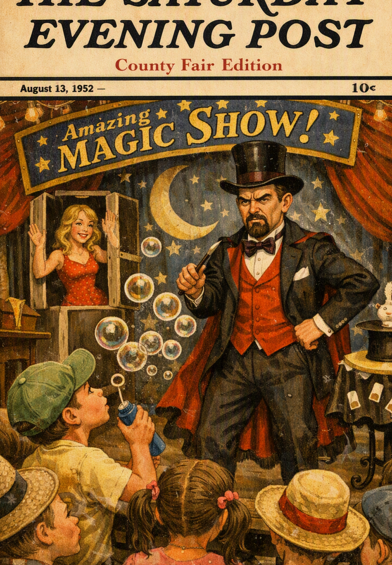
bubbles in a magic show

One of the things that I hate when performing at fairs is the vendors that sell bubble guns. People will give them to a toddler, and the kid will just sit there and shoot bubbles the whole show. This is a HUGE distraction.

Not only is it a distraction, but the bubbles can also get on my glasses and smudge them (which is super annoying) or my props.

How Do I Politely Get Them To Stop?

Here’s what I started doing when there’s a kid with a bubble gun at my show: I say (on mic), “No bubbles during the show, I’m allergic to the detergent in them”

That’s it, super direct and simple. Sure, it’s a lie; however, it tells them that not everyone wants bubbles blown into their face. It also gives a reason they might not have thought of for why they’re being inconsiderate by letting their kid spray bubbles everywhere.

Give them a reason for the request and they’ll (usually) follow it.

-Louie

Should You Wear Sunglasses Onstage?

I wrapped up twelve days of performing my Vintage Organ at a state fair. This is very different than performing magic. The booker didn’t want a show, but something more ambient, like a stilt walker. You have interactions with people, but you’re there to create a vibe, not do a show.

When I started doing the Vintage Organ, my costume (outdoors) had me wearing sunglasses. That was intentional; it was so that I could look around and not look bored or distracted.

The sunglasses do their job of making it harder to tell how mentally engaged you are. However, the drawback is that people don’t want to engage you as eagerly as if they could see your eyes. You lose how you initially connect with people. If I took my sunglasses off and just wore my normal glasses, the percentage of people who would approach me versus me calling out to them was higher.

Whenever I see stage magicians or jugglers wear sunglasses, I always wonder why they’re wearing them. They are cutting off how humans initially connect with each other…eye contact!

-Louie

Making a Juggling Routine

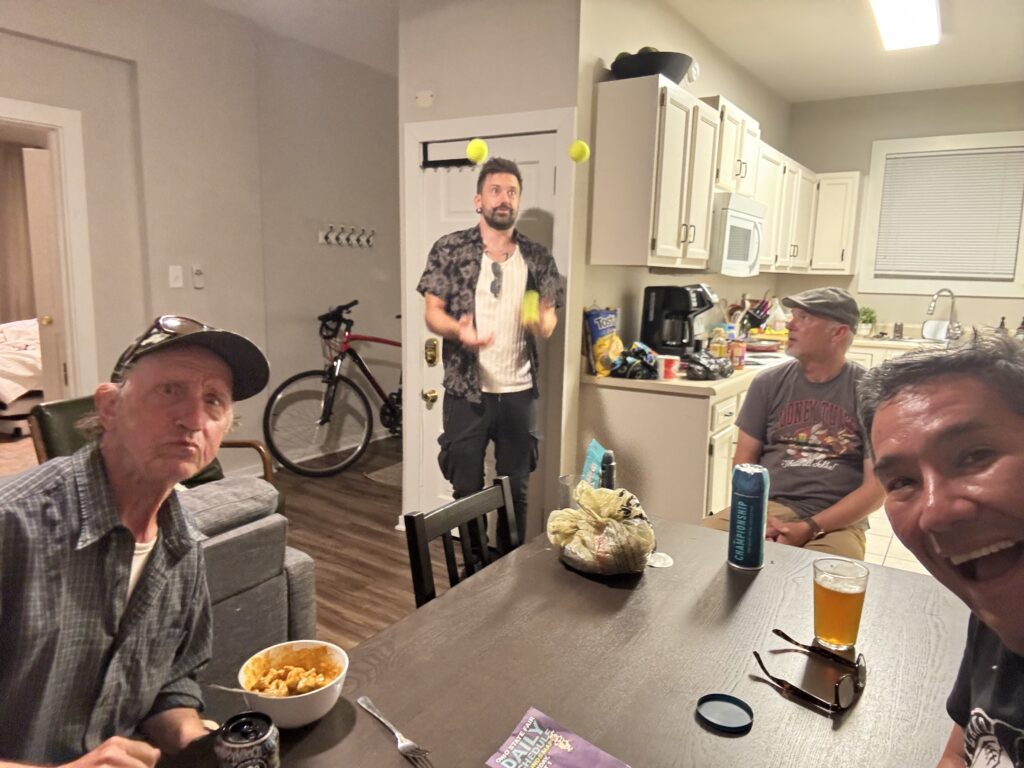
A few days ago I had an idea for a magic routine, and in that routine there is a juggling element. I can juggle, but am not a juggler and needed to work out a sequence. Luckily, in the performer house that I’m at, there are two jugglers and a physical comedian there. Last night we had a little workshop on the routine!

juggling workshop

I’m a huge fan of workshopping with other performers. It’s a way to get a lot of ideas quickly, or to get expertise that you don’t have. I can juggle, but I don’t know the best way to put together a juggling sequence.

Workshopping with performers who don’t just do magic brings in a lot of different thinking and ideas than just magicians.

-Louie

Workshops for Variety Acts

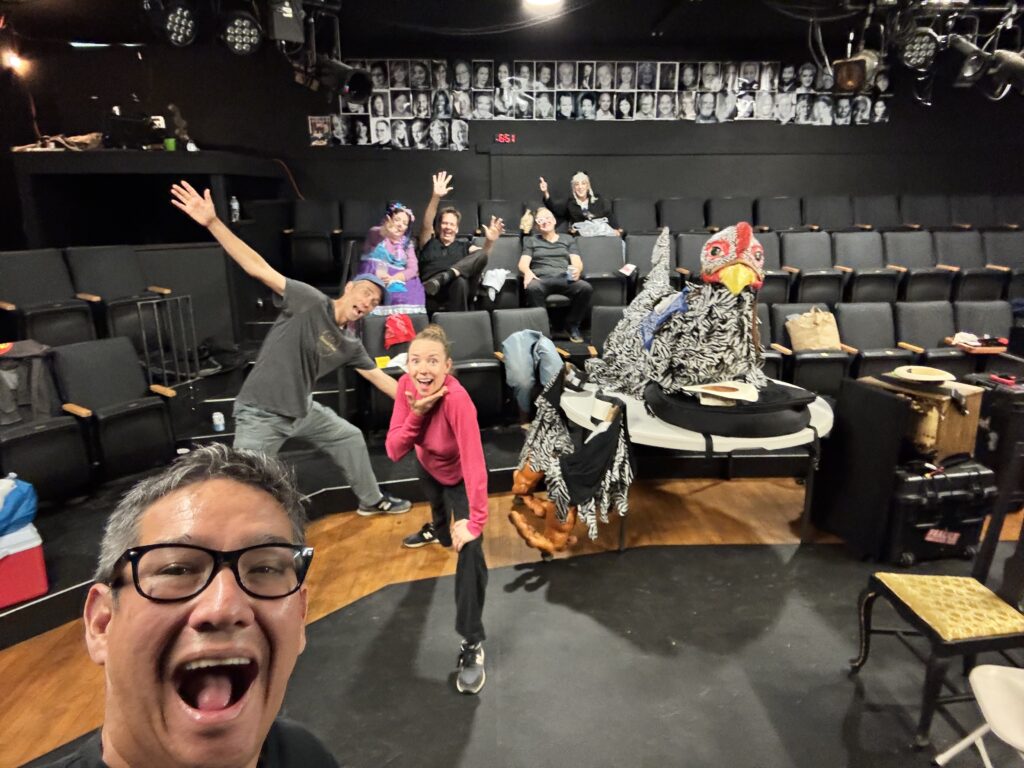
Whenever I’m performing at a multi-day event with other variety acts, I try to put together a workshop night. This is where performers try something new, talk about an idea, or do some troubleshooting about a problem. Then we all brainstorm ideas or solutions for them!

Workshop for variety acts

These are a great way to get thinking that’s outside your normal box. It’s even better when you have acts that aren’t all magicians, or whatever you are. Everyone brings a different experience and backstory which will give you ideas that you may not have thought of.

You can be very creative when you create by yourself, but I think most of the time, when you create with others, you get more ideas faster!

-Louie

Performing on a Difficult Stage

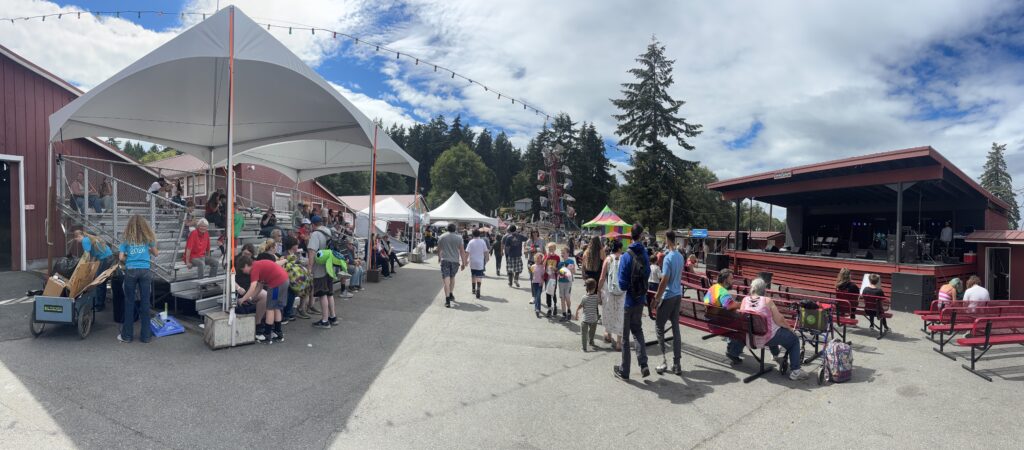
Sometimes there are stages that are more challenging to work than other stages. This stage and audience configuration is a good example of that.

stage for magic show

First, let’s tackle the obvious: there’s a walkway between the benches and the bleachers. Unfortunately, that’s just how it is, and there’s not really anything you can do about that.

The bigger issue is getting on and off stage; it’s a high stage, so a lot of stairs, and the stairs are off to the side. It’s good that they are on the side; if they were on the front of the stage, the handrails would be a visual distraction. It just takes a lot of time for me or someone from the audience to get on and off stage.

I have a spot in the show, right after my introduction, where I need to hand something to someone in the audience. That’s dead time while I walk on and off stage.

Here’s what I did:

Opening bit, then walk into the audience to give the thing to someone in the audience.

2nd trick happens on the floor in front of the stage.

After the second trick, I bring someone from the audience to the stage with me for the third trick.

For the fourth trick, it happens on the floor in front of the stage. This trick needs access to people so they can hold things at different points.

When the fourth trick is done, I bring someone from the audience back to the stage with me and send them back to their seat when the fifth trick is done.

The final trick happens with me solo onstage.

There are a lot of ways to deal with the “long walk to the stage“, however for this situation, moving my show between the floor and stage worked great; it reduced the dead time a lot. This makes the show feel tighter!

-Louie

How To Create a Visual Hook For Magic Routines

One of the things that I try to do when creating magic routines is to think about what they look like. This is important when you perform at places like state and county fairs, where you have a transient audience. Having strong visual hooks that will stop someone that’s walking by is important in that market.

Here’s an example of a visual hook, it’s part of my Body Language Book Test which is in my 2025 PCAM Lecture notes.

In the routine, a guy ends up hitting me in the belly with a tube. It’s a great bit, but more importantly, the routine is visually interesting virtually the whole time!

Three Easy Way To Adding Visual Appeal To Magic Routines

Here are three common, and easy ways to add visuals to magic routines:
1: Props – If you have an interesting prop, that is obviously visually interesting, and of course, the bigger the better! People need to see it from a distance, or they won’t stop.
2: People – More people onstage can create drama. You’ve changed your show from monologue to dialogue.
3: Action – Having motion onstage makes people stop to watch. A bad dance troupe will having an easier time getting a crowd than an amazing stand up comedian.

Ultimately, most things will use more than one of the things above to draw attention.

A good example is my Straight Suit routine, which you can see here. It combines a interesting prop, the inflatable suit with action.

Also keep in mind that not every single routine needs to be a giant thing, for texture in your show, you should vary things. A great example is Franz Harary in one of his MEGA illusion shows also does silk to egg.

-Louie

Recording Magic Shows

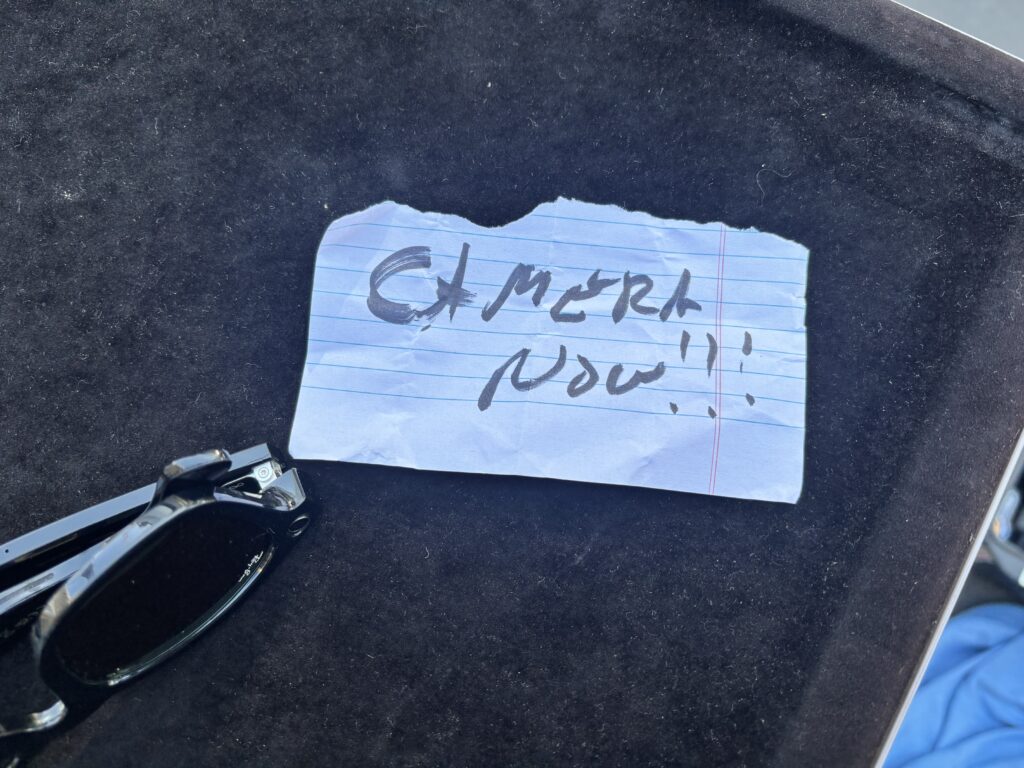
One of the things that I do to work on my show is record them. Nothing fancy, just a camera in the back of the room. I have a bad habit of almost forgetting to take my camera, so what I do is put a note in my case that simply says “camera now”.

magic-show-camera

When I’m packing up and I get to the note, I stop everything and go grab the camera. It’s a simple little thing that has saved me forgetting my camera many, many times!

-Louie
PS: you can learn more about how I work on my shows here.