Color Change

The other night while watching TV with the family I was fiddling with a deck fo cards and came up with a strange color change. There’s a lot wrong with it, and in its current state it’s not a good color change.

The main problem with it is that it’s not good for video. I can see the flash that happens when you palm the card being hidden in a live show, but not on video. Also there are better ways to do a color change.

It was fun to play with.

Cards Thru Newspaper

A magician friend of mine a few months ago performed Albert Goshman’s Cards Thru Newspaper for me. I remember reading it in Goshman’s book, however I remember reading it and working through it and it didn’t feel spectacular. I was also probably 17 years old at the time, so that might have affected my opinion of the trick.

If you haven’t seen the trick, here’s Goshman doing it:

Compared to a lot close up magic, it’s pretty slow. It’s still a good trick for non magicians and had a couple of good moments in it. I like it as a “formal” close up thing that could be done via video projection. However, I have to look at what I don’t like about it. The biggest thing I don’t like is the newspaper.

In the trick there are two newspapers, the one laying flat on the table and the one being used as a cover. The cover newspaper was easily replaced by a jumbo card.

Cards thru newspaper magic trick

Replacing the flat newspaper on the table made me have to rework the method of the trick. There’s a couple of moments in Goshman’s routine where you need that newspaper. I could replace it with something like a handkerchief, but decided to rework the routine.

What I ended up with is something complete different than Goshman’s Cards Thru Newspaper, and an original trick. Taking a trick as a starting point and then continually removing what you don’t like is one way to create original material.

Original Magic!

I found the trailer for the upcoming season of Masters of Illusion and you get to see a trick I invented at the 27 second mark:

One of the great things about creating original material, not just presentations is that when you are pitching acts to a TV show you don’t have to worry if something has been done before. This applies to more than just TV, it’s a huge advantage for variety shows as well. You don’t need to fight over who gets to do what trick.

Original content is king!

Masters of Illusion…

Several months ago I hinted that I was putting together some material for a TV show. I always assume that I’ll have my bit cut and end up no being on the show. I recently got an email of the list of acts that will on the show, and I’m on the list!

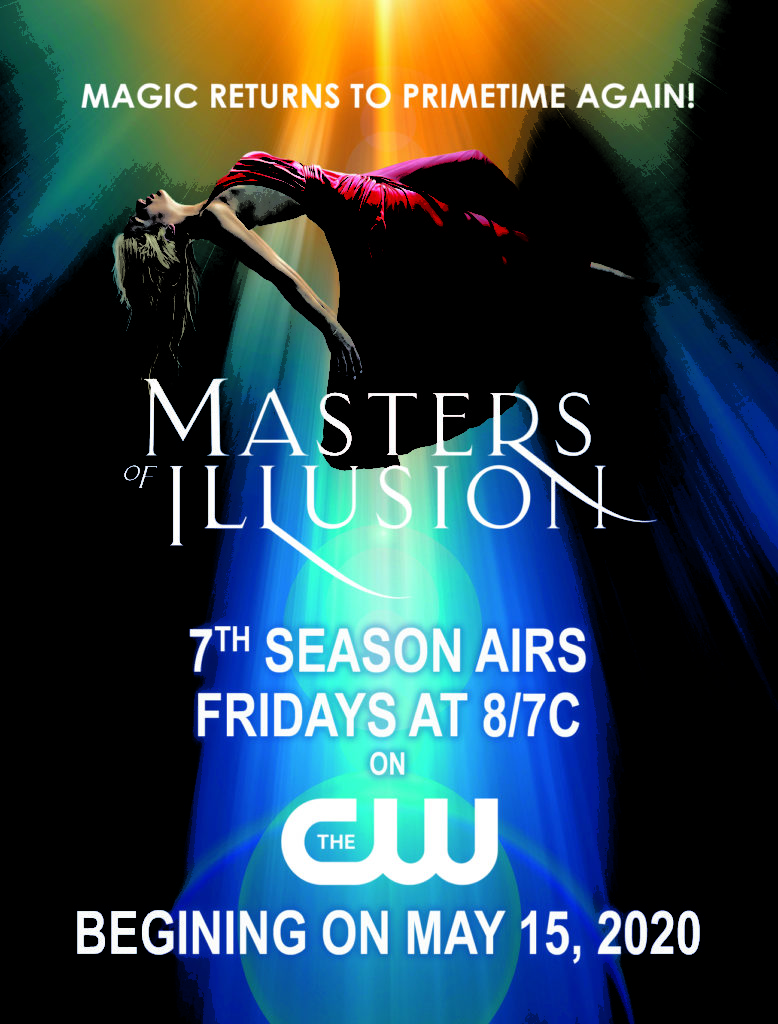
I’m excited to be a part of the 7th season of Masters of Illusion on the CW network!

It was a lot of fun getting to work on a TV show and hanging out with all of the acts!

My First Virtual Show

I’ve now gotten my first live virtual show completed and it was a huge learning experience. First of all, it wasn’t a full of show of me, it was a variety show that I co-hosted. Pulling together all of the technical things to make it work was a huge challenge for me. There’s a huge learning curve.

In the show we did, the format was Matt Baker and I hosted live acts. Bringing in those acts was a bit of work after reviewing the video I’ve learned to make the transitions much smoother.

I think the key to doing virtual shows is to actually go back and watch them and see what you could do better. Treat not just the show as something that can be improved, but the medium it’s delivered in. Would the show be better if it had title cards, or a canned video as a transition? Things like that, you’re not doing a magic show, you’re doing a live TV show!

Rethinking LIVE Close Up

Lately I’ve been thinking about how live magic is going to change after shows start up again. I’m thinking mostly about material selection and what people will be willing (or not willing) to do in the context of a show. Before COVID you could get people to do just about anything, however I’m not sure what the future holds.

One thing I know is that if your “Go To” trick is sponge balls, you probably need to come up with another trick. I think they’ve passed their prime. Most who magicians rely on a trick like sponge balls don’t have much going for them. If you can’t crush a close up set without them, then you’re doing something wrong.

For close up, I’m lucky that I stopped doing sponge balls a long time ago. However I do the a card that appears in held in my lips as a phase of my ambitious card. I’m going to need to rethink that phase, and come up with something else to do, or just eliminate it.

Make It Easy To Watch!

This morning a buddy of mine sent me a video of a magician doing a card trick and wanted to know my thoughts on it. The thing that stood out to me, and is something that I should have realized before is that most of us are doing card tricks for social media incorrectly.

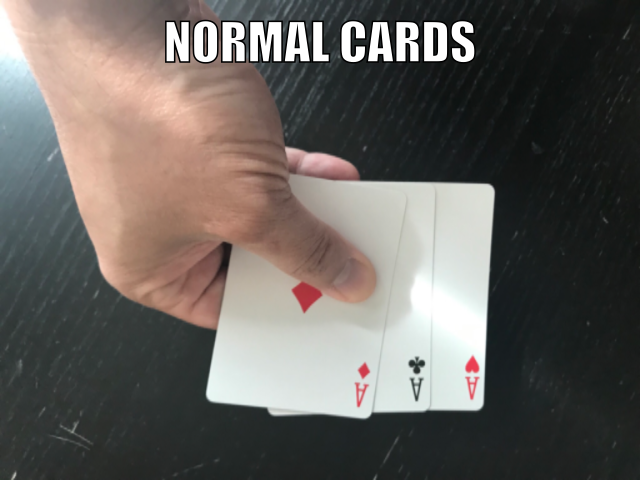
Many videos of just the hands have them coming down from the top of the screen, or are from the spectators point of view showing more of the magician. If you are doing any card tricks that require you to spread the cards, the indexes are upside down.

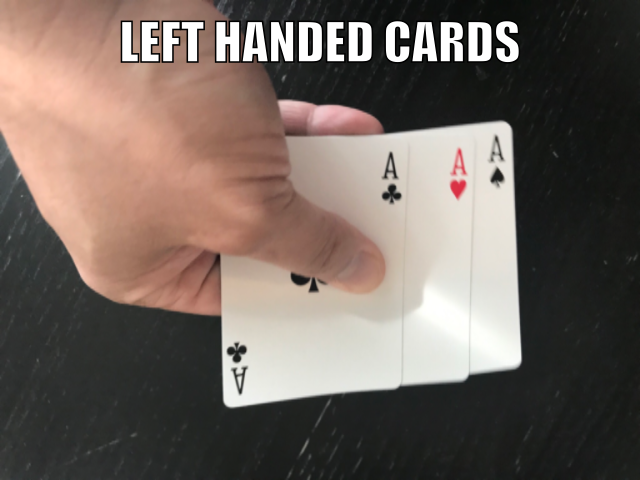
If you are someone that frequently handles cards, it’s pretty easy to tell what is what. However, most people are not. If you asked someone to memorize a card and they saw it upside down there’s a great chance they will struggle with it. It’s also visually unappealing to look at. Here’s my suggestion, use a left handed deck of cards.

left handed cards

This cards spread this was a so much easier to identify for someone that’s not familiar with cards. If you don’t spread the cards, like in an ambitious card routine then it’s not really a issue.

Progressive Anagram Routine…

Recently, I’ve been writing a bit about progressive anagrams and their use in virtual shows over the internet. I’ve come up with a bit of a routine, here’s what my idea looks like:

You put display a coin envelope in your left hand and hold your empty right hand palm up.

“Imagine I have some coins here…nothing crazy, just a penny, nickel, dime, quarter, half dollar and a silver dollar. I want you to look at the coins and since you can’t actually grab one through the screen, pretend to take one.”

You can now lower your right hand.

“Look at it, on the back you’ll notice I wrote the name of the coin on the back. If it’s a quarter, I wrote quarter. On the half dollar I wrote half dollar. Look at the word I wrote, visualize it in your head”

Now we’re going to get into the progressive anagram. How it works is: If you say a letter you move down to the next letter. If that say no, you move to the right. If you get all “yes” answers you end up on the fifty cent piece.

E – Half Dollar
I – A (No: Penny Yes: Quarter)
C – A (No: Dime Yes: Silver Dollar )
F- Nickel
Fifty Cent Piece

You’ll notice in the script I didn’t give fifty cent piece as an option, but I’m trying to foresee someone not listening to me. I have the list above written out where the camera can’t see it. You now know the word, in this example they are thinking of the nickel and they don’t know you know it. Direct attention to the envelope.

“I’ve got a coin in this envelope”

Rip the top off the envelope. Oh, I forgot to mention you have an index of coins in thumb tips out of the camera’s view. For the quarter or larger coins you have folding coins in the thumb tips so that they fit. Once you know the coin, you put on the correct thumb tip. As you rip the top off, you load the thumb tip inside.

“I’m guessing you’re thinking of the nickel!”

They confirm this and then you dump the nickel out of the thumb tip that’s inside the envelope onto your palm and display it. You can now steal the thumb tip as your rip up the envelope to show there are no other coins and then get rid of the thumb tip as you throw way the envelope pieces.

There you go, an easy routine using a progressive anagram and with slight adjustments you could do it in a show with a live audience.

Taking It Further…

In yesterday’s blog post about progressive anagrams, I mentioned a good way to use them for internet shows without any memory work. That doesn’t solve the problem of people not knowing how to spell words. The easy way is to use simple, common words, and not things like astrological signs like, “Sagittarius” which took me 4 tries to correctly spell it before I did a web search to figure it out just now.

The next problem and what I think is the biggest weakness is when you get the letters wrong. There are some instances where you will get no letters wrong, but you can’t count on that. There are also some where you’ll only get one wrong and immediately know the word, which is the problem. It feels like you are doing exactly what you are doing, figuring out the word by the letters.

To remove the idea that you’re just guess based on the letters, you need a prediction. Something physical to show that you knew it all along. This could be a written prediction, or whatever. A simple solution (depending on your words) would be a nail writer. Another easy way would be an index of the words, or multiple out set up.

What the prediction does is makes it harder to backtrack the method. If people talk after the show it ends up being, “If he was just guessing, then how did the prediction match what I was thinking of?” Taking it a step further makes it a more solid trick!

Progressive Anagrams…

Soon after I got seriously into magic I picked up a copy of the book Thabbatical by Phil Goldstein (Max Maven). It’s got several progressive anagram tricks in the book. If you don’t know what a progressive anagram is, it’s a way of figuring out a word that someone is thinking of by asking them if certain letters are in the word. Everytime you get a “NO”, you move to a new list. In a good list, by the time you get to the second “NO” you know the word.

The huge problem with using a progressive anagram is the person needs to be able to spell the word correctly in their head. Sure you can have them take the word off of a list, but I think that takes ways what makes this type of trick work, and that’s that you don’t need any props.

The other challenge is that you need to memorize a flow chart of letters and words. It’s not super hard, but it does take work and you need to keep in practice. However, right now with use all stuck at home and doing magic over the internet, you can easily do progressive anagrams without memorizing anything! The way to do it is to simply print it out and put it someone outside your camera’s field of view. No memory work, it’s plug and play!