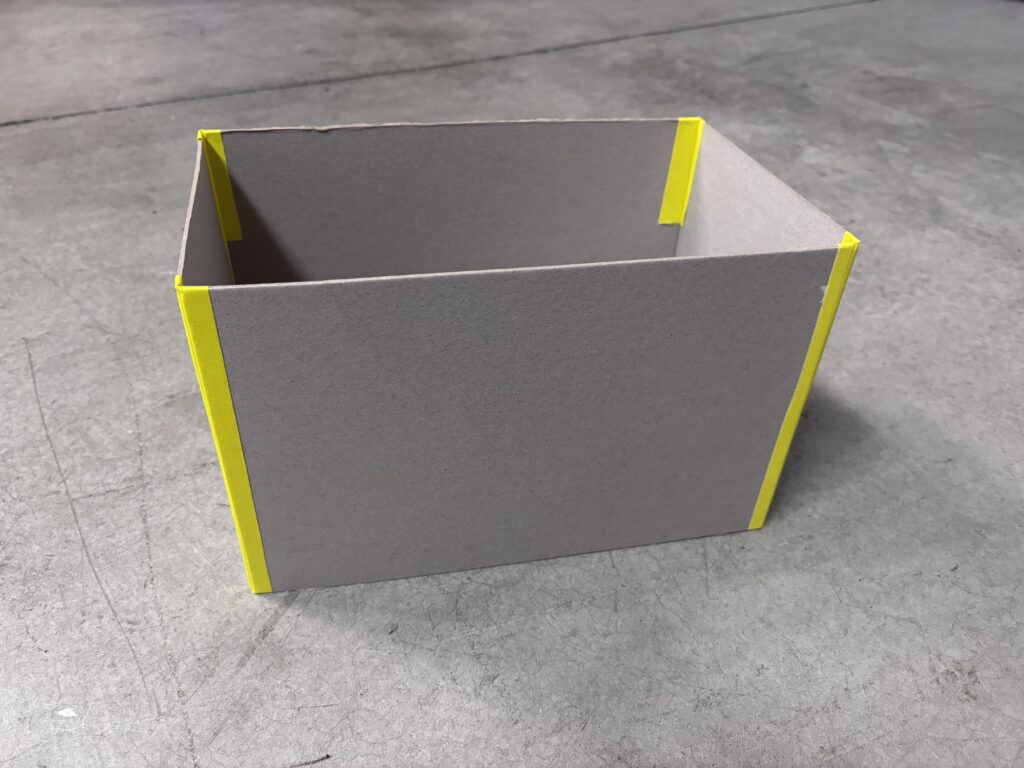
I’m still working on my Snake Basket Magic Routine. The basket won’t be a basket; it will be a box. I’ve written on this blog before about why I’m not using a basket for the snake. I want the box to look like a shipping crate, but it also must be light and pack as small as possible. I started with a cardboard frame with gaff tape hinges.
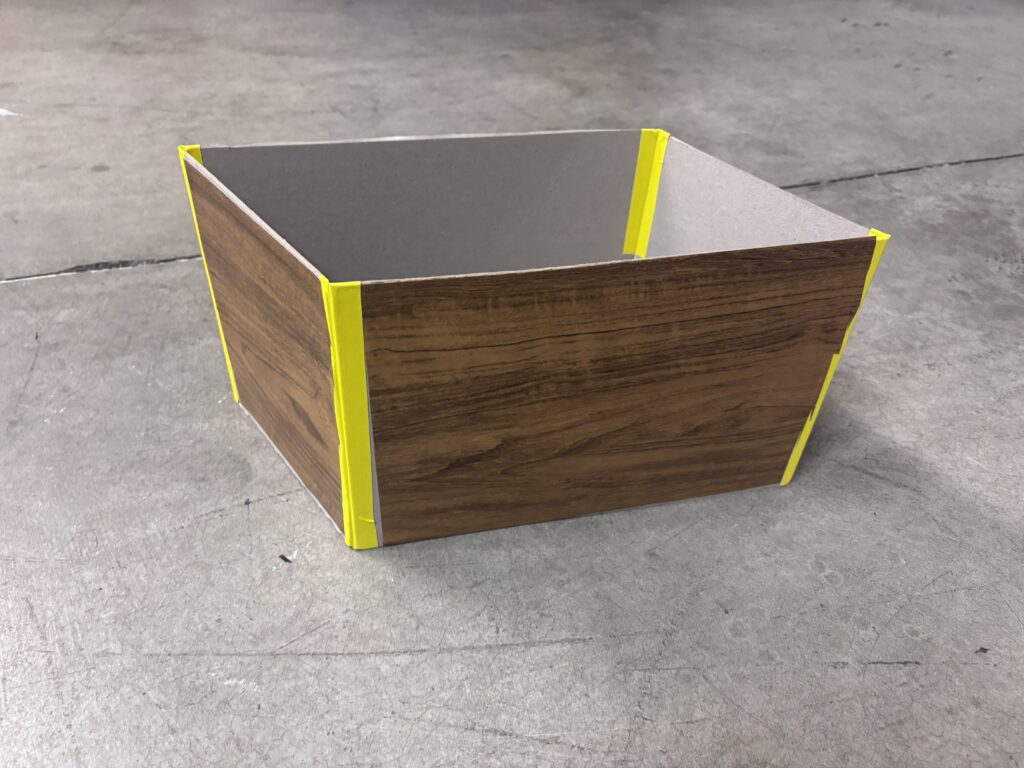
I then covered the middles of the panels with wood patterned contact paper.
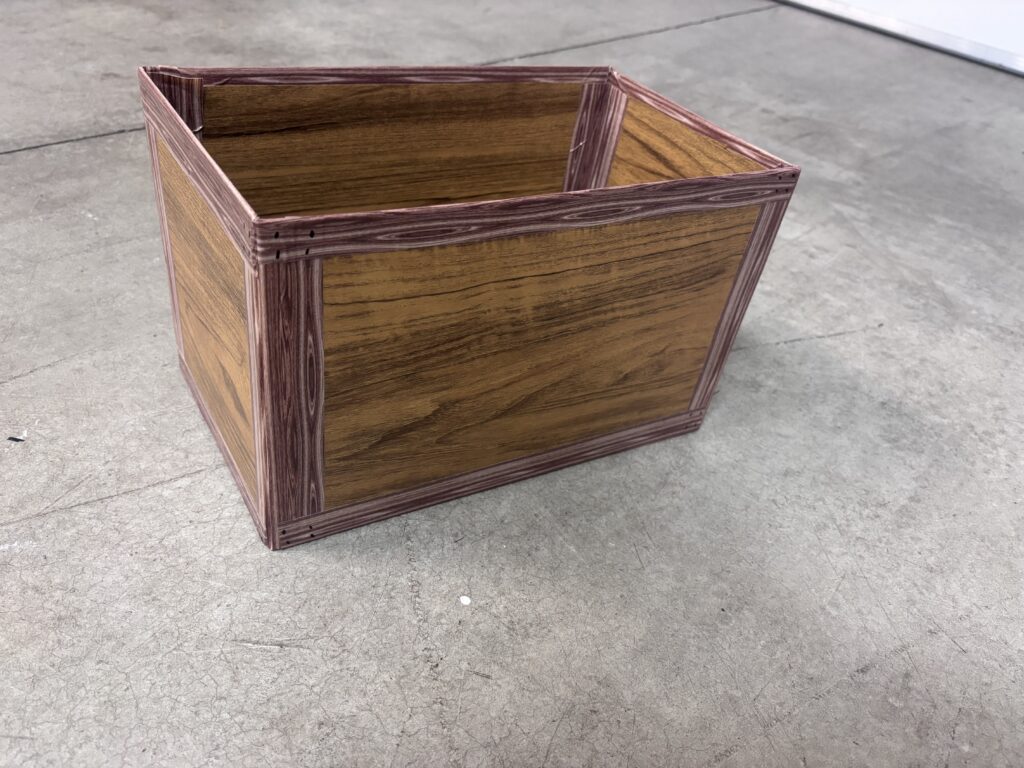
Finally I did the corners with a wood patterned duct tape to give it the crate look.
This gave me the look that I was going for without the weight of wood, and it packs flat!
This snake basket magic trick I’m working on feels like a “project car” that’s in someone’s garage that they are constantly working on. It’s something I keep finding ways to improve. The first version is barely finished, and I’m working on a second one!
The big change is that I’m going to move it away from a card trick. I’m going to merge it with Terry Seabrook’s Chattering Teeth Routine. The snake will chew holes in the paper, and the reveal will be when the paper is opened. A paper is physically larger than a playing card, even a jumbo playing card. Bigger is better for a reveal!
Moving to paper also allows me to customize the routine to a show. For example, if I were doing a safety-themed show for kids, the snake could chew a stop sign in the paper. It could still be a card a la the original Seabrook routine, or spots (like on a die) or even the image a piece of art!
The snake basket magic trick that I’m working on won’t have a basket or any of the old snake charmer tropes. The main reason is that after reading about snake charmers and their rise in pop culture, I don’t think my personal values align with that imagery. It’s like “yellow face” Asian stuff that used to be popular in magic. The original intent of it was not positive.
Another reason I’m not using the basket is that it’s a trope that no longer exists. It’s not something that appears in modern pop culture. I know it was in every Bugs Bunny cartoon, but kids haven’t watched those for decades. There’s really no reason to have a basket today.
If you see a reptile show at a school or library, none of the snakes are in baskets; they’re all in boxes or tubs. That’s what I want my snake basket to look like, a box, well, specifically a wooden crate. I’m waiting on the supplies to make it, but the box will be cardboard, so it packs small and light. I’m going to cover it in wood grain contact paper and then add trim with wood grained duct tape.
The snake basket that I’ve been building is finally starting to take shape! I have a completely functional version of it! Here’s what it looks like:
I’m going to make a small change to the code. I’m going to add a three second delay after the button push for the action to take place. I want to be able to have some physical distance between my hands and body when the actions take place.
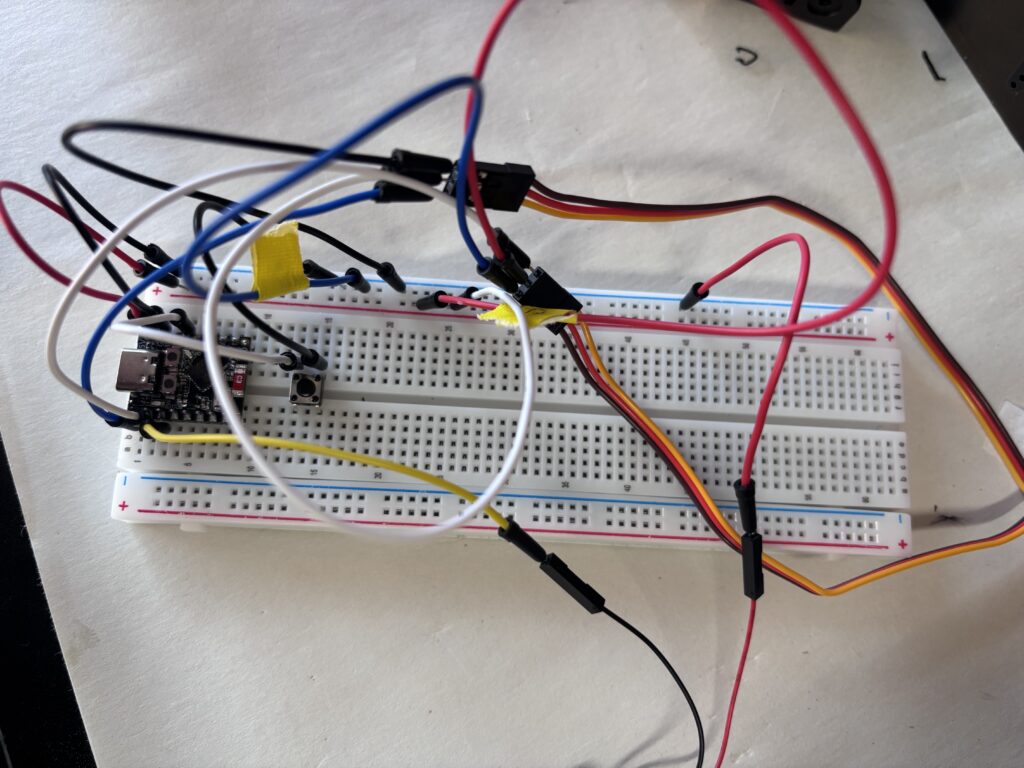
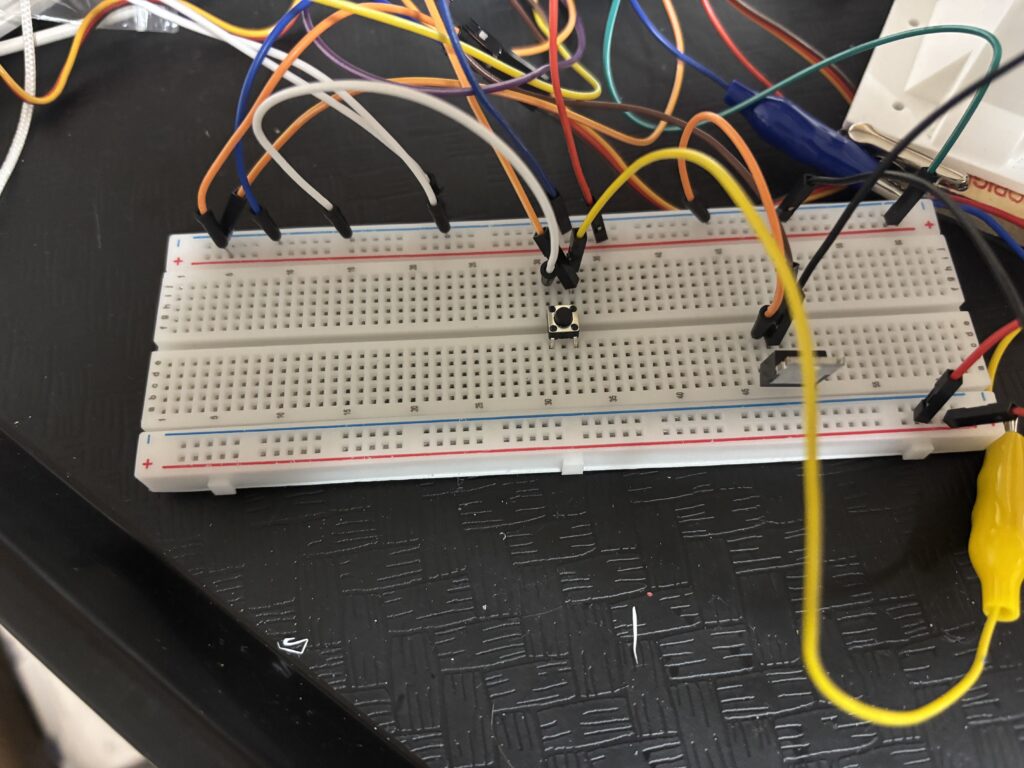
The more I work on this snake basket, the more I want to simplify the wiring in it. The previous versions had an LED to indicate that it was on. I eliminated that using the ESP32’s built in LED, so that took out some wires. Here’s the current wiring:
One thing I have that’s redundant is that each action is triggered by a button press. The first version just had a single button that started all of the actions that would be timed. I didn’t like this as it makes me a slave to the preprogrammed timing. To give me more freedom, I added a second remote control button, and both buttons trigger each action. I could eliminate the wired button, however, I can see a situation where it could come in handy, like if the remote unexpectedly ran out of batteries.
The next tweak will be in the code, and that will be adding some delays after the button press. That will get my hands away from the remote control or the wired button when the action takes place.
I think this is coming along nicely, and I’ve learned a lot about using microprocessors!
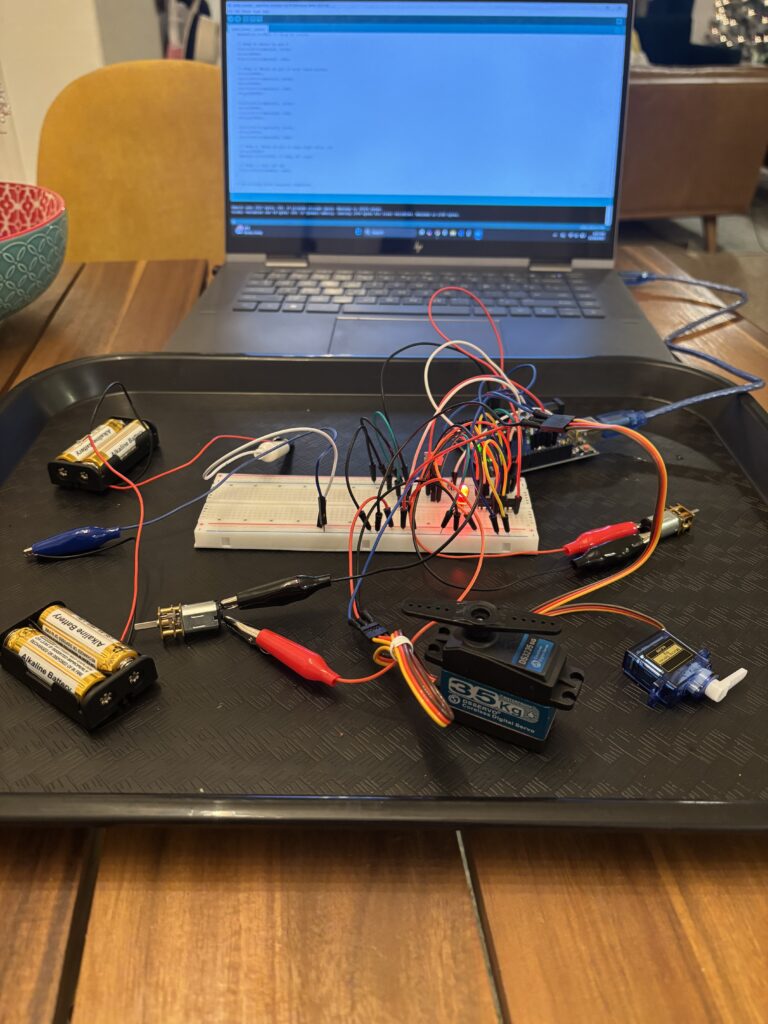
I’ve been working on learning to use Arduino and over the summer I made a working model on an Arduino simulator, but haven’t had time to actually make it, until a few days ago.
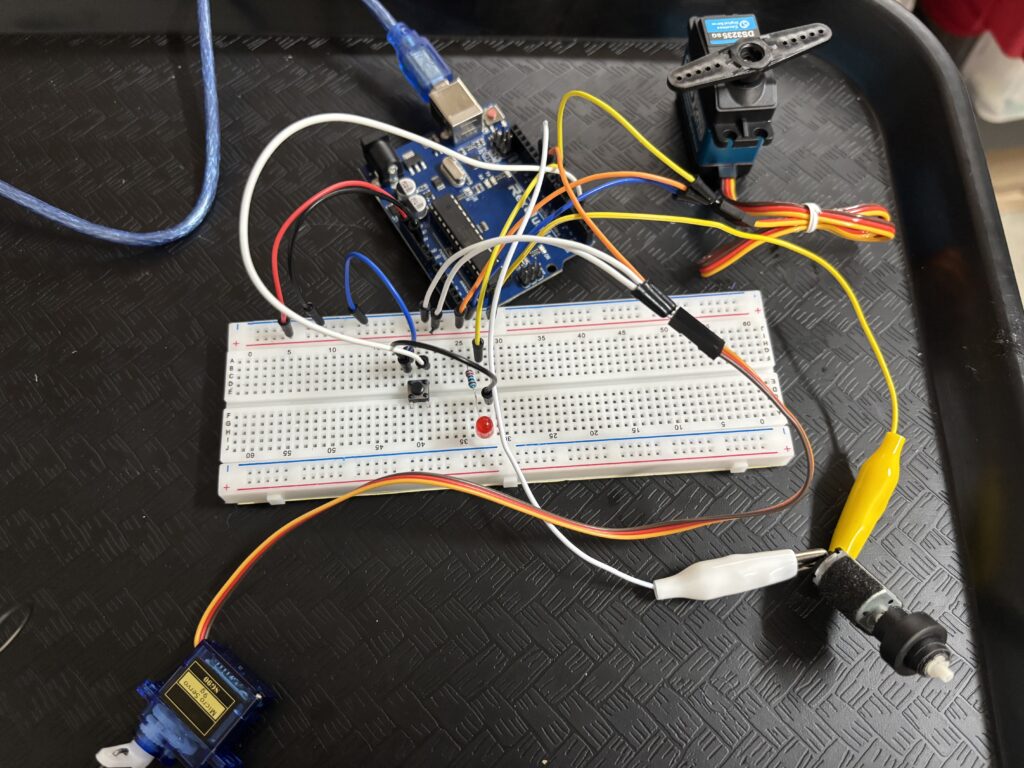
The arrangement above has a lot of wires, but it works! All of the functions do their thing. Like any project, once it becomes a physical thing, it will change. I realized I could eliminate one motor and have one servo handle two tasks. The motor would make the snake rise, then the servo would make it move back and forth. I decided to eliminate the motor and have the servo make the snake rise and shake. That simplified this a lot, and here’s the new wiring:
Usually, simpler is better; here’s less to go wrong, and it’s easier to diagnose if something does go wrong.
The next step will be to move it from an Arduino UNO board to an ESP32 board and put everything onto a PCB board for more sturdy final version of this.