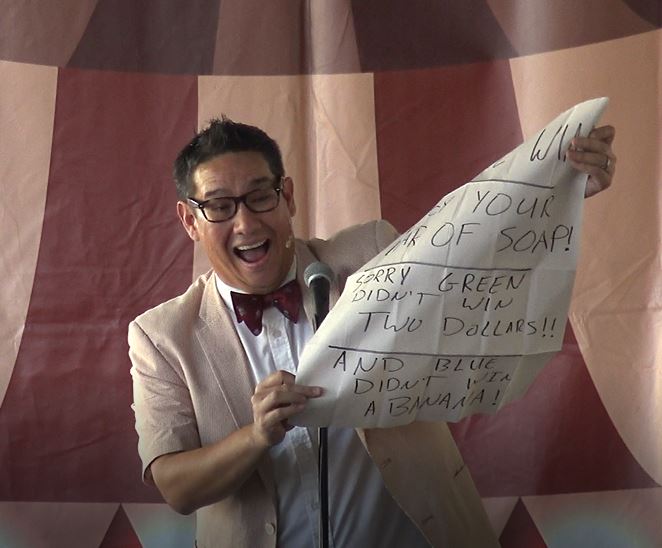
A few days ago, I wrote about post about rewriting a prediction on larger paper and the trick playing better (you can read it here). I’m now running into a new challenge with the prediction, if there’s a little bit of wind, it will warp and it’s hard to read the whole thing.
The nice thing is that the prediction is revealed and read 1/4 of the page at a time, so if the top bends, that information has already been revealed to the audience. However seeing the whole thing is a better picture.
While I probably won’t have time to try this in the next few days, a solution would to be put a line of tape on the back of it. Maybe just around the edges and and X across the middle. That would give it some support. If that doesn’t work, I could completely line the back with tape. That would essentially be laminating the back of the prediction.
I thought I was done with the virtual shows, but last night I was back at it! Doing this show as a nice change of pace from the three shows a day I’m doing at a state fair all month.
This was a corporate gig that was for the employees and their families. This was a fun group! One thing I’ve noticed with virtual shows is the time really flies by, compared to a live show. I think that with an in person show, time travels soo much slower. I think it’s because I’ve done it in person soo much that I have to think less. With the virtual I’m constantly on my toes.
In my virtual show my daughter usually runs the production end of the show and in it I normally do a prediction that she helps me out with, but unfortunately she wasn’t available last night. So I had to had to do it all solo. Running the production part is easy, but doing the prediction was going to be a bit of a challenge. Normally the prediction we do is my “Wheel of dinner”. I was going to modify it to a “wheel of costumes” as the client wanted some Halloween themed tricks. The problem was how I was going to accomplish the trick. With the wheel there are 20 options and it doesn’t force. There are ways to force from the wheel, but I really like just spinning it. It feels random.
It hit me, a while ago I had bought Manifest by Danny Weiser, which is a prediction on a luggage tag and never used it. I hung the luggage tag in the background, and during the course of a trick, I asked someone what they were going to be for Halloween. Then at the end of the trick, I did the reveal of the prediction. It played really well. I like a prediction, where the prediction is not the routine, but a bonus…especially because I takes a lot of the heat off of the method!
One of the tricks I’ve been working on, sort of on and off all summer is based on Alan Wong and Luca Volpe‘s The Key of Fate. I’m using their basic framework for the trick, but have changed the props a lot. I’m using totally different forces for the prizes and the method for forcing the winner. The basic effect is you predict the outcome of game and what prize the winner gets.
When I first started doing this I was using a larger piece of paper, but the paper got damaged and all I could find was a smaller piece of paper. The small piece was about 15×10 inches, so still fairly large. The trick wasn’t hitting, but due to my schedule I was having trouble finding time to hunt for bigger paper. The effect was playing just OK with the smaller paper and I was thinking of giving up on it. I was attributing the OK response to my performance. Then I had time to hunt down some giant paper, that’s 30×20 and rewrote the prediction.
Here’s the size comparison:
The new prediction is soo much bigger than the previous one. Much to my surprise, the trick is hitting soo much harder with the bigger paper than with the smaller paper. Sometimes it’s small changes that can make a huge impact to a routine.
Now I’m wishing I had done thing a long time ago, I would have gotten a lot more work on this routine done this summer.
A couple of years ago I created a original (as far as I know) method for making a fork bend. The cool thing about it is I never touch the fork that bends. This came about when I was chatting with a mentalist about metal bending and asked a stupid question, “does anyone do a spoon straightening routine?” He said that a lot of the optical illusion parts of the method probably wouldn’t work as well with the bend going backwards.
That conversation put the thought in my head, and I ended up creating a method and publishing it in Vanish Magazine called The Perceptive Bend.
In the picture above you see the lady confirming the two forks are exactly the same before one of the forks bends in her hand. I think the method should be pretty obvious if you reread the first paragraph of this post, or you can track down Vanish Magazine issue 57 (I think it’s that issue).
I don’t normally do metal bending in my roving show, however I had a bunch of forks leftover from doing it virtual shows, I took them to the fair to use them up. After doing it live this week, I’m thinking of adding it to my roving at fairs. It gets a really good reaction, and I think I’ve finally figured out how it fits in with how I perform.
Today I was messing around with adding stinger music to trick that didn’t get the final reaction I wanted. Stinger music is a short, usually upbeat musical tag that’s used to punctuate the end of a trick. I was really surprised at the effect it had on the trick. It took the trick from a mild response (much less than I thought it deserved) to a good response.
The two places I put it, one in a magic trick and one in a mentalism trick worked out great. The mentalism trick was where I think it really needs it, the effect is there, but it lingers in the audience’s heads. I need something to snap it out of their heads, and this may be the way.
Now for me the trick is to make it make sense. I don’t want to just blast music at the end of the trick. I think there needs to be music leading up to the stinger. This isn’t much of a problem, I just need to find music with lyrics that I can talk over.
I’m hoping to add a little bit more theatrical / production elements to the show. I’m trying to “level up” my show a little bit.
I’m really trying to clean up the sloppiness that has crept into my show over the last 18 months of not really performing it much. That’s my main goal this week at the fair. However I am adding some newer stuff to the show and also trying to figure that out.
One thing I’m working on in my version of Luca Volpe’s Key of Fate. It’s playing alright, but it was missing some punch at the end. I was trying to figure out what to do, as the trick has a kicker ending, so I can’t really add another kicker on top of the first one.
What I ended up trying was adding some “stinger” music. Music that’s upbeat that I play right after the kicker is revealed, and it worked great! It got a much more applause at the end. Now I’m not sure this is how I want to do it, but it is a definite improvement!
Yesterday I wrote about some changes to the Luca Volpe’s Key of Fate routine that I’m making. I figured I should write out the effect:
I show lock that’s locked to a little case and four keys in a cup and only one will open the lock. There are also three colored notebooks and three matching colored spots on the floor.
Three people from the audience are invited onstage to play a game. Whoever’s key opens the lock will win one of the prizes written on one of the pages of one of the notebooks. Each person grabs one key and one notebook, leaving a single key on the table for me. They are to stand on the spot on the floor that matches their notebook’s color.
You flip the pages of the notebook for the first person to see what prize they are playing for. They end up picking 500 Pesos, but unfortunately their key doesn’t open the lock. The first person returns to their seat.
The second person selects the ice cream sundae from their notebook as a prize, but their key doesn’t open the lock. The second person returns to their seat.
The final person, who is standing on the blue spot selects a prize, which is a banana. When they try to open the lock, it opens! Inside the case is their prize, a banana!!! They can keep the banana and return to their seat in the audience.
For the kicker, you show underside of the two spots from the people that didn’t win and there’s nothing under them. The spot of the person that won, has some paper taped to the bottom of their spot. It says, “Congratulations on winning the banana, sorry the other two people didn’t wind the ice cream sundae and the 500 Pesos!”
Ok, so that’s how the routine plays. I’m a huge fan of being able to describe what happens in the trick in a sentence. If I take those six paragraphs of how the routine plays and condense it into one sentence it would be:
The magician predicts the outcome of a game played with the audience.
That’s the effect, it’s a prediction of the outcome of a game.
This week I’m heading down to California to perform for 8 days at a fair. It’s been over a year since I’ve done a fair gig, and that’s my core market. I’m working on something new, that’s a variation of Luca Volpe’s Key of Fate routine. I’ve made some major changes to stream line it for how I perform. The big change is that I can’t have the audience write their prizes. For me, that takes too much time, and logistically doesn’t really work out.
In lieu of this, I’m going to useSvenPadsto force the prizes. I bought three of notebook SvenPad‘s that look like this:
For the routine I needed three notebooks with different covers. I bought three notebooks and swapped out the covers.
The picture above shows the process of switching the cover. Below is the final product of the three covers:
I think that using these three notebooks to force the three prizes streamlines the process. We’ll see how it ends up playing…
A few day ago I ordered Jon Allen’s download All or Nothing. It’s fantastic! For about $20 usd you many methods for going a very cool routine / concept.
I tried it last night and it got a great response and I’m using it as a lead in to another trick. For the price it’s a steal, hit up Jon and order it!
Another day, another change to my wheel. This is a subtle change, but I added colors to the wheel.
There’s a very good reason for this, I’ve figured out a way to force a color on the front and an object on the back. I can now do a prediction that will have three reveals with the wheel, the only variable would be the number, which would be the first selection. Once the first number is made, I can pull the prediction from an index and I’m set! It’ll take a lot of the heat off of the switch, as it happens at the very beginning of the routine!