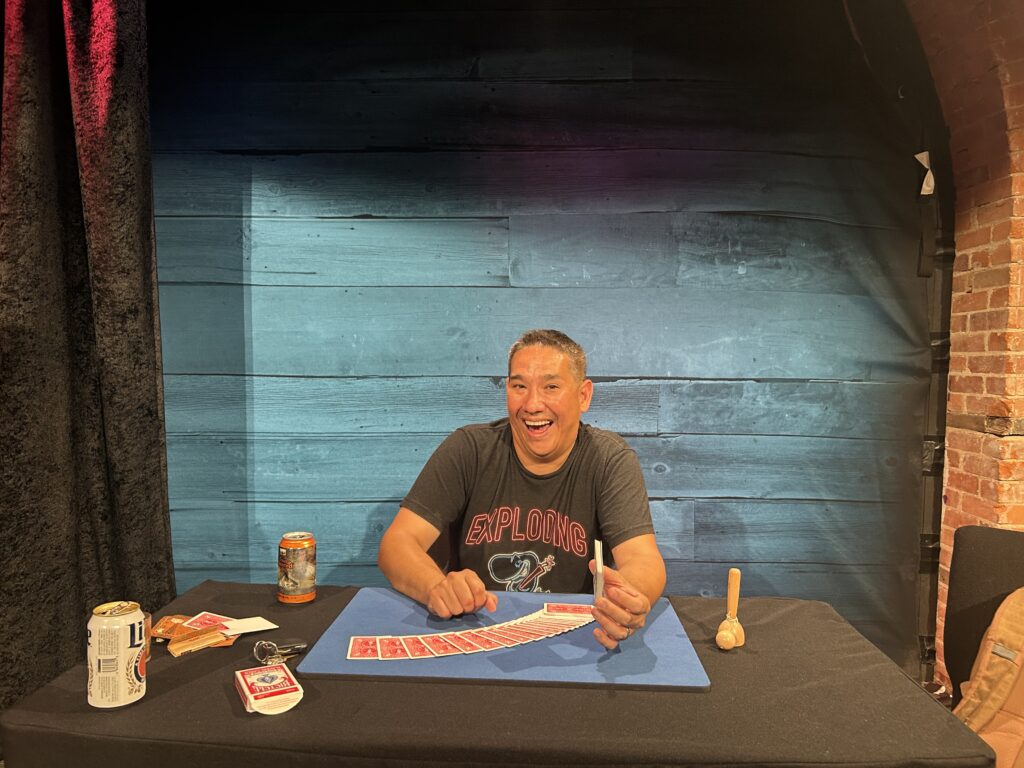
Somehow I got into collecting dead magician’s tie bars! Recently I was visiting with Alan Sands and he gave me one of George Sands tie bars!
If you’re not familiar with George Sands, he created the Sandsational Rope Routine. Most modern cut and restored rope routines are built off of his routine.
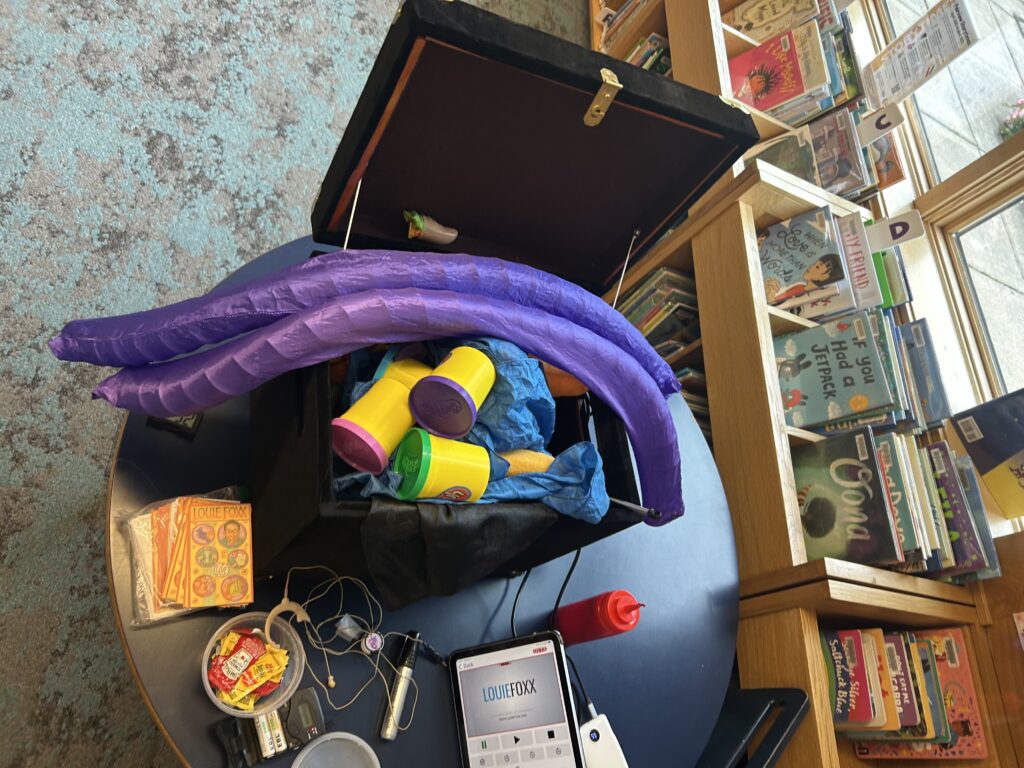
For my library and summer camp shows this year, I added a screen to my table.
There’s not much to it. It connects to an iPhone that’s running IQpro and controlled by a Flic Button. The main reason I’m using it is to get used to running IQpro.
I want to be more comfortable using production elements in my show, and obviously the best way to do that is to use them! -Louie
There are some magic products that just shouldn’t exist. This is one of the products:
It’s a cheat sheet for the invisible deck. Let’s start with the memory, you really need to remember two things. You need to remember which side of the deck is even, and hearts to spades, that’s it. For the math, you need to be able to subtract a number from 13.
It’s not too hard, however, it that’s too much for you, you can eliminate the math and memory by simply opening the flap and looking at which side is towards you. Then removing them from the box the correct way and fanning them vertically while looking for the named card. Boom, no math, no memory, no need for an Invisible Deck Crib.
OK, so is this solving a problem? If you’re not going to put the time into learn a trick, you really should be doing it. I suspect that’s what’s behind all the versions of ACAAN that are marketed, it’s to try to make the trick accessible to lazy magicians.
Maybe someone has a learning disability and can’t do the math in their head? OK, there are lots of things that I don’t do because I don’t have the ability to do them. For example I can’t use memory pegs because I have a thing called Aphantasia, however I was able to learn a memorized deck. It took a lot of work and I had to create little things to help me learn it. I wanted to learn to a memorized deck, so I figured out a way.
Now let me mention the worst line in magic advertising: “eliminates memory and math (or commonly sleight of hand) to allow you to focus on performing.” This makes it seem like you can’t do the two at the same time. Let’s look at famous magicians: Darren Brown, David Copperfield, David Blaine, Doug Henning, and Criss Angel All of them do or have done technically challenging things in their shows and could still entertain with it. Why can’t you? If the answer is because it takes practice, then maybe performing magic isn’t for you.
I found this picture in my phone of a street performer when I was in New Orleans last month. I just caught the end of the strait jacket escape, which also was the end of the show, so I don’t know if it was a one trick show, or more.
What I saw was fine for what it was, a get the money show. I’m not it’s target audience, so all the standard hack jokes didn’t really do anything for me, but the people watching seemed to like them and that’s all that matters…or is it?
It comes down to what is your art?
What are you giving the audience a piece of you, or a piece of a dozens of other people’s shows that are used without permission?
Is your art a line that you saw another magician get a laugh with, so you started doing it? If it is, that’s fine, that’s your art.
Is your art giving the audience some sort of experience that no one has ever seen before? This is what the kind of art that I like to watch.
Is there anything wrong with this show? No, it’s fine, just not for me. His show would probably also run circles around mine at that pitch in NOLA. There are a tons of places where a guy drumming on a bucket will absolutely do better than the guy with the a million dollar violin. Sometimes the right show for the right venue matters.
Whenever someone finds out that I’m a magician and asks to show me a trick I always say yes. I’m amazed at the amount of magicians that hate being shown tricks. By saying “yes” I’m promoting someone’s enthusiasm (and my own) for magic.
The quality and variety of tricks that people show me are way better than a decade ago. I think YouTube has helped people learn more than just the 21 card trick.
By saying yes, I met a guy that could do a tabled faro shuffle with a beat up deck and he helped me learn to do it. The other day one I saw a coin trick that I’d never seen before and it was cool!
Magicians can learn a lot from taking tours. I did a whiskey tour when I was in Nashville and Jimmy the tour guide was a great example of what magicians can learn.
Jimmy had a great “character”, we all knew what he was about very quickly. He also had what was essentially a stand up comedy set that he did while he drove the bus. He told personal stories about the landmarks we were driving by and the history of the area. I think many magicians miss that, connecting with the performer.
I do think that magic is important and you have to have good magic, but connecting with the audience and letting them know who you are is a close second.
Many years ago I heard an interview with Jerry Seinfeld that had an interesting piece of advice. He said your job isn’t having fun onstage, you should be working! I agree, your first job is to work, but that doesn’t mean you can’t have fun at the same time.
Here’s how sweaty I am after a show:
I know it’s gross, but I busted my ass onstage! It was fun, but I worked
When I was in Nashville recently I saw a ton of bands whose names I can’t remember. One of the bands playing at a bar that I stopped in was this one:
Their name was one the screens behind them. This is something that’s easy for you to do with your show. Put your logo on to a flash drive and keep with with your show gear. Now anytime there’s a TV in your performing area, plug in the flash drive and pull up your logo.
Personally I think having your logo on a screen is more modern than having a sign on our table. It also adds a touch of “production” to your show. This is a super easy way to get them to remember your name!