Somehow I got into collecting dead magician’s tie bars! Recently I was visiting with Alan Sands and he gave me one of George Sands tie bars!
If you’re not familiar with George Sands, he created the Sandsational Rope Routine. Most modern cut and restored rope routines are built off of his routine.
For my library and summer camp shows this year, I added a screen to my table.
There’s not much to it. It connects to an iPhone that’s running IQpro and controlled by a Flic Button. The main reason I’m using it is to get used to running IQpro.
I want to be more comfortable using production elements in my show, and obviously the best way to do that is to use them! -Louie
Whenever someone finds out that I’m a magician and asks to show me a trick I always say yes. I’m amazed at the amount of magicians that hate being shown tricks. By saying “yes” I’m promoting someone’s enthusiasm (and my own) for magic.
The quality and variety of tricks that people show me are way better than a decade ago. I think YouTube has helped people learn more than just the 21 card trick.
By saying yes, I met a guy that could do a tabled faro shuffle with a beat up deck and he helped me learn to do it. The other day one I saw a coin trick that I’d never seen before and it was cool!
Many years ago I heard an interview with Jerry Seinfeld that had an interesting piece of advice. He said your job isn’t having fun onstage, you should be working! I agree, your first job is to work, but that doesn’t mean you can’t have fun at the same time.
Here’s how sweaty I am after a show:
I know it’s gross, but I busted my ass onstage! It was fun, but I worked
A bit ago I was at a gig and before the show the MC told me the introduction there were going to use for me. It don’t remember the exact wording, but it essentially said that I was “slumming it” to perform for that audience.
Personally I don’t like putting down the audience before I even start. You don’t know about the audience, for some people it could be their big night out for the month or year. I don’t want to do that. I’ll put myself down all day in the show, but not the audience, and especially not before I’ve taken the stage. The audience doesn’t know me or my vibe.
An introduction should build up the performer or inform the audience about what they’re going to see. Not put down the audience.
I politely asked the MC to use the prepared introduction.
Don’t be afraid to tell an MC or show host exactly how you want to be introduced. There are times when I’m the MC and an act insists that I use something that I know is wrong. Like when they hand me four paragraphs to read. I’ll ask if I can shorten it, but if they insist, I read what they gave me.
For my show this summer that I’ll be doing at libraries and summer camps, I wanted to dedicated prop box for it. I found this old RC Cola box at a junk shop. The guy wanted way too much for it, but I talked him down to where it made sense as I didn’t want it as an advertising collectible, I just wanted it as a box.
Once I got the box home I covered it with black fabric, added metal corners and changed the hinges. Here’s what it looks like now:
This was a quick, easy way to make a prop box for the summer magic show. It doesn’t need to last for years, just 3 months!
A performer that I was working with was showing me the iQ pro app that he uses to run the production for his show. It does it all, music, video and it doesn’t need to use any internet to function. All of that lives on your phone, so a laptop isn’t needed. I played with his and then immediately downloaded it!
I’m still learning to use it, but it’s simple to use (so far) and will do what I need it to do. It runs off of a Flic Button, and that’s the only thing that worries me. My friend assures me that he’s never had a problem with the Bluetooth and he works a lot!
It’s now cheap at $14.99 a month or a lifetime subscription for $595. I’m on monthly for now, and if it ends up working how I hope it will, I’ll probably buy the lifetime subscription.
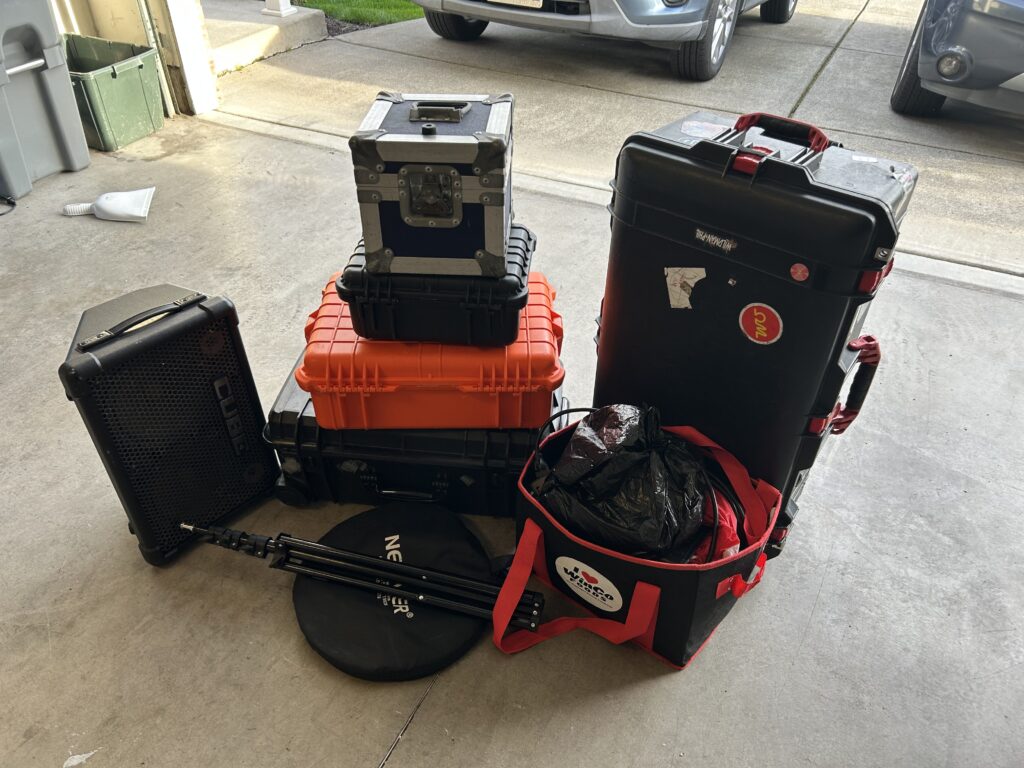
I’m getting old! I used to be able to perform all day, I think one time when I was younger I did 6 birthday parties in one day! Unfortunately age is creeping up on me. The other day I did three shows, I did two shows at different libraries that were forty five minutes each, then did a 90 minute theater show!
Here’s what the 45 minute library show and the 90 minute theater show look like when packed up:
And here’s what the three venues look like when set up:
I don’t know what I was thinking when I scheduled them! I also should have scheduled them with some time between them, not with just travel time between them. I could have used a nap between the libraries and the theater.
I need to be better about not pushing myself, and scheduling some gaps in my day if I’m going to do 180 minutes of performing!
Last week when I was hosting a show at the Moisture Festival in Seattle it was the first time I’ve ever worn my reading glasses onstage! While notes in the picture in this post are a reasonable font size, some of the other notes I were given were written in a super tiny font that I wouldn’t be able to accurately read.
It was strange to wear them as they made everything else blurry that was what I would normally look at. I ended up turning it into a bit with my normal stage glasses which have no lenses and my reading glasses.
I can see good enough to do my show with my stage glasses. The reason they don’t have lenses is that I don’t want reflection on the lenses to block my eyes.
When I fly with my show, I always seal the checked cases shut with a zip tie.
This provides very little in the way of security, but it lets me know if my cases have been opened. This is a huge help, because it lets me know if I need to check my cases before the gig. Years ago when my checked show cases were screened by TSA they took out my two table tops and didn’t put them back in. I didn’t realize it until I was at the next gig and it made that show a challenge! It was also a nightmare tracking them down and getting them back!
When I put the zip tie on my checked luggage, I use a fairly thin zip tie. I need to be able to open it without a blade. With a thin one, I can just jam a pen in between it and the case and twist. That will easily break it.
I also use a neon color so it’s less likely it’s been resealed. I’ve had TSA put zip ties on my gear after screening. It’s rare that it happens, but they don occasionally do that. When they done that, they’ve always been white. It’s less likely they’ll have an orange and green one!
When my bags arrive, seeing my zip ties gives me some piece of mind that I have all of my gear!