Last night I was playing with a set of mini cups and balls that I have. This particular set was made by Leo Smesters. These are a great little set, however honestly I don’t have much of a use for them. When I originally bought them I had an idea, but haven’t done much with them.
I had the idea of doing a vertical three shell game. The ball would switch places vertically while the cups were stacked. Here’s a quick video of the basic idea:
There’s a little bit more to the full idea I have. Right now the cups are ungimmicked and they will stay that way. However the balls have magnets in them and they stick to each other through the cup. So the cups can sort of function like a chop cup or regular cup depending on the positions of the two balls.
My idea is to have one ball with a very strong magnet in it and then two others with smaller magnets in them. The audience is only aware of one ball. You will steal the ball with the strong magnet and use that magnet like you would a use thumbtip with a magnet inside of it. That will give much more options with what you can do with the cups.
The reality moving forward whether we like it or not will be shows that are socially distant. What that means is a gap between the performer and the audience and having to have people onstage stay somewhere between six and twenty five feet from you. What that means is people can still manipulate objects, they just need to do it from a distance.
That has me thinking of tricks that can be done with someone onstage, but on the opposite side of the stage and using props that I never touch. One of these tricks is Promystic’s Color Match. I did this trick for years, but it cycled out of the show a couple years ago. This fits the rules, it can be done at a distance and without any contact or sharing of the props.
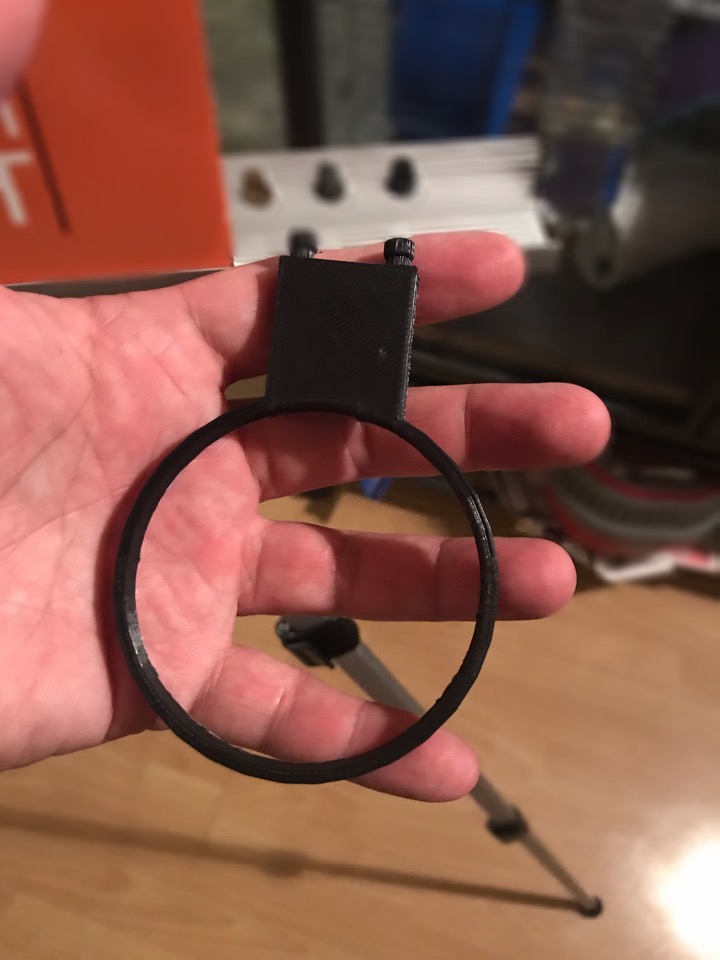
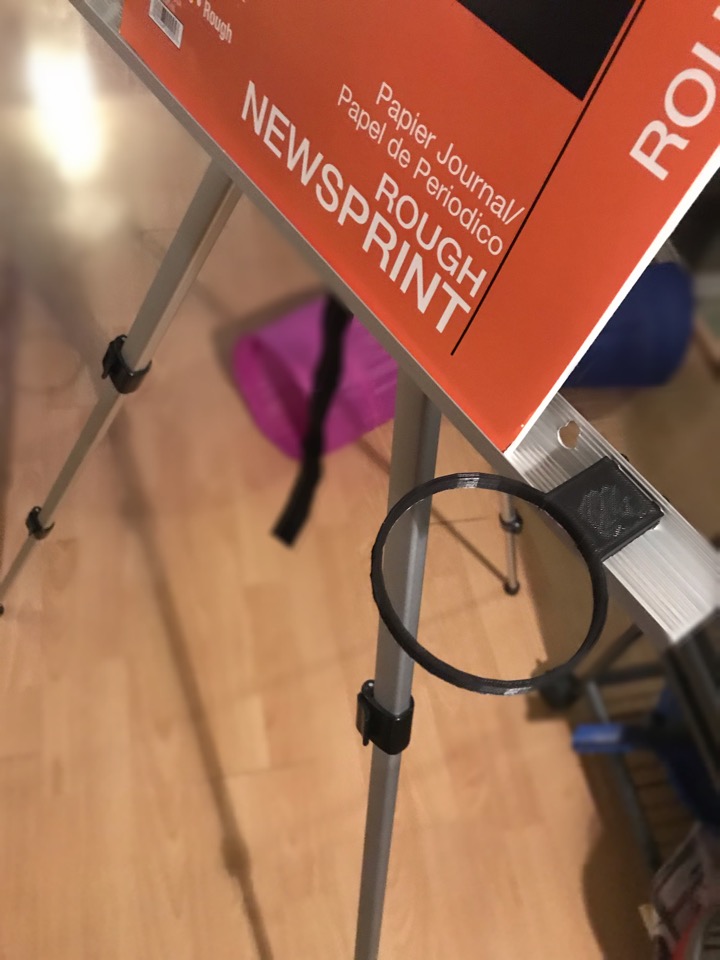
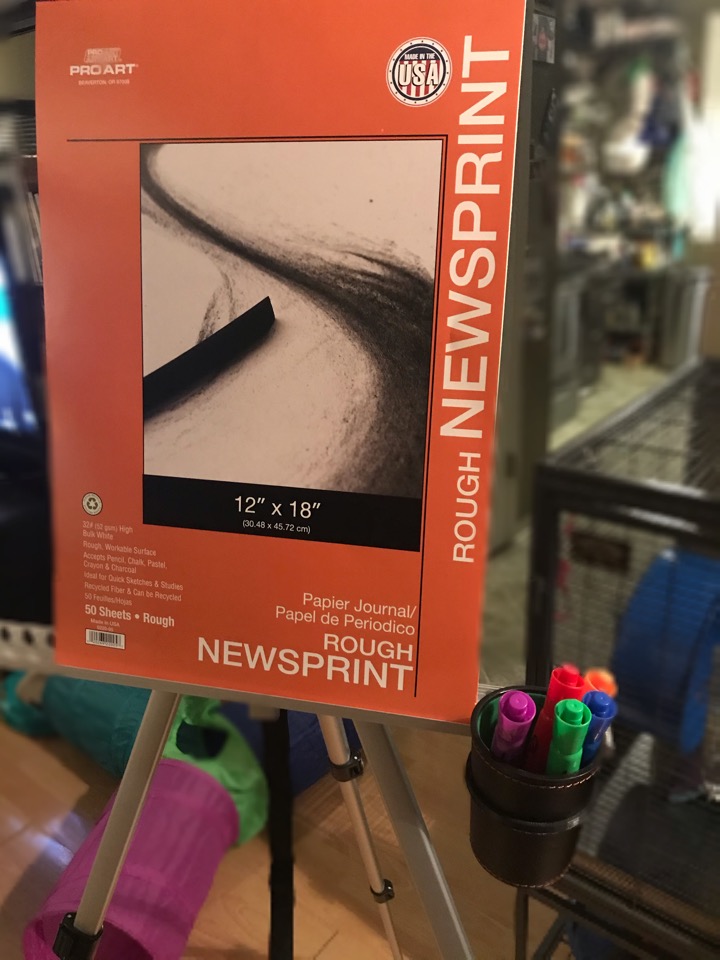
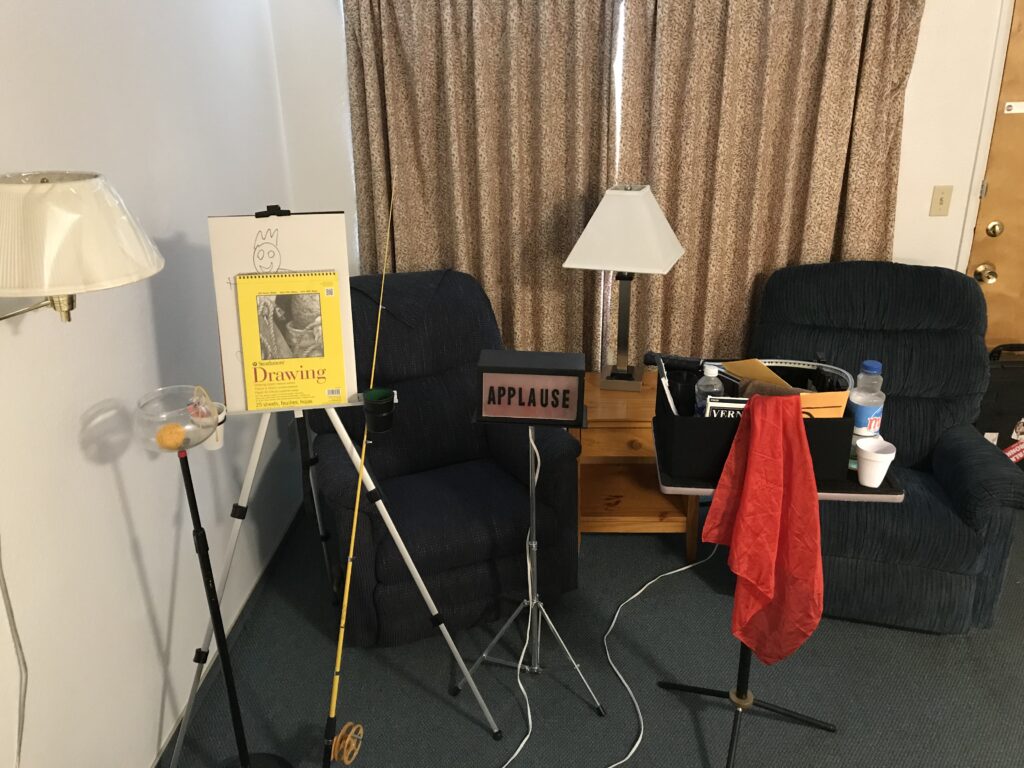
I went out an bought a collapsible easel and 3D printed some cup holders for the easel.
One the right side (when facing the easel) is the cup full of pens and on the left is the empty cup. I have the cup on the left labeled “used”. The “used” pen bin is something that’s very common right now at stores and restaurants due COVID rules. It’s something 18 months ago would be strange, but something that people see often now. Even if they’ve never seen the two cup system at the store, it’s a very simple concept to grasp.
The cool thing is that this solves the problem with what to do with the pen after they use it during the Color Match trick in a logical manner.
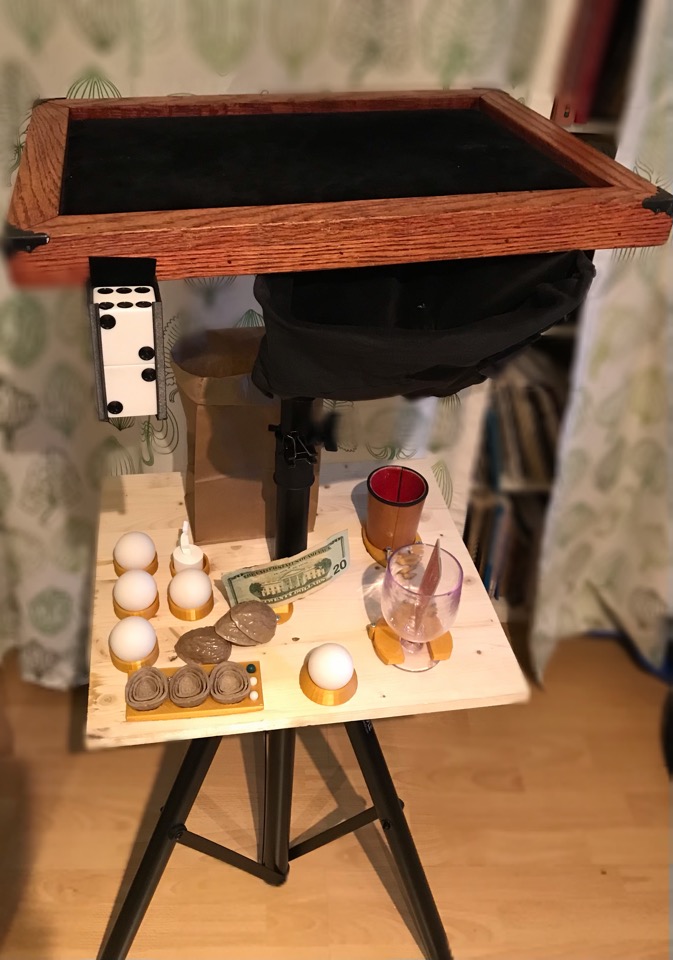
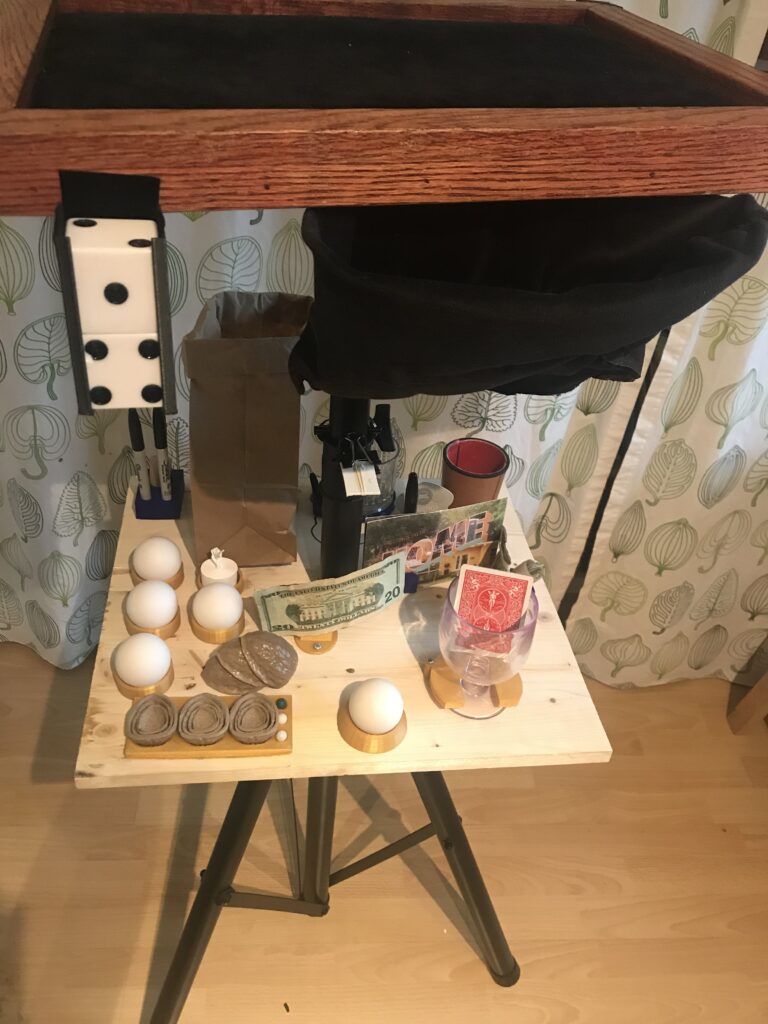
In a continuing effort to use my virtual performing space wisely, I added a little bit more to the shelf below my working surface.
The four ball holders on the left are new, along with the coil holder. This also eliminates a couple of body loads that would have been in my in person show. There are still a few prop holders that need to be added, however it’s just a matter of time to design and print them.
It’s kinda strange getting back to work. I’ve been practicing all week and got into the city I’m performing in last night and spent the night practicing. Today’s agenda is more practicing. Luckily this hotel has some space to set up the show.
Running the show as much as I have the last week is really helping my lines come back to me more automatically.
I think that’s one of the things that separates more seasoned performers from newer ones is that they know their show soo well they don’t need to think. That frees up brain computing space to deal with ad libs, paying attention to what’s happening in the room or fixing any problems that arise.
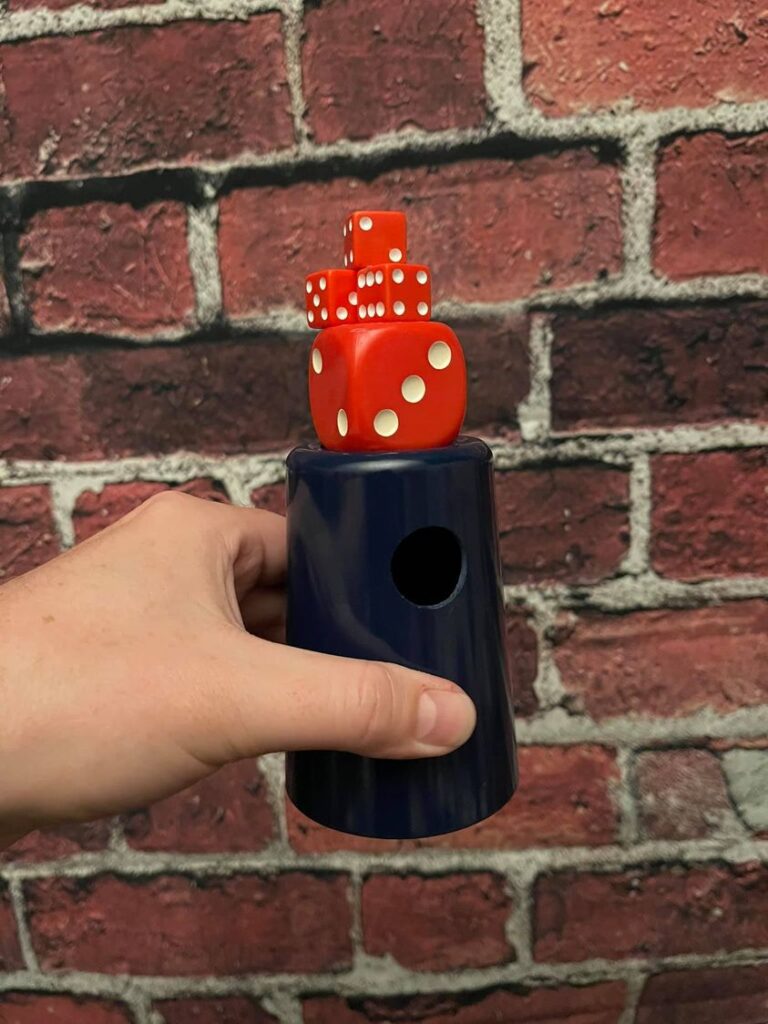
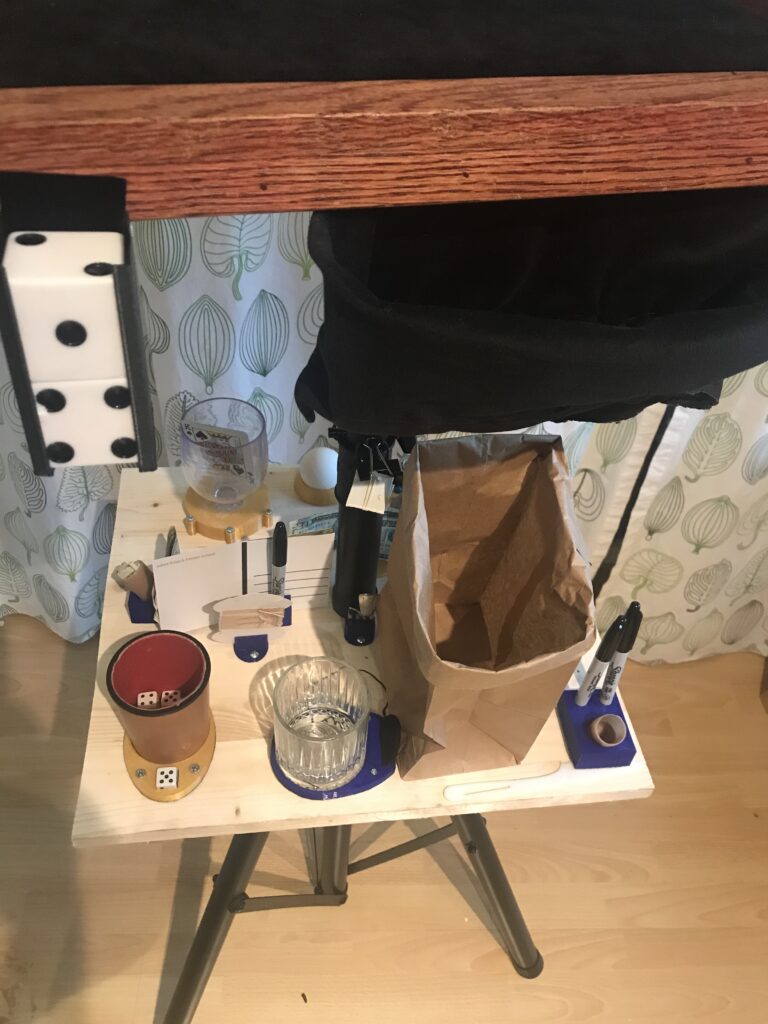
People love to crowd source information on the internet. The problem is that you don’t know the quality of the information you are getting back. Recently someone posted a picture of a prop they had acquired, but didn’t know what it did. It was a dice cup with a hole in the back, four dice and a jumbo die.
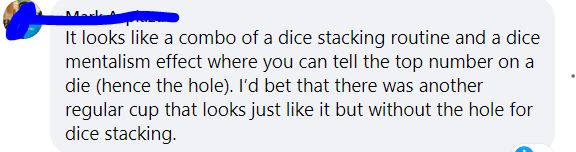
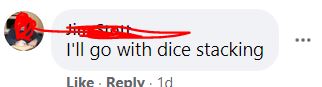
The misinformation starts when people don’t know what they are talking about start it tell the person what the cup is for. Here’s the first couple of responses:
Then a couple of people took the dice stacking suggesting a bit further and said you could look through the hole to see the number on the top die. Let’s start with that idea of using it to see the number on the top of the top die. Learning to stack the dice is hard…once you can do that, knowing what number is on top of the stack without a gimmicked cup is VERY EASY. It makes no sense to make the stacking aspect harder without make knowing the number uppermost easier.
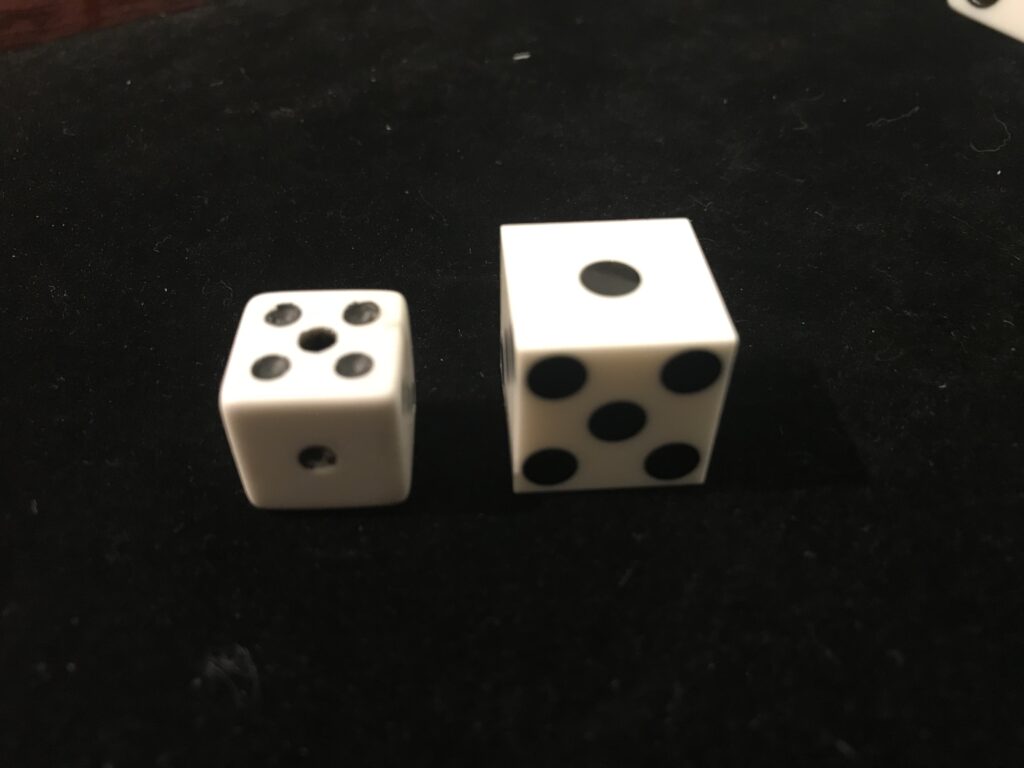
Now let’s look at the props. You have regular game dice, where any marketed dice stacking set would come with casino dice which are the standard for people who stack dice. In the picture below, the casino die is on the right.
Yes, I’m aware you can stack game dice, however it’s much harder than on casino dice due to their size, rounded edges, and lack of consistent 90 degree angles. I learned to dice stack with a drinking glass and game dice, so I know it can be done, I also know who much easier it got when I had proper tools.
Next if you look at the cup, it tapers and is not straight sided. Some people stack with dice like this, however most people use straight sided dice cups. On it’s own the tapered cup wouldn’t say it’s not for dice stacking, but then you look at the height of the cup in relation to the dice. Once you get them in the up and ready to stack, they have a long way to fall, which is where you will give you trouble.
Looking at the whole picture, the style of dice and style of cup, I’m 99% sure it’s not for dice stacking. I’m leaving 1% as it’s some strange homemade prop that was never marketed.
I made a quick replica of the props shown and here’s the style of routine that I think the props are for:
The internet is a great way to crowd source answers, but the problem is that it’s hard know the quality of those answers.
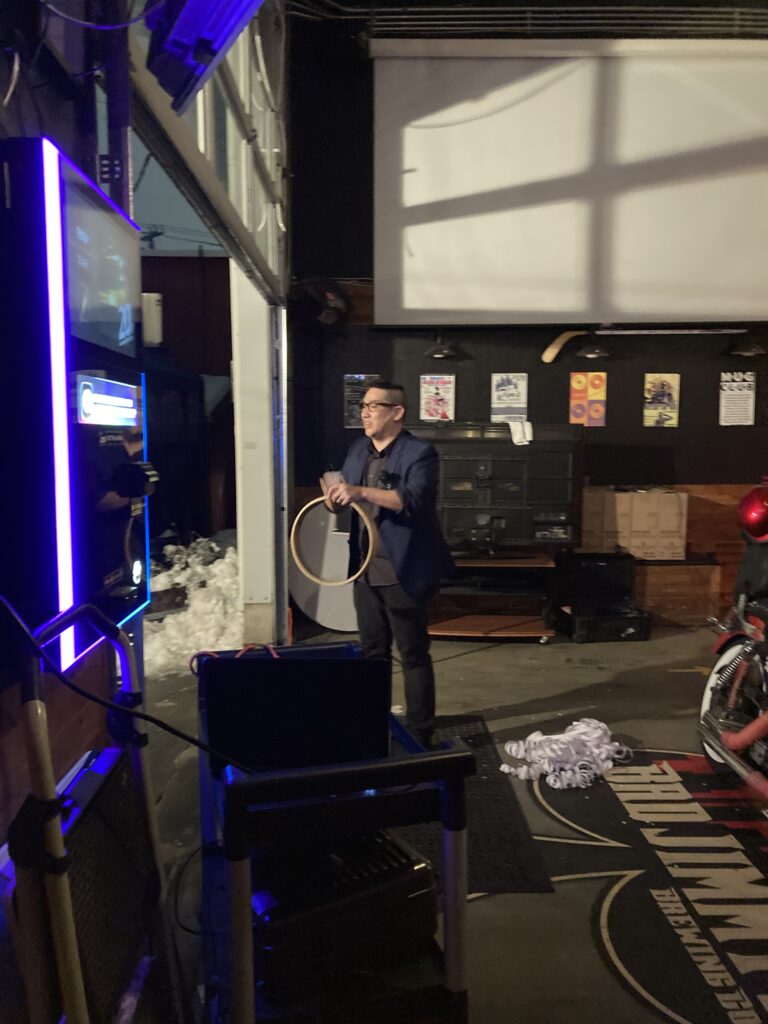
Last night I performed at a hybrid in person / virtual show. The in person aspect of it was interesting as it was a socially distant, outdoor event in tents…oh, the show took place at the tail end of a snowstorm, so it was cold out! I was performing indoors with a an open roll up door in front of me. I could see one table, the rest were in tents watching on a projection screen which was showing what was on the zoom feed.
It was a very interesting experience. The camera was over my left shoulder and the audience in front of me. The challenge was where to play to. I chose to mostly play to the camera as that’s where the majority of the audience’s viewpoint was from. It’s very strange to no play to the only group of humans you can see. I didn’t ignore the one table I could see, but did most of my talking to the camera.
Going forward, I think ticketed, in person shows are going to have to do this hybrid approach to make any money if they physical audience has to be socially distant. How you will approach this scenario is something to start thinking about now…
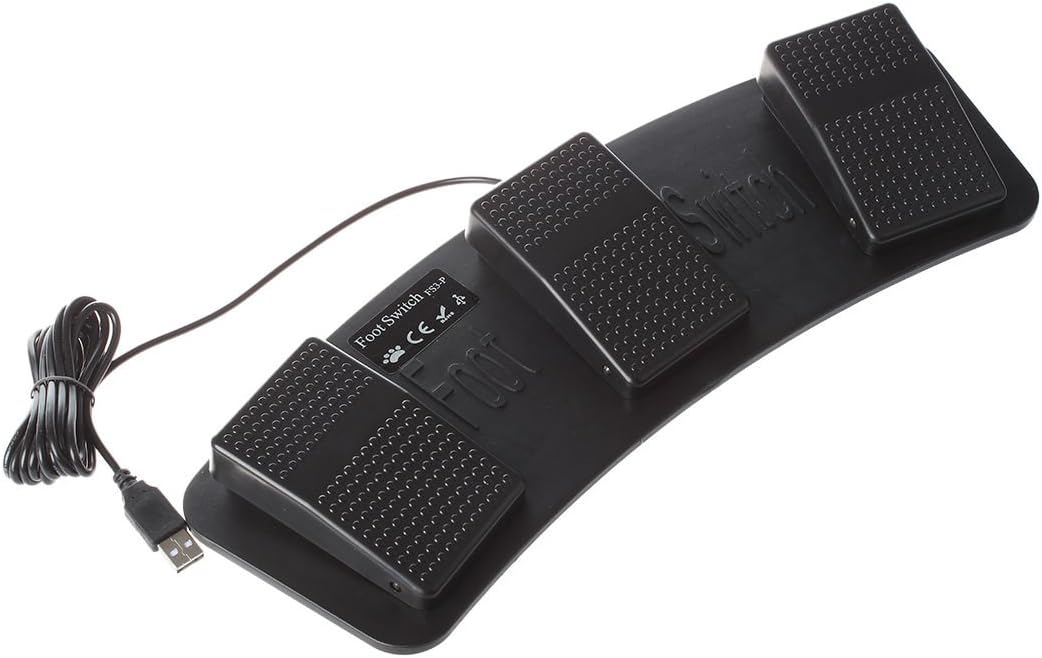
In an effort to streamline things for my virtual show, I picked up some foot pedals. Each pedal acts as a button that you can program to do a specific task.
The first thing I did was something that Richard Lake mentioned in the talk he did with Nick Lewin and made them up and down arrows. I then went through my show in OBS and made a scene for everything, so my show basically went straight down. It was a pain to do, but useful if I’m doing the show without a producer.
Normally I have a producer in the room running my OBS scenes, so I changed the foot pedals to activate a camera shot. So I have my general, tight, and close up that I can control with my feet. I’m really liking having the control of the cameras with my feet.
I feel like I’ve put a lot of work into the table I’m using for virtual shows. I think it’s really made a difference in the flow of the show. It’s soo much more efficient use of space than how I was previously doing it.
Here’s one view of the shelf:
And here’s the shelf rotated 180 degrees:
The nice thing with having holders is that I can look down and immediately know if something isn’t there as it’s holder will be empty. There are two wild cards as far as set up goes, the rest of the props can stay set up all the time. Those are the Gypsy Yarn and the silk in apple/peach. Both of those routines I set up on the day of the show.
You’ll also notice some redundancies, like each trick that uses a pen has it’s own pen. This is because I don’t want to be searching around for a pen, and it makes sure I have a back up pen if one dries out.
One of the ways I get a lot of work is through showcases. These are where you perform in front of people who are in a position to book your show. This year has been interesting with them happening virtually. I think a lot of “newer” musicians are struggling in this format compared to what a variety act can do.
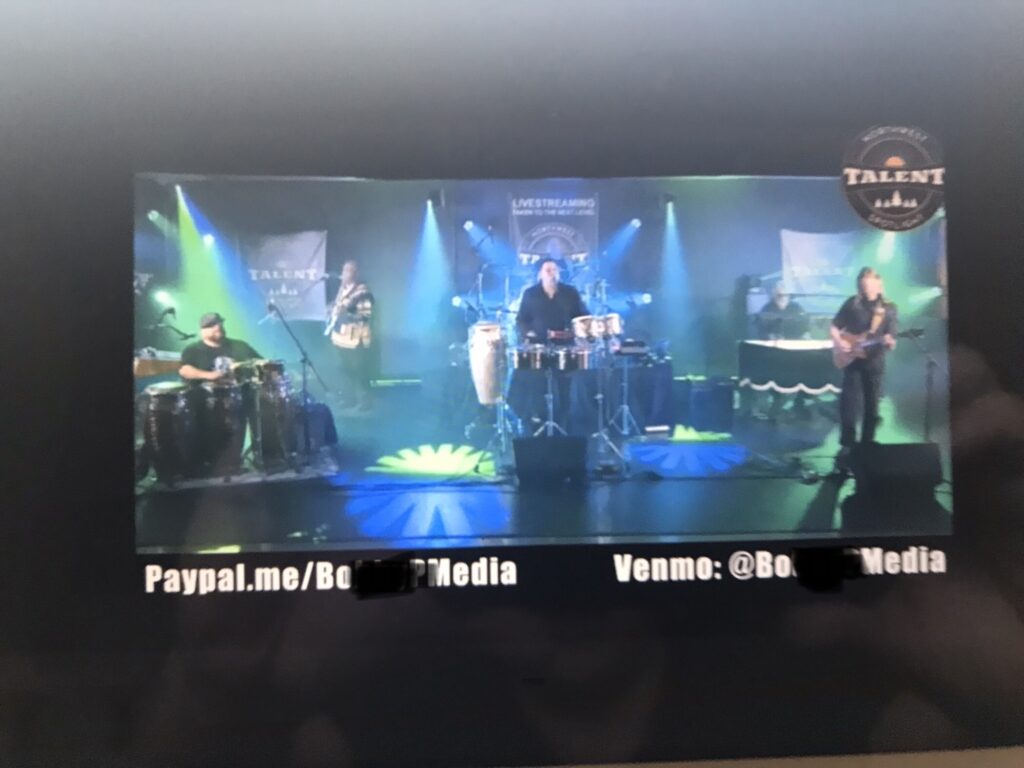
Recently I was at a showcase and took this picture of this band’s virtual showcase:
They had their tip info on the video!!!!
I can’t believe their agent didn’t look at it and tell them to take it off. I think it’s not only disrespectful to the viewer, it’s just lazy. The band added the tip info to an existing video, that means they have a copy of it without it.
Show that you respect your audience and don’t ask them for a tip, when you’re trying to get a contract worth thousands of dollars!
When I’m working on my show, I’m not trying to make giant leaps in getting better, but more smaller things that get better more frequently. What I mean by that is instead of trying to put together a finished show piece before adding it to the show, I get it good enough, add it to the show, and then keep improving it. It’s this constant action that hopefully keeps things evolving and improving.
For my virtual shows I’ve been using a mic on a stand that pics up the audio in the room. It’s a repurposed podcast mic, and while the sound is decent, I think I’m going to be switching back to using a mic pack and lapel mic. This will give me consistent audio as I move around my performing space. It will also allow me to easily mute myself if I need to say something to my producer.
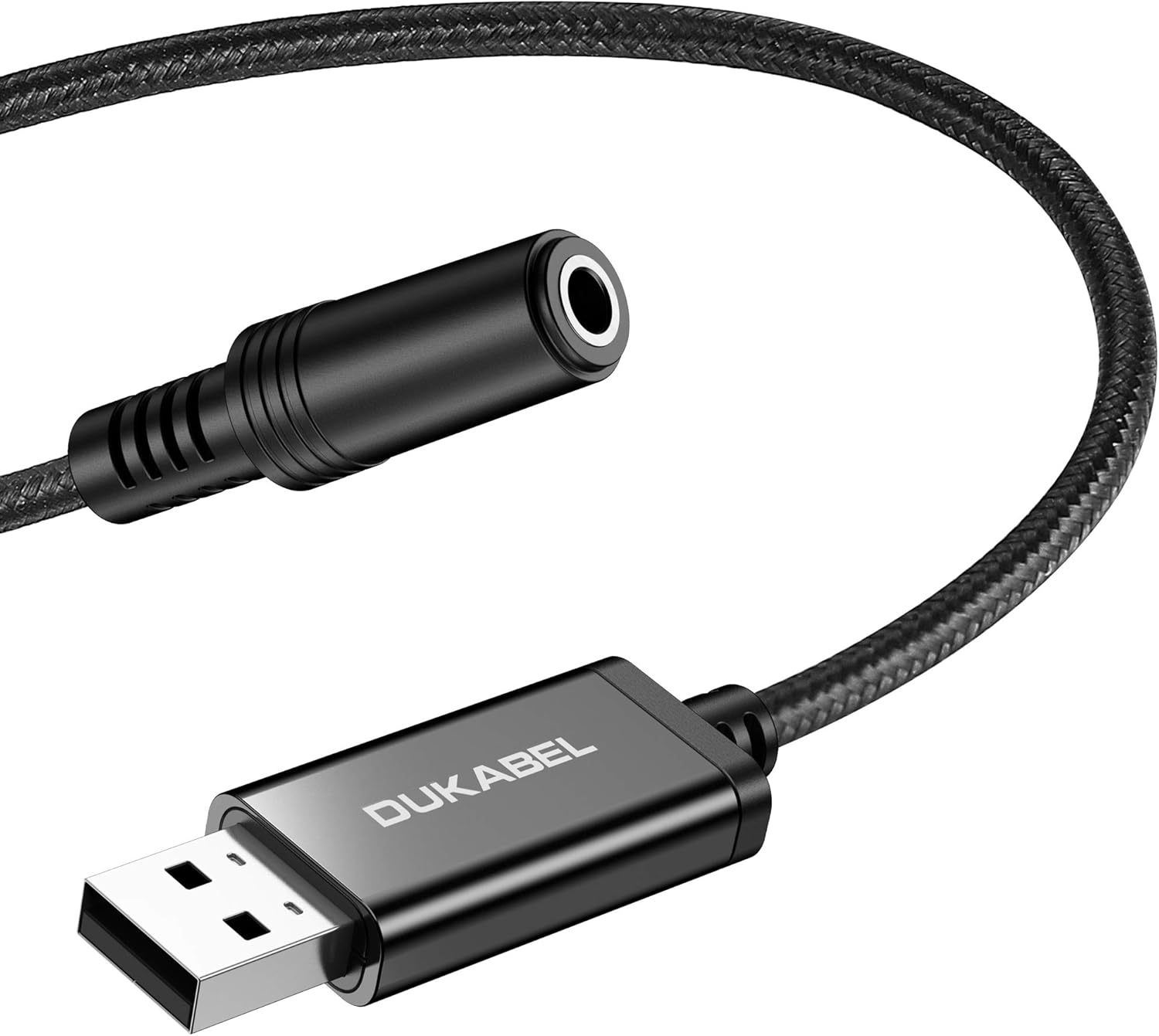
One little challenge this is adding is getting the audio into my production software. One of the main reasons I had switched to the podcast mic was that it was a USB mic. With my mic pack, I can’t plug it into the 3.5mm port in my laptop because I’ll lose the speakers on my computer. That’s where a quick amazon search lead me to a 3.5mm to USB adapter. So far in my little tests today the adapter works great.
Not only will this improve my audio, but it will clear up some floorspace eliminating the mic stand that held the podcast mic. I’m excited to try it for real in my show next week!